
Amitus hesperidum
Amitus hesperidum
Description
How to identify
Amitus hesperidum is a tiny parasitic wasp belonging to the family Platygastridae. It is recognized as a key beneficial insect in the control of citrus pests, specifically the citrus blackfly.
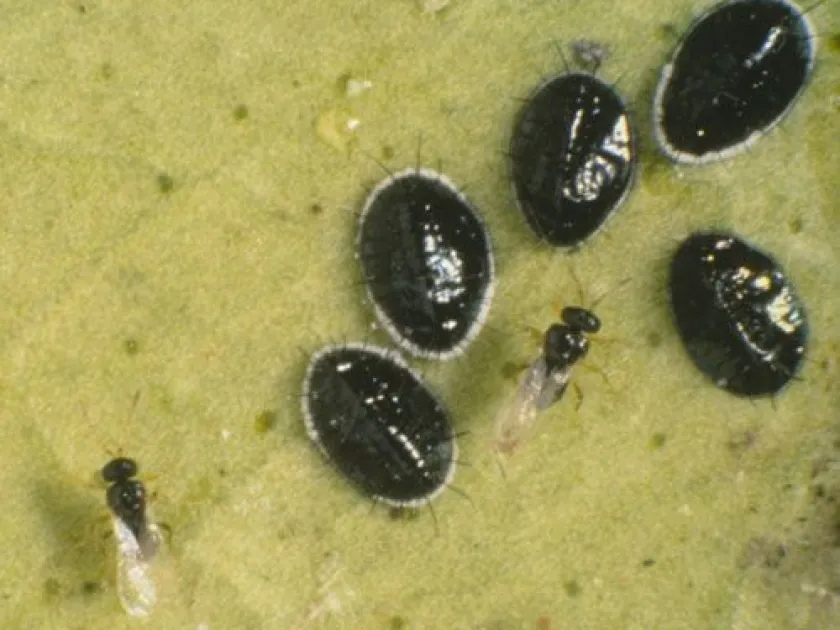
The adult wasp is microscopic, typically measuring about 1 mm in length. Its body is black, and it has specialized antennae that help the female wasp locate host larvae on the underside of citrus leaves.
Identification in the field is difficult due to its small size. Agronomists often use lens magnification or sticky traps to detect its presence and monitor its population density within the orchard.
This species is highly host-specific, meaning it focuses its reproductive efforts almost exclusively on the citrus blackfly (Aleurocanthus woglumi), making it a high-value biological agent.
Because of its agility and efficiency in host location, it is considered one of the most successful natural enemies utilized in integrated pest management programs globally.
What it damages
Amitus hesperidum does not damage plants; it is a predator-like parasitoid that acts as an ally to growers. Its activity is strictly beneficial for the health of citrus trees.
The wasp targets the larval stages of the citrus blackfly. By laying its eggs inside the host larvae, it ensures the destruction of the pest before it reaches the reproductive stage.
The citrus blackfly itself is the damaging agent, as it drains nutrients from the tree and excretes honeydew, which leads to the growth of sooty mold, blocking photosynthesis.
By effectively parasitizing the blackfly, Amitus hesperidum helps maintain tree vigor, prevents crop yield loss, and reduces the need for synthetic chemical interventions.
In terms of economic significance, this wasp represents a sustainable and cost-effective method to suppress pest outbreaks without harming the tree or the surrounding ecosystem.
When it appears
The activity of Amitus hesperidum is highly dependent on environmental temperature and the life cycle of its host. It is most active during warm seasons when citrus blackfly populations are expanding.
The wasp has multiple generations per year, closely synchronized with the citrus blackfly. This synchronization ensures that the parasitoid is present whenever the host is vulnerable.
During colder months, the wasp survives by remaining in the pupal stage inside the mummified bodies of its hosts, protected on the underside of the leaves.
With the arrival of spring temperatures, the adult wasps emerge, immediately beginning the search for new citrus blackfly hosts to start the next generation of control.
Continuous monitoring during the peak growing season is essential to ensure that the population of Amitus hesperidum is sufficient to keep the citrus blackfly under control.
Signs of infestation
The most reliable sign of Amitus hesperidum activity is the presence of citrus blackfly larvae that have turned a dark, brownish-black color on the leaves.
Upon closer inspection with a hand lens, one can observe tiny, neat emergence holes on the dorsum of the parasitized larvae, indicating that the adult wasp has successfully exited.
A noticeable decrease in the honeydew secretion and the subsequent reduction in sooty mold coverage on the foliage are strong indicators that the parasitoid is effectively managing the pest.
- Larvae turn dark or black due to internal parasitism.
- Small emergence holes visible on dead host larvae.
- Clearance of honeydew and sooty mold on leaf surfaces.
- Reduction in overall blackfly count within the grove.
Field inspectors measure the "parasitism rate" by counting the percentage of darkened larvae compared to healthy ones to evaluate the biological pressure against the pest.
Control measures
The primary strategy for protecting Amitus hesperidum populations is to avoid broad-spectrum insecticides that are toxic to beneficial parasitoids.
When chemical control is absolutely necessary, integrated pest management (IPM) guidelines should be followed, utilizing selective pesticides that pose minimal risk to natural enemies.
Maintaining a clean and healthy orchard environment helps promote the natural movement of the wasps between trees, enhancing the overall biological control effect.
In cases of severe infestations, augmentative releases of lab-reared Amitus hesperidum can be performed to jump-start the parasitoid population and gain rapid control.
Consistent communication between orchard management and biological control experts is key to balancing chemical use and biological conservation for long-term sustainability.
Taxonomy
- Latin name
- Amitus hesperidum
- Order
- Hymenoptera
- Family
- Platygastridae
- EPPO code
- AMIUHE
Discussion
No discussions yet — be the first.