
Dock sawfly
Ametastegia tener
Description
How to identify
The dock sawfly (Ametastegia tener) belongs to the order Hymenoptera and the family Tenthredinidae. The adult insect is a small, shiny black wasp, usually measuring between 6 to 8 mm in length.
The larvae, which are the main cause of damage, are often referred to as false caterpillars. They have a characteristic grayish-green color with a dark stripe running down the back, growing up to 15 mm.
A key aspect of their biology is the overwintering stage, where larvae burrow into hollow stems, woody plant parts, or debris, ensuring survival through harsh winter conditions.
Pupation occurs in early spring, leading to the emergence of adults that lay eggs on the underside of leaves, carefully concealing them within the leaf tissue.
The life cycle is rapid, allowing for multiple generations per growing season, which enables the pest population to expand significantly if left unchecked.
What it damages
The dock sawfly primarily targets sorrel and rhubarb, making it a significant pest for kitchen gardens and commercial herb producers.
Alternative hosts include various members of the Polygonaceae family, including certain weeds that act as bridges for the pest to move into vegetable beds.
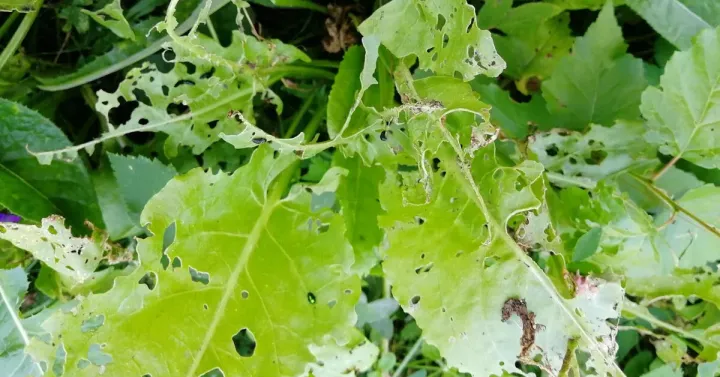
Larvae feed voraciously on the foliage, leaving large irregular holes or completely skeletonizing the leaves, which destroys the crop's marketable value.
Continuous feeding causes the plant to weaken, leading to stunted growth, reduced root development, and decreased ability to produce fresh green leaves throughout the season.
Heavy infestations can result in the total loss of the leafy harvest, rendering the plants entirely unsuitable for culinary use.
When it appears
Adult activity typically begins in late spring when temperatures are sufficiently warm to trigger mating and egg-laying processes.
The peak feeding period for larvae usually occurs from early June through July, coinciding with the prime harvest time for most leafy greens.
Warm and dry summers often favor population explosions, as the pest can complete its developmental stages more rapidly under these conditions.
As autumn approaches, larvae seek protected environments to enter diapause, effectively disappearing from the foliage to survive the winter months.
Continuous monitoring is essential from spring through late summer to detect the arrival of the first generation and prevent subsequent outbreaks.
Signs of infestation
The first indicator of an infestation is the appearance of small, translucent "windows" or pinholes on the leaf surface where the larvae have begun feeding.
- small circular or irregular holes in leaves;
- presence of grayish-green larvae on the undersides of leaves;
- yellowing or drying of damaged leaf margins;
- noticeable slowing of plant growth;
- presence of fine, granular frass on the leaves.
Damaged plants often show signs of stress, including leaf curling and premature senescence of older foliage, which impacts the overall yield.
Because larvae tend to feed in the center of the plant or near the crown, they can often go unnoticed until significant leaf damage has already occurred.
Control measures
Cultural control measures, such as removing weeds from the Polygonaceae family, are the first line of defense in managing sawfly populations.
Autumn tillage is highly effective at destroying the overwintering sites of the larvae, exposing them to predators and cold weather.
On a small scale, hand-picking the larvae during the early morning hours can be an effective way to suppress the pest without using chemicals.
Biological control options, such as Bacillus thuringiensis, provide a targeted approach that is safe for edible crops and helps maintain the health of the garden ecosystem.
Chemical intervention should be considered a last resort, as the fast harvest cycle of sorrel makes most conventional pesticides unsuitable due to residue concerns.
Taxonomy
- Latin name
- Ametastegia tener
- Order
- Hymenoptera
- Family
- Tenthredinidae
- EPPO code
- AMETTE
Discussion
No discussions yet — be the first.