
Red-necked ambrosia beetle
Ambrosiodmus rubricollis
Description
How to identify
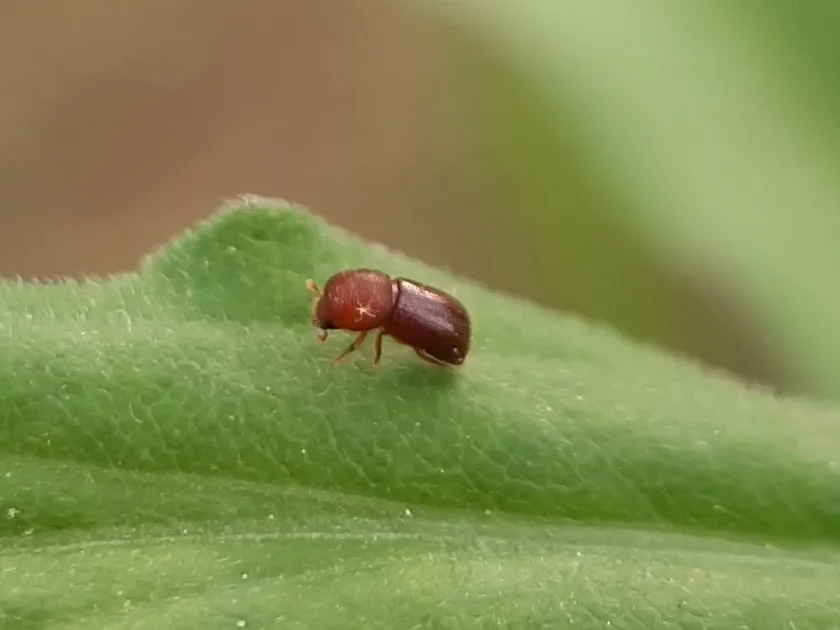
The red-necked ambrosia beetle Ambrosiodmus rubricollis is a member of the Curculionidae family and the Scolytinae subfamily. Measuring 2.5 to 3.2 mm in length, these beetles are typically dark brown with a distinct reddish-brown pronotum, which gives them their common name.
As ambrosia beetles, they exhibit a unique mutualistic relationship with specific fungi. These fungi are cultivated within the beetle's galleries and serve as the primary nutrient source for both larvae and adults, rather than the wood tissue itself.
These insects are elusive, spending most of their life cycle inside the wood. Their development stages include eggs, larvae, pupae, and adults, with the females being responsible for boring into the host tree to establish galleries.
The species thrives in environments where host trees have reduced physiological resistance. Their activity is heavily influenced by temperature, typically peaking during the warmer months when the beetles emerge to colonize new trees.
Accurate identification often requires professional entomological examination, as many ambrosia beetles share similar external morphological traits, particularly in the shape and texture of their elytra.
What it damages
This pest attacks a variety of hardwood tree species, including oak, maple, hornbeam, beech, and various fruit trees. While they often target stressed or dying trees, large populations can successfully attack healthy trees.
The damage is two-fold: physical galleries bored into the wood by the insects and the introduction of fungal spores. These fungi can colonize the vascular system, causing systemic blockage that prevents water and nutrient transport.
Symptoms of an infestation often include crown dieback, leaf wilting, and reduced tree vigor. If left unmanaged, these symptoms progress rapidly, often leading to the tree's complete mortality.
Beyond ecological damage, these beetles cause significant economic loss by degrading timber quality. Wood riddled with tunnels and stained by fungus is unsuitable for high-quality construction or furniture production.
In commercial orchards, the red-necked ambrosia beetle poses a serious threat to productivity and plant longevity, necessitating strict monitoring and integrated pest management strategies.
Signs of infestation
The most reliable sign of an infestation is the presence of "frass" — fine, sawdust-like particles extruded from small, circular entrance holes on the tree's trunk or larger branches.
In some cases, the frass may form thin, toothpick-like protrusions sticking out from the bark, which are a hallmark of ambrosia beetle activity in the forest or orchard.
Visible changes to the tree canopy, such as yellowing leaves or sudden wilting, indicate that the vascular system is being compromised, typically caused by the fungal infection introduced by the beetles.
Inspecting the wood under the bark reveals tunnels that are often stained dark or black due to the fungal mycelium cultivated by the beetles within their galleries.
Necrotic spots or bark cracking can also develop around the entry points, reflecting the tree's attempt to compartmentalize the injury and the resulting fungal spread.
Control measures
Sanitation is the cornerstone of control. Removing and destroying infested wood, fallen logs, and stumps is essential to eliminate breeding sites that sustain the population of beetles.
Promoting tree health is an effective preventive measure. Regular irrigation, proper fertilization, and strategic pruning help trees maintain the vitality required to resist beetle colonization.
Pheromone-based traps serve as a critical tool for monitoring flight patterns. By tracking the beetle's arrival, growers can implement timely protective measures before an infestation becomes severe.
When infestation risk is high, systemic insecticides can be applied to protect vulnerable trees. These treatments act by making the wood tissues toxic to beetles attempting to penetrate the bark.
Integrated Pest Management (IPM) strategies, including the encouragement of natural predators like parasitic wasps and predatory beetles, can help keep ambrosia beetle populations under control in a sustainable way.
Taxonomy
- Latin name
- Ambrosiodmus rubricollis
- Order
- Coleoptera (beetles)
- Family
- Curculionidae
- EPPO code
- AMBDRU
Discussion
No discussions yet — be the first.