
Alder flea beetle
Altica sylvia
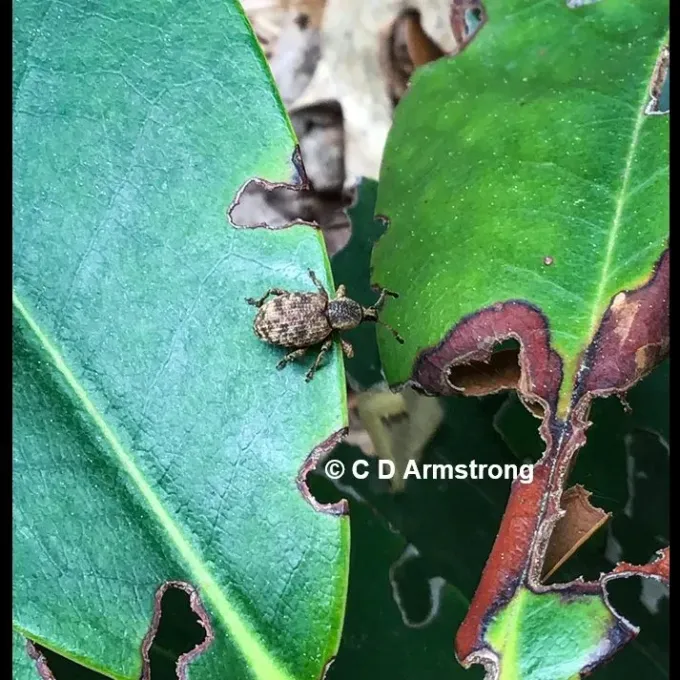
Description
How to identify
The Alder flea beetle (Altica sylvia) is a small leaf beetle belonging to the Chrysomelidae family, well-known for its impressive jumping ability.
Adult insects typically measure between 3 to 5 mm in length and are distinguished by a glossy, metallic blue or green coloration.
Their hind legs are significantly enlarged and muscular, which functions as a specialized spring mechanism for rapid escape from threats.
The head and pronotum are smooth and shiny, while the elytra feature distinct rows of tiny punctures, providing a diagnostic visual character.
Larvae are typically dark-colored and elongated, often found feeding openly on the undersides of leaves where they undergo their development.
What it damages
While often associated with forests, Altica sylvia can migrate to horticultural and ornamental plants when their primary food sources are depleted.
These beetles prefer foliage from various woody plants, including members of the Rosaceae family, causing aesthetic and physiological damage.
Adult beetles create numerous small, round holes in leaves, which can coalesce if the infestation is severe, leading to extensive tissue loss.
Larval stages engage in skeletonization, consuming the leaf tissue between veins, which significantly impairs the plant's photosynthetic efficiency.
Heavy infestations lead to foliage thinning, reduced growth rates, and can potentially cause dieback in young or weakened plants under stress.
When it appears
The life cycle begins in early spring when overwintering adults emerge from soil debris to begin feeding on emerging buds.
Following a period of maturation feeding, the beetles mate and lay eggs on the undersides of host leaves throughout the late spring.
Larvae emerge and grow rapidly during the early summer months, coinciding with the peak period of vegetative growth in many trees and shrubs.
Once larval development is complete, the insects descend into the soil to pupate, emerging as a new generation of adults later in the season.
Depending on the local climate and temperature gradients, the species may complete one or more generations before entering winter diapause.
Signs of infestation
The most prominent sign of an infestation is the presence of shot-hole damage across the foliage, giving the leaves a perforated appearance.
Inspecting the underside of leaves will often reveal the presence of dark larvae and adult beetles resting on the surface.
If the damage is severe, affected leaves may become brown, shriveled, and drop prematurely, leading to canopy thinning.
In addition to physical holes, a general loss of plant vigor and the presence of frass on leaves are indicators of active feeding activity.
- Small, circular holes distributed across the leaf surface.
- Skeletonized leaf patches showing only the vein structure.
- Presence of dark-colored larvae on the abaxial side of leaves.
- Adult beetles visible on foliage, jumping when disturbed.
Control measures
Cultural control methods, such as maintaining soil health and removing weeds around the base of plants, can disrupt the pupation cycle of the beetle.
Biological control agents, including specialized parasitic wasps or fungal pathogens, can be introduced to manage high pest densities effectively.
For chemical interventions, targeted applications of systemic insecticides should be applied during the early larval stage to maximize efficacy.
Regular monitoring of plants during spring is essential to detect early activity and prevent the spread of the beetle to nearby crops.
Creating habitats for predatory insects, such as ground beetles and ladybugs, helps maintain a natural balance and suppresses pest population growth.
Taxonomy
- Latin name
- Altica sylvia
- Order
- Coleoptera (beetles)
- Family
- Chrysomelidae
- EPPO code
- HALTSY
Discussion
No discussions yet — be the first.