
Altica litigata
Altica litigata
Description
How to identify
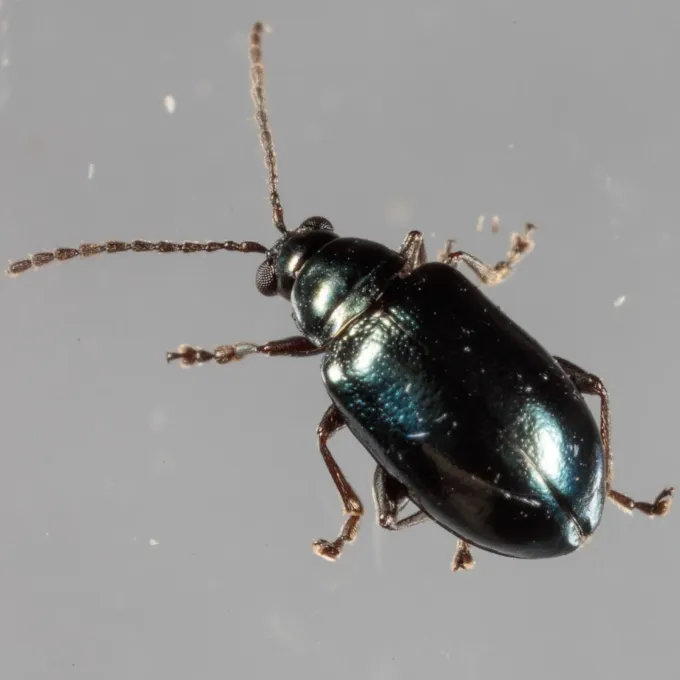
Altica litigata is a beetle belonging to the Chrysomelidae family, within the order Coleoptera. Adult specimens are characterized by a metallic sheen, typically deep blue or greenish-copper, and a pronounced jumping ability due to their enlarged hind femora.
The adult body is oval-shaped, measuring between 3 to 5 mm in length. Like other members of the Altica genus, this species exhibits specific morphological features, including a transverse depression on the pronotum before the base, aiding in accurate taxonomic identification.
The larvae are generally elongated, often covered in small tubercles and fine hairs. Their color ranges from yellowish to dark brown, providing effective camouflage while they feed on the underside of leaves.
The life cycle is closely associated with moist habitats, as the species favors high-humidity microclimates. Development from egg to adult takes approximately 30 to 45 days, depending on environmental temperature conditions.
Adult beetles overwinter in the soil layer, under leaf litter, or within debris. They emerge in early spring once ambient temperatures consistently rise above 10-12 degrees Celsius.
What it damages
This pest shows a strong trophic preference for plants within the Onagraceae family and several other wild and cultivated species. In agricultural settings, it can cause significant damage to the leaf surface area.
Adult beetles feed on leaf tissue by chewing numerous small holes, a phenomenon often referred to as "shot-holing." During outbreaks, plants can lose a significant portion of their photosynthetic leaf area.
Unlike the adults, the larvae frequently skeletonize the leaves by consuming soft tissues between the veins, which may lead to the total desiccation of leaf blades and reduced plant vitality.
The greatest harm occurs during the seedling stage, when young plants lack sufficient resilience to withstand feeding. Damage to the growing point in early phases often results in plant mortality or severe stunting.
Economic losses arise not only from reduced vegetative yield but also from degraded cosmetic quality of produce, which is particularly critical for leafy vegetable crops and ornamental plants.
Signs of infestation
The first visual sign of Altica litigata presence is the appearance of numerous small pin-sized holes in the leaves, which may increase in diameter and coalesce into larger necrotic patches over time.
Upon inspecting the underside of the leaf, one may find larvae leading a cryptic lifestyle, alongside characteristic black-dotted frass, which serves as a clear indicator of active feeding.
During daylight hours, as one approaches the crop, one may observe the mass jumping of adult beetles, providing direct evidence of a high population density within the field or garden area.
Heavy infestation is accompanied by leaf yellowing and wilting. While early stages may be confused with fungal pathogens, a close inspection reveals the mechanical damage caused by the beetle's chewing mouthparts.
Intensive feeding leads to slowed growth rates and decreased photosynthetic efficiency, eventually impacting harvest weight and overall crop quality if the pest moves toward reproductive organs.
Control measures
Cultural control methods include proper crop rotation and the thorough removal of plant debris, which serves as the primary overwintering site for the adult stage of this species.
An important technique involves optimizing growing conditions, including timely irrigation and fertilization, as robust and vigorously growing plants are better able to tolerate damage and recover from pest pressure.
The use of biological insecticides based on fungal cultures or entomopathogenic nematodes has shown high efficacy in small-scale farming, minimizing the chemical residue on the final produce.
If population thresholds are exceeded, the application of registered systemic insecticides is recommended for specific crops, strictly adhering to pre-harvest intervals to ensure safety.
Preventive spraying with wormwood extracts or tobacco dust is also effective; these natural repellents discourage beetle colonization and reduce activity during the critical spring period.
Taxonomy
- Latin name
- Altica litigata
- Order
- Coleoptera (beetles)
- Family
- Chrysomelidae
- EPPO code
- HALTLI
Discussion
No discussions yet — be the first.