
Alder flea beetle
Altica bimarginata
Description
How to identify
The Alder flea beetle (Altica bimarginata) is a member of the leaf beetle family (Chrysomelidae), order Coleoptera. These insects are small, oval-shaped, and possess powerful hind legs that enable them to jump significant distances when disturbed.
Adult beetles typically exhibit a metallic sheen, ranging from blue to bronze, which is a key identifying characteristic during field scouting. Their bodies are well-adapted for survival in various climatic conditions.
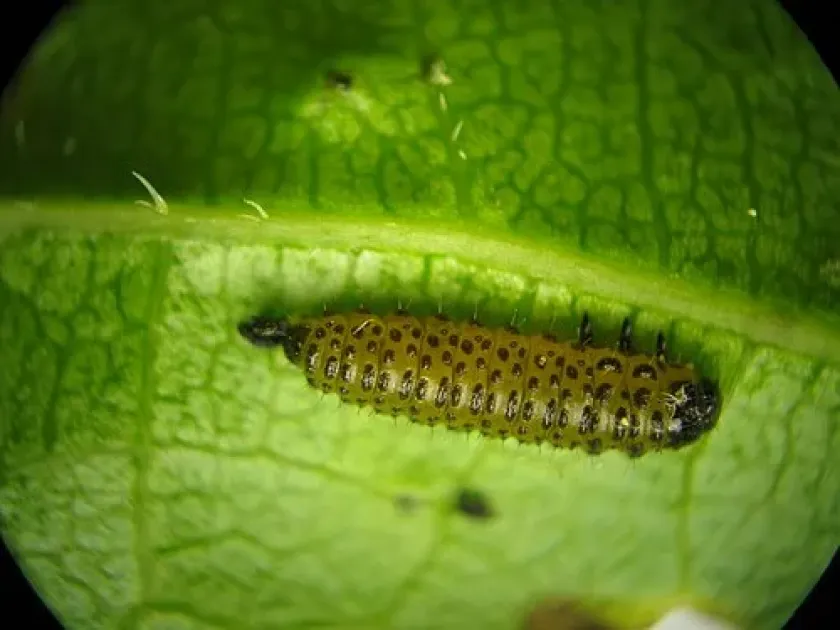
Larvae of the species are dark-colored, often covered in small bumps or segments, and are highly active feeders that concentrate on the underside of leaves to consume plant tissue.
The lifecycle consists of complete metamorphosis: egg, larva, pupa, and adult. This transition allows the species to exploit seasonal food sources effectively throughout the spring and summer.
Overwintering occurs in the adult stage within leaf litter, soil crevices, or under the bark of host trees, where they remain dormant until rising temperatures signal the start of spring.
What it damages
The primary host for this beetle is the alder tree (Alnus), although they are known to occasionally feed on related deciduous species when population numbers surge.
Both adults and larvae cause damage by skeletonizing the foliage. They chew the soft parenchyma between the veins, leaving behind only the vascular framework of the leaf.
Severe infestations result in heavy defoliation, which causes the tree to lose photosynthetic capacity and may lead to premature leaf drop by mid-summer.
Continuous attacks over successive years significantly reduce tree vigor, leading to stunted growth and making the trees susceptible to secondary infections or wood-boring insects.
In forest management, the economic impact is observed in the decline of health and vitality of alder stands, particularly in sensitive riparian ecosystems.
When it appears
Adult emergence typically coincides with bud break in early spring, as beetles seek out fresh growth to begin feeding and mating.
Larval activity peaks during the late spring and early summer months, which is the most aggressive feeding phase for the species, leading to visible damage on tree canopies.
The species may complete one or more generations per year depending on the geographic latitude and local weather patterns, extending the period of potential damage.
As autumn approaches, the new generation of adults feeds briefly before seeking overwintering sites, often moving down the trunk towards the forest floor.
Winter survival is dependent on the depth of the leaf litter and local insulation, as the beetles remain protected in these micro-habitats until the next growing season.
Signs of infestation
The most prominent sign of an infestation is the skeletonized appearance of leaves, which look like fine lace or nets against the light.
Visual inspection of the underside of leaves reveals dark, slug-like larvae or the metallic adults, which often hop away when the leaf is touched.
Early-season defoliation of the crown is a critical indicator that the population density has exceeded the threshold for natural ecological management.
Black, granular frass (insect excrement) on the leaf surface is a clear sign that the beetles are currently active and feeding on the foliage.
Curling or scorched-looking leaf margins, occurring despite adequate moisture, are secondary symptoms of extensive tissue damage caused by high larval populations.
Control measures
Management in large-scale areas relies on biological monitoring and, if necessary, the application of targeted biological insecticides like Bacillus thuringiensis.
In ornamental or sensitive environments, manual removal of infested leaves during the early stages of infestation can help suppress population spikes.
Promoting a healthy environment for natural predators, including predatory beetles, bugs, and birds, provides long-term suppression of flea beetle numbers.
Maintaining high forest floor health and minimizing chemical disruption helps keep native insect populations balanced and prevents outbreaks.
- Regular monitoring of canopy health during the spring season.
- Using systemic insecticides only if extreme defoliation risk is present.
- Removing and destroying heavily infested plant material during the larval phase.
Taxonomy
- Latin name
- Altica bimarginata
- Order
- Coleoptera (beetles)
- Family
- Chrysomelidae
- EPPO code
- HALTBI
Discussion
No discussions yet — be the first.