
Allantus
Allantus
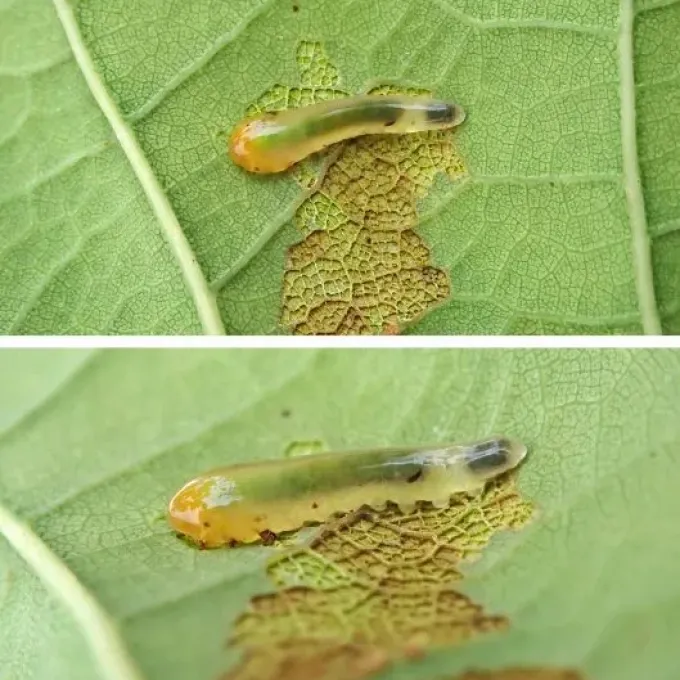
Description
How to identify
The genus Allantus comprises various species of sawflies belonging to the Tenthredinidae family. Adult sawflies are often mistaken for small wasps, but they lack the characteristic narrow waist found in the Vespidae family.
Visually, adults are typically black with distinct yellow or white markings on the abdomen. Their wings are transparent and feature a specific vein pattern that defines the systematic classification of this group.
The larvae, often referred to as false caterpillars, are the stage responsible for the damage. Unlike butterfly caterpillars, Allantus larvae have more than five pairs of abdominal prolegs.
Their bodies are usually soft, ranging in color from pale green to yellowish-grey, and they often exhibit a characteristic curved posture when resting on the underside of a leaf.
Identifying the species usually requires close inspection of the larva's color patterns and the specific shape of the head, as these traits can differ between various species within the genus.
What it damages
Allantus species primarily target plants in the Rosaceae family, with cultivated roses and briar roses being the most frequent victims of their feeding habits.
The larvae are voracious leaf-eaters. They begin by creating small irregular holes or grazing the edges of the leaf, eventually consuming almost the entire leaf blade, leaving only the veins behind.
This skeletonization of the leaves severely impacts the plant's ability to undergo photosynthesis, which leads to stunted growth and poor flower production throughout the growing season.
In cases of severe infestation, entire bushes can become defoliated, which significantly reduces the plant's vigor and makes it more susceptible to environmental stresses and secondary diseases.
Besides roses, some species may occasionally attack other shrubs, making them a recurring problem for amateur gardeners who maintain diverse flower beds.
When it appears
The life cycle of Allantus is synchronized with the development of its host plants. Adults typically emerge in late spring when the new foliage of roses becomes available for feeding and egg-laying.
Females use their saw-like ovipositors to cut into the leaf tissue and deposit eggs safely inside. This protects the offspring from predators and harsh weather conditions during the early stages.
Once the larvae hatch, they begin to feed aggressively. The duration of this feeding stage is heavily dependent on ambient temperature, typically lasting several weeks in the summer.
Depending on the region, these insects can complete one or two generations per year. The summer generation is usually the most damaging due to the peak of the insect population.
As autumn approaches, the final instar larvae move into the soil or under debris to form tough silken cocoons where they overwinter until the following spring.
Signs of infestation
The first sign of an Allantus infestation is the appearance of small, jagged holes on the foliage, often appearing on the lower leaves of the rose bushes first.
Presence of tiny, granular droppings (frass) on the leaves or the surface of the soil directly beneath the plant is a clear indication that larvae are currently active on the host.
Upon closer examination, you may find the larvae themselves, which often roll into a protective "c" shape when disturbed or remain still on the leaf's underside.
Withered or yellowing leaves that appear prematurely are signs that the infestation is advanced, leading to the collapse of the leaf structure in the most affected areas.
General lack of bloom or stunted development of new buds can also indirectly point to significant foliage loss caused by these pests earlier in the season.
Control measures
Cultural control is highly effective; regular weeding and careful cultivation of the soil around the base of the bushes can disrupt the pupation sites of overwintering larvae.
Hand-picking the larvae is a viable and environmentally friendly option for smaller gardens or when the infestation is caught in its early stages.
Biological treatments, such as those utilizing Bacillus thuringiensis or specific entomopathogenic nematodes, are excellent for managing larval populations without harming beneficial garden insects.
Chemical intervention should be considered a last resort and should be timed to hit the larvae early in their development to minimize the impact on the overall rose bush health.
- Inspect plants weekly during the peak growing season.
- Always dispose of infested clippings safely away from the garden.
- Ensure roses are well-watered to help them recover from stress.
Taxonomy
- Latin name
- Allantus
- Order
- Hymenoptera
- Family
- Tenthredinidae
- EPPO code
- ALLASP
Discussion
No discussions yet — be the first.