
Alissonotum pauper
Alissonotum pauper
Description
How to identify
Alissonotum pauper is a species of beetle belonging to the family Scarabaeidae, subfamily Dynastinae. These beetles are primarily known as soil-dwelling pests during their larval stage.
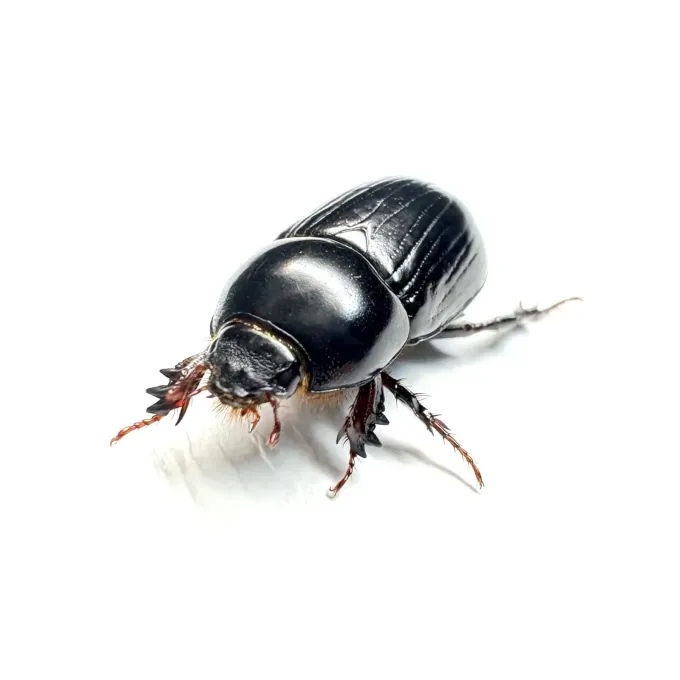
Adult beetles are robust insects, typically measuring 15–20 mm in length, with a dark brown or black coloration. They are characterized by a smooth, convex pronotum and a heavy, armored body structure.
The larval stage, commonly referred to as a white grub, has a distinct C-shaped body, a soft white abdomen, and a hard, dark brown head capsule adapted for digging through soil.
They thrive in tropical and subtropical climates where high soil moisture supports the development of successive generations throughout the warmer months of the year.
Proper identification of this species requires expert examination of the male genitalia and specific morphological traits, as several related species often occupy the same ecological niche.
What it damages
The primary agricultural importance of Alissonotum pauper lies in its status as a significant pest of sugarcane, affecting both young seedlings and mature plants.
Larvae feed directly on the roots and the basal part of the stem, effectively severing the plant's connection to soil nutrients and water, often causing total plant death.
Adult beetles may tunnel into the base of the stalks, causing structural damage that leaves the plants prone to lodging and reduces the overall vigor of the crop stand.
Damaged plants frequently exhibit stunted growth, yellowing of leaves, and an inability to recover from stress, leading to significant yield losses in commercial plantations.
Secondary infections by soil-borne pathogens are common in tissues damaged by the beetles, further complicating the pathology of the infested crops.
When it appears
Adult beetle emergence is highly synchronized with the onset of the rainy season, which provides the necessary moisture for mating and oviposition in the soil.
Adults are nocturnally active and are strongly attracted to artificial light sources, which makes nocturnal monitoring an effective tool for tracking population density.
Larvae are most destructive during the active vegetative growth phase of sugarcane, when the roots are most succulent and available for heavy feeding.
The life cycle can be prolonged depending on environmental conditions, with larvae often seeking deeper, cooler soil layers during periods of extreme drought.
By monitoring meteorological trends and soil conditions, farmers can anticipate peak larval activity and schedule preventive measures before extensive damage occurs.
Signs of infestation
One of the earliest signs of infestation is the appearance of yellowing leaves on young sugarcane stalks, often progressing to wilting during the hottest hours of the day.
Plants affected by larval feeding can be easily pulled from the ground because their root systems have been pruned or entirely destroyed by the grub activity.
Small circular exit holes on the soil surface in the field provide evidence that adult beetles have recently emerged from their pupal chambers below ground.
Patches of dead or severely stunted sugarcane within a field are indicative of established larval colonies feeding on the root network of the crop.
Excavating the soil around the base of affected plants typically reveals the presence of C-shaped larvae, confirming the infestation status of the specific field area.
Control measures
Cultural control methods, such as deep plowing between planting cycles, are effective in bringing larvae to the surface, exposing them to predators and unfavorable conditions.
Crop rotation remains a fundamental strategy, as shifting away from sugarcane disrupts the life cycle of the beetle, preventing the buildup of large populations.
Chemical control involves the application of systemic or contact insecticides into the soil during planting to create a protective zone around the root system.
Light traps deployed throughout the plantation during the peak flight season can significantly reduce the number of egg-laying adults in the area.
Biological control using entomopathogenic fungi, such as Metarhizium anisopliae, has shown promise in reducing larval populations in soil without the need for synthetic chemicals.
Taxonomy
- Latin name
- Alissonotum pauper
- Order
- Coleoptera (beetles)
- Family
- Scarabaeidae
- EPPO code
- ALISPA
Discussion
No discussions yet — be the first.