

Pest · Lepidoptera (butterflies) · affects Soybean, Winter wheat, Winter rapeseed
Especially harmful
Lima bean pod borer
Etiella zinckenella
Description
How to identify
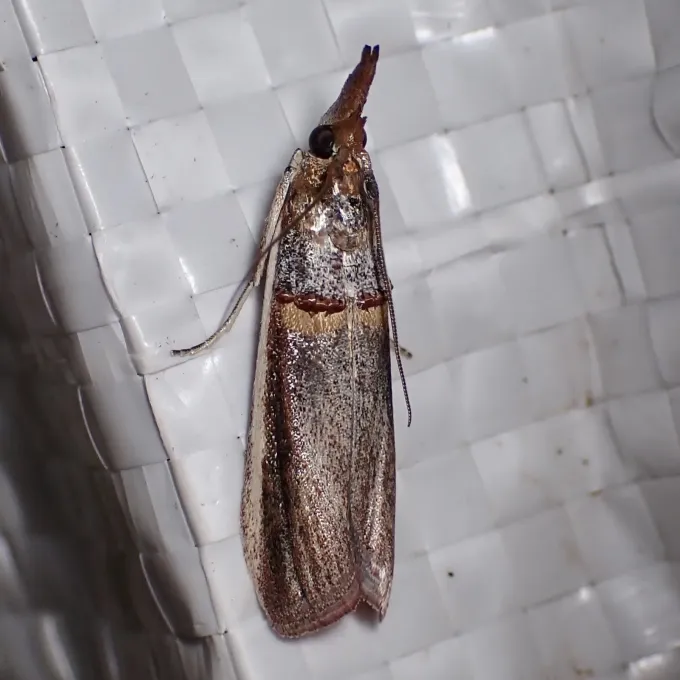
The Lima bean pod borer (Etiella zinckenella) belongs to the Pyralidae family of the order Lepidoptera. The adult moth has a wingspan of 20 to 30 mm, with grayish-brown forewings featuring a distinct white stripe along the costal margin.
The final instar larvae reach a length of 15–18 mm and vary in color from greenish to pinkish-brown. They possess a characteristic brown head and a body sparsely covered with fine hairs, which serves as a key feature for field identification.
The pupae are approximately 10–12 mm long, light brown, and enclosed in a dense silken cocoon located in the topsoil. The total development time of one generation depends on ambient temperature, usually ranging from 25 to 40 days.
The pest overwinters as a final instar larva in cocoons within the soil at a depth of 5 to 10 cm. In the spring, once soil temperatures rise to 10-12 degrees Celsius, pupation occurs, leading to the emergence of the first generation of adults.
Females lay eggs primarily on young pods or flower calyces of leguminous plants. A single female can lay up to 200–300 eggs, facilitating rapid colonization of fields, especially during the flowering and pod formation stages of host plants.
What it damages
This pest is highly destructive to various legumes, including soybeans, peas, lupins, and lentils. Under high-density conditions, it can also infest crops such as rapeseed, fodder beet, maize, grapevines, apples, and winter wheat.
When it appears
The flight of the first generation of moths typically begins in late May or early June, coinciding with the flowering phase of early-season legumes. Depending on the climatic region, the insect may complete two to three generations annually.
Maximum damage occurs during the pod development and seed-filling stages. The larvae feed on the developing seeds within the pods, with the highest levels of infestation usually observed during the second half of summer in warm, dry weather.
Signs of infestation
The primary sign of infestation is the presence of small entry holes on the surface of the pods. These holes indicate where the larvae have penetrated the pod wall to feed on the seeds inside, often leading to secondary infections.
Inside the pods, frass (excrement) resembling fine brown powder is commonly found along with larval webbing. Severely damaged pods contain eaten seeds, which significantly reduces grain yield and affects the overall quality and marketability of the crop.
In some cases, yellowing or premature drying of individual pods is observed. Careful inspection of the canopy, especially during twilight hours, can reveal the presence of adult moths, which are active at night and lay eggs on the host plant.
Control measures
Integrated pest management strategies should include crop rotation and maintaining a spatial distance between new legume crops and perennial leguminous fields. Deep autumn plowing is crucial to disturb and destroy overwintering pupae in the soil.
Planting early-maturing cultivars can help crops escape the peak egg-laying period of the later generations. Proper field sanitation, including the destruction of weeds in the Fabaceae family, further limits the local population of the pest.
Chemical control involving insecticides is effective if applied during the period of egg hatching and initial larval penetration. Monitoring with pheromone traps is highly recommended to time pesticide applications precisely and maximize control efficiency.
When selecting chemical agents, choose products that minimize impact on beneficial insects and pollinators. Always follow the manufacturer's label instructions regarding dosage, safety intervals, and application techniques to ensure sustainable crop protection.
In brief
7
Damages crops
Content graph
Damages crops · 7
Content graph
Connections · Lima bean pod borer
Most often together:
Marketplace
Products · 20


Alfazol
Nanjing No.1 Pesticide Factory of Red Sun Group Co., Ltd.
Insecticides
0
0
·
2.6K
1 offer
11.59 €per 1 l
Buy

Puska
Три Дельта Компані Інтернешнл, Гонконг, Китай.
Insecticides
1
0
·
1.9K
1 offer
7.76 €per 1 l
Buy


Instriker
Parijat Industries (India) Pvt. Ltd, Індія.
Insecticides
0
0
·
41
5 offers
15.45 €per 1 l
Buy

Dragun
Nanjing No.1 Pesticide Factory of Red Sun Group Co., Ltd.
Insecticides
0
1
·
2.3K
No offers
—
Details


Dragun c.e.
Nanjing No.1 Pesticide Factory of Red Sun Group Co., Ltd.
Insecticides
0
0
·
43
No offers
—
Details
Biology
Taxonomy
- Latin name
- Etiella zinckenella
- Order
- Lepidoptera (butterflies)
- Family
- Pyralidae
- EPPO code
- ETIEZI
Community
Discussion
No discussions yet — be the first.