
Alder leaf beetle
Agelastica caerulea
Description
How to identify
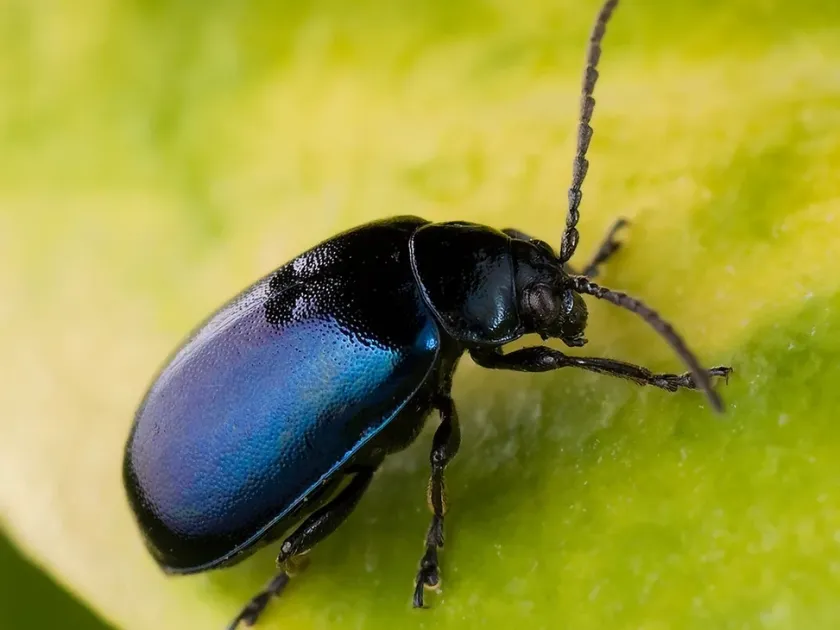
The Alder leaf beetle (Agelastica caerulea) is a member of the leaf beetle family (Chrysomelidae) within the order Coleoptera. It is recognized by its vibrant blue or blue-green metallic sheen.
Adult beetles typically grow to about 6–8 mm in length. They have a distinct oval shape with a smooth, shiny exterior that makes them highly visible against the green leaves of the host tree.
The larvae are greyish-black in color, often covered with small tubercles. As they mature, they grow significantly in size, passing through several larval stages before pupation.
The eggs are small, yellowish, or orange in color, and are typically laid in organized clusters on the underside of leaves to provide some level of protection from predators.
Adults are strong fliers and exhibit high levels of activity during warm days, which facilitates their spread across alder groves and wooded areas during the spring season.
What it damages
Alder trees are the primary host for this beetle, although it may occasionally feed on hazel or other related species if they are growing in close proximity to infested alders.
The primary damage is caused by both adults and larvae feeding on the foliage. Adults tend to eat holes in the leaves, while larvae often scrape away the leaf surface.
Heavy infestations can lead to severe defoliation, where trees are stripped of their leaves, significantly reducing their ability to photosynthesize and accumulate nutrients.
Young trees and saplings are particularly susceptible to damage. Repeated defoliation over consecutive seasons can weaken the tree, leading to stunted growth or branch dieback.
In addition to physical damage, the stress caused by the beetle makes trees more vulnerable to secondary infections, bark beetles, and various environmental stressors.
When it appears
These beetles overwinter as adults, finding shelter in leaf litter, debris, or under the loose bark of trees and in the upper layers of the soil.
Activity begins in early spring, coinciding with the initial budding and leaf development of the host trees. Adults emerge to feed and begin the mating process immediately.
Egg-laying usually occurs in late spring, around May. The timing is synchronized with the availability of tender, new foliage which is essential for the survival of early-stage larvae.
The larvae reach their peak feeding intensity during the mid-summer months. This is when the visual evidence of infestation becomes most apparent to observers.
By late summer, the larvae descend to the soil or leaf litter to pupate. After a brief pupation period, the next generation of adults emerges before retreating to hibernate.
Signs of infestation
The most recognizable sign is the presence of shot-hole damage or complete skeletonization of the leaves, where only the veins remain behind after the beetle has fed.
Observing groups of larvae on the underside of leaves is a definitive sign of an active infestation, often accompanied by thin, transparent patches on the leaf surface.
In severe cases, the entire canopy of an affected tree may turn brown or scorched due to mass foliage consumption, making the damage visible from a distance.
The presence of adult beetles on the foliage, which often drop to the ground when disturbed, provides further confirmation of the pest's presence.
Early-season monitoring often reveals the initial feeding damage on the first few leaves, which serves as a warning sign to initiate early management practices.
Control measures
Cultural control includes maintaining healthy, vigorous trees and removing leaf litter during the late autumn to eliminate the overwintering sites for the adult beetles.
Biological control involves encouraging the presence of natural predators, such as insectivorous birds and predatory insects, which can help keep beetle populations in check.
When chemical intervention is necessary, the application of targeted insecticides during the larval stage is most effective at preventing large-scale damage to the foliage.
For small, isolated ornamental trees, manual removal of larvae or clusters of eggs by hand can be a highly effective and eco-friendly method of management.
Periodic monitoring and timely identification are crucial for successful control, allowing for localized treatments that prevent the spread of the beetle to larger areas.
Taxonomy
- Latin name
- Agelastica caerulea
- Order
- Coleoptera (beetles)
- Family
- Chrysomelidae
- EPPO code
- AGLACO
Discussion
No discussions yet — be the first.