
Alder leaf beetle
Agelastica alni
Description
How to identify
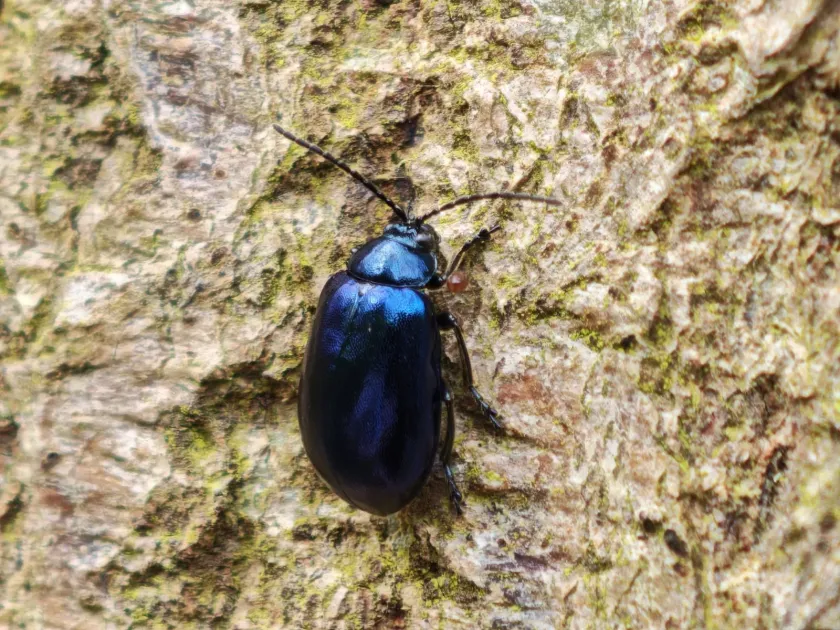
The Alder leaf beetle (Agelastica alni) is a member of the leaf beetle family (Chrysomelidae). Adult beetles are small, measuring approximately 6–7 mm in length.
They are easily recognizable by their shiny, dark metallic blue or violet color. The body shape is oval, and the antennae are thread-like and black, which is a distinguishing feature.
The larvae are black, matte in appearance, and grow up to 10–12 mm long. Their bodies are covered with small bumps, which provide camouflage and protection while they feed on leaves.
The eggs are bright yellow or orange and are laid in clusters on the undersides of leaves. These clusters are often clearly visible during the spring inspection of foliage.
Pupation occurs in the soil, where the beetle undergoes its transformation inside a protective chamber. The insect completes one generation per year, overwintering as an adult.
What it damages
The primary host for the Alder leaf beetle is the alder tree (Alnus spp.), specifically black and grey alder. It can cause significant defoliation when population levels are high.
Although it prefers alder, the beetle may also attack hazel, birch, and sometimes fruit trees if they are growing in the immediate vicinity of a heavily infested site.
Both adults and larvae feed on the foliage. Adults typically eat holes through the leaf, while larvae consume the leaf tissue while leaving the veins intact, creating a skeletonized effect.
Heavy infestations can lead to premature leaf drop. This reduces the tree's photosynthetic capacity, causing stunted growth and increased susceptibility to secondary infections or drought stress.
In forest management, high populations of this beetle are considered detrimental to the health and aesthetic value of riverine and parkland alder stands.
When it appears
Overwintered adults emerge in April or early May, precisely when the alder buds are opening. This timing allows them to feed on the tender, new spring foliage.
Egg-laying takes place in late spring. The larval stage begins in late May and continues throughout June, which is the period of most intensive damage to the trees.
In July, mature larvae descend into the soil to pupate. The pupal stage lasts for two to three weeks, depending on soil temperatures and moisture levels.
Adult beetles of the new generation emerge in late summer, typically in August. They feed actively before seeking winter shelter in leaf litter or topsoil.
Monitoring should be most intense during the spring and early summer when the beetles are most active and the damage to the leaves is most visually apparent.
Signs of infestation
Small holes scattered across the leaf blade are the first indicators of adult beetle feeding activity in the spring.
Skeletal remains of leaves, where only the vein structure remains, are a definitive sign of larval infestation. This damage is often seen on the lower parts of the tree first.
The presence of bright yellow egg clusters on the underside of leaves during May is a clear warning sign that a potential outbreak is about to occur.
Withered or yellowing leaves in mid-summer are a secondary sign of damage, often caused by heavy feeding that has compromised the vascular integrity of the foliage.
Birds or other insectivorous predators showing increased activity around an alder tree can often indicate that there is a high population of beetle larvae present.
Control measures
Biological control, including the use of entomopathogenic fungi or bacterial sprays, is highly effective for managing outbreaks in forest areas without harming beneficial insects.
In gardens and nurseries, targeted applications of systemic or contact-action insecticides can be used if the infestation threatens the vitality of high-value trees.
Removing and destroying fallen leaves in the autumn is a recommended cultural practice to eliminate potential overwintering sites for adult beetles.
Cultivating the soil around the base of the tree in late summer can help destroy pupating larvae in the ground, significantly reducing the population for the next season.
- Periodic inspection of tree foliage.
- Encouraging natural predators like ground beetles.
- Using pheromone-based monitoring traps.
Taxonomy
- Latin name
- Agelastica alni
- Order
- Coleoptera (beetles)
- Family
- Chrysomelidae
- EPPO code
- AGLAAL
Discussion
No discussions yet — be the first.