
Alder leaf beetle
Agelastica
Description
How to identify
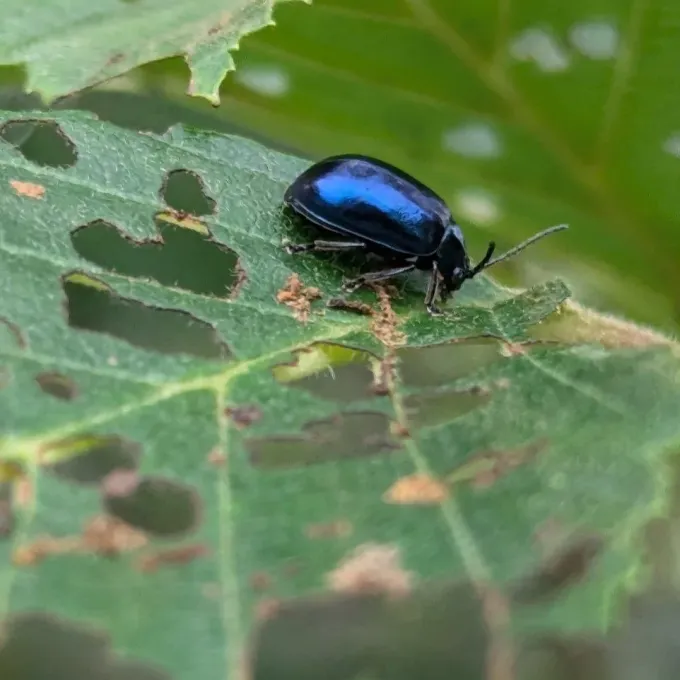
The Alder leaf beetle (Agelastica alni) is a member of the leaf beetle family (Chrysomelidae), widely recognized as a significant defoliator of alder trees. Adult beetles are small, usually measuring between 6 and 7 mm in length, and possess a striking metallic blue or violet-colored carapace.
Larvae of this species are distinct from adults, appearing as dark, charcoal-colored creatures with soft bodies covered in small tubercles. They often feed in groups, making them highly visible on the undersides of leaves during the early stages of their life cycle.
The beetle undergoes a complete metamorphosis, including egg, larval, pupal, and adult stages. Overwintering occurs primarily in the leaf litter beneath host trees or within the upper layer of soil, where they remain dormant until the warmth of spring triggers emergence.
Adults emerge in spring and begin feeding on developing leaves before mating. Females deposit their eggs in dense batches on the undersides of leaves, ensuring that hatching larvae have immediate access to a food source.
The species is highly mobile, with adults capable of flight to find new host trees. This mobility, combined with high reproductive potential, often leads to rapid colonization of entire groves or parklands if left unmanaged during the early outbreak phase.
What it damages
While the Alder leaf beetle has a strong preference for alder trees (Alnus species), it can occasionally affect other deciduous trees when food sources are scarce. Both adults and larvae contribute to the damage, though they consume foliage in different ways.
Adult beetles create numerous circular holes in the leaves, often referred to as "shot-hole" damage. In severe infestations, the cumulative feeding activity can leave the foliage looking like lace, significantly reducing the tree's photosynthetic capability.
Larvae cause a different type of damage known as skeletonization. They consume the soft tissues of the leaf but leave the harder veins and the upper epidermal layer intact, which eventually causes the damaged areas to wither and turn brown.
Heavy infestations lead to widespread defoliation, which causes significant stress to the host tree. This depletion of energy reserves can lead to reduced growth rates, increased vulnerability to secondary pathogens, and poor winter survival in younger or weakened trees.
In ornamental landscaping or nursery settings, the aesthetic and physiological damage can be severe, requiring immediate intervention to prevent the permanent loss of plant vitality or complete death of saplings.
Signs of infestation
The most common sign of an Alder leaf beetle infestation is the appearance of small holes in the leaves starting in late spring. A closer inspection of the foliage, particularly the underside, will often reveal the presence of dark-colored larval groups.
As the infestation progresses, the canopy may appear scorched or heavily browned due to the extensive tissue damage caused by feeding. In peak years, the lack of healthy foliage makes the trees stand out in the landscape for all the wrong reasons.
The shiny, metallic-blue adult beetles are often easily spotted on the leaves or branches during the day, as their color contrasts sharply with the green foliage. Their presence is a clear indicator of an active population.
Frass (insect excrement) found on the leaves or falling to the ground serves as another indicator of heavy feeding. This waste product can sometimes contribute to the colonization of fungi on the weakened leaf tissues.
- Circular holes and jagged edges on leaves.
- Skeletonized leaf patches caused by larval feeding.
- Clusters of dark-colored larvae on leaf undersides.
- Premature browning and thinning of the tree canopy.
Control measures
For small infestations or individual ornamental trees, manual removal of adult beetles and larvae can be effective. Shaking the branches over a cloth or container can help collect the insects for destruction.
A simple but effective cultural practice is the removal and composting or burning of leaf litter during the autumn. This eliminates the overwintering habitat for adult beetles and significantly reduces the population for the following spring.
When chemical intervention is necessary, the use of insecticides (contact or systemic) is recommended. It is vital to time the application to coincide with the period of larval hatching, as they are most vulnerable at this stage of development.
Biological control agents, such as formulations containing Bacillus thuringiensis, offer a safer, environmentally friendly alternative for controlling beetle populations, particularly in protected areas or urban parks.
Promoting tree health through regular irrigation, mulching, and proper fertilization enhances the tree's natural resilience. Stronger trees are better equipped to withstand defoliation and can recover more efficiently from pest attacks.
Taxonomy
- Latin name
- Agelastica
- Order
- Coleoptera (beetles)
- Family
- Chrysomelidae
- EPPO code
- AGLASP
Discussion
No discussions yet — be the first.