
Agasicles
Agasicles
Description
How to identify
Agasicles (Agasicles hygrophila) is a member of the leaf beetle family (Chrysomelidae), widely recognized for its role in the biological control of invasive aquatic weeds. It belongs to the order Coleoptera.
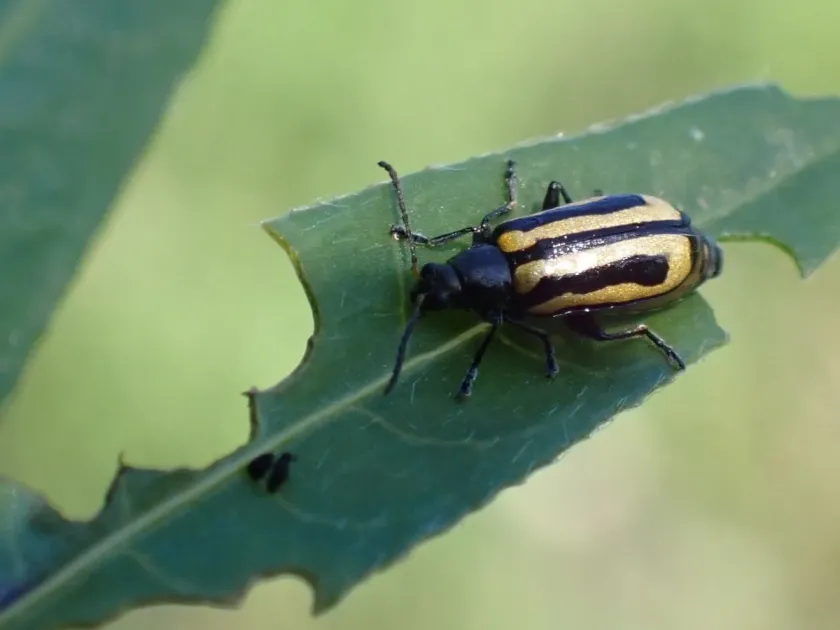
The adult beetle is small, typically ranging from 4 to 6 mm in length. Its body is elongated with distinctive black and yellow longitudinal stripes, providing camouflage against the leaves of its host plant.
The life cycle consists of egg, larval, pupal, and adult stages. The larvae are voracious feeders, specialized to consume the tissue of their specific host plant throughout their development.
This beetle is highly specialized, meaning it does not pose a threat to crops or non-target plants, making it a safe tool for environmental management in agricultural settings.
The beetle thrives in wetland environments, canal banks, and moist areas where its primary host, alligator weed, is present in abundance.
What it damages
The Agasicles beetle exclusively feeds on alligator weed (Alternanthera philoxeroides), which is a serious invasive aquatic weed causing major issues in waterways and irrigation systems.
In an agronomic context, the "damage" caused by this beetle is considered highly beneficial, as it suppresses the growth of a persistent weed without the use of chemical herbicides.
By consuming the leaves and stems of the weed, the beetle causes massive defoliation, which significantly weakens the plant's root system and prevents it from spreading further.
Mass infestations of Agasicles can clear vast areas of alligator weed, opening up water channels for better flow and reducing the need for mechanical clearing equipment.
The beetle acts as a natural pressure agent that forces the weed to retreat, allowing native flora to reclaim its space in the ecosystem.
Signs of infestation
The first sign of Agasicles activity is the presence of small, circular holes in the leaves of alligator weed, created by adult beetles feeding on the foliage.
As the infestation progresses, larvae begin to skeletonize the leaves, eating the green tissue and leaving only the vascular veins, which gives the plant a lace-like appearance.
Heavily infested patches of weeds will start to turn yellow and wilt, as the structural integrity of the plant is compromised by the feeding activity.
Adult beetles are most active during warm periods and can be found gathered in clusters on the tips of the shoots, especially during the early morning hours.
In severe infestation cases, the dense mats of weeds begin to break apart and dissipate, revealing the water surface that was previously covered by the invasive growth.
Control measures
There are no measures needed to control Agasicles, as it is a beneficial organism. Farmers should protect the beetle colonies to maintain long-term biological weed suppression.
The use of broad-spectrum insecticides in areas where Agasicles is performing biological control should be avoided to prevent the destruction of this beneficial agent.
Management of the beetle population is largely self-regulating; when the host weed population declines, the number of beetles decreases naturally due to the lack of food.
Monitoring the health of the Agasicles population is recommended to ensure they are effectively managing the weed, rather than requiring intervention with chemical sprays.
In areas where the invasive weed is re-emerging, additional releases of Agasicles can be a highly effective, cost-efficient, and sustainable method of weed management.
Taxonomy
- Latin name
- Agasicles
- Order
- Coleoptera (beetles)
- Family
- Chrysomelidae
- EPPO code
- AGAISP
Discussion
No discussions yet — be the first.