
Maple midge
Acericecis
Description
How to identify
The maple midge (lat. Acericecis) belongs to the order Diptera and the family Cecidomyiidae. These are tiny, fragile-looking insects, with adults typically measuring only a few millimeters in length.
The most commonly encountered stage is the larva, which lives inside specialized structures called galls. These galls are formed on the leaves as a protective and nutritional response by the host tree to the midge's presence.
Adult midges are short-lived, with their primary biological role being the search for suitable host trees and the mating and oviposition process during early spring.
Because they are highly specialized, these midges are found almost exclusively on maple species, making them a well-known pest in both urban parks and managed forests.
Accurate identification is typically based on the characteristic appearance of the galls on the maple foliage, as observing the tiny adult midges is quite challenging for non-specialists.
What it damages
The primary hosts for this pest include various maples, most notably the Norway maple (Acer platanoides) and field maple. They specifically target young, tender leaves in the early stages of the growing season.
As larvae feed on plant tissues from within the leaf, they cause the formation of abnormal growths or galls. This process draws essential nutrients away from the leaf's standard physiological functions.
Heavy infestations can significantly impair the photosynthetic capacity of the maple tree, leading to a general decline in health and reduced aesthetic value.
In cases of severe attack, leaves may wither or drop prematurely, creating a sparse appearance in the tree's canopy during the summer months.
While mature, established trees usually tolerate infestations well, young saplings may suffer from stunted growth and compromised vigor over several consecutive seasons.
When it appears
The midge's life cycle is tightly synchronized with the bud burst of the maple tree. Eggs are laid on the young leaves just as they begin to unfurl in early spring.
Larvae develop inside the protective environment of the galls throughout late spring and early summer, growing rapidly as they consume the plant tissues.
By mid-summer, the larvae reach maturity, exit the galls, and drop to the ground. They burrow into the leaf litter or topsoil to pupate and remain dormant for the winter period.
The pupae remain in the soil until the following spring, providing them with protection against harsh winter temperatures and predation.
This single or occasionally double-generation cycle ensures that the pest remains present in the environment as long as suitable host trees are available.
Signs of infestation
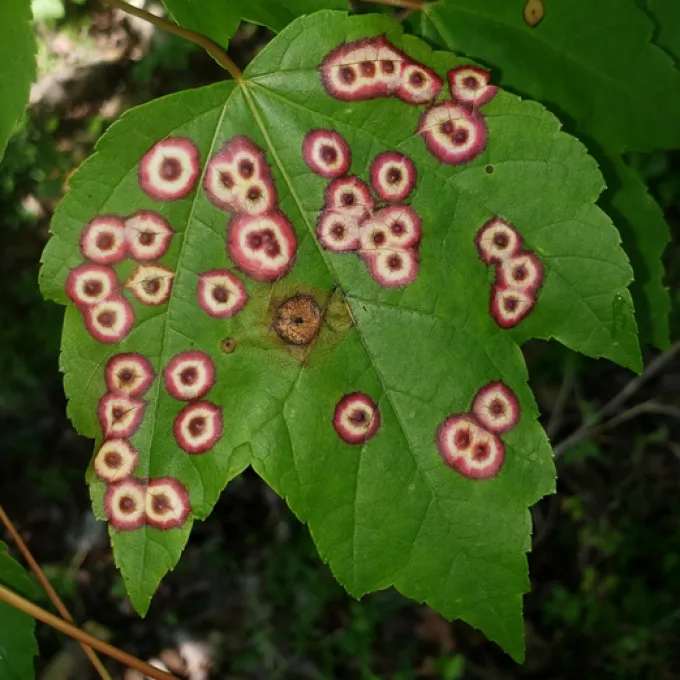
The first signs of infestation are small spots or speckles on the young leaves, which gradually develop into distinct, raised galls as the larvae grow.
Galls vary significantly in shape and color depending on the specific midge species, ranging from green to vibrant shades of red, purple, or yellow.
Leaf deformation is a common symptom, where the leaf blade may become twisted, curled, or puckered because of the uneven growth caused by the larvae.
- Appearance of wart-like or pouch-like galls on the leaf surface.
- Discoloration of the affected areas, often turning red or yellowish.
- Distorted and asymmetrical leaf shapes.
- Visible exit holes on the underside of the galls after larvae exit.
- Premature yellowing and leaf shedding during high-pressure years.
If an infestation is high, the foliage may look entirely speckled with galls, which reduces the tree's overall vigor and attractiveness.
Control measures
Sanitation is a key control measure: raking up and destroying fallen leaves in the autumn helps to remove the pupating larvae from the site.
Cultivating or loosening the soil beneath the canopy can help disrupt the pupae, exposing them to environmental factors or predators during the winter months.
Systemic insecticides, if used, must be applied precisely at the time of bud burst to target the adults or young larvae before they are shielded inside the galls.
Maintaining optimal tree health through proper irrigation and fertilization ensures that the maples are more resilient to pest damage and can recover more effectively.
In ornamental settings, frequent monitoring during spring allows for early intervention, which is much more effective than trying to manage a fully established infestation later in the season.
Taxonomy
- Latin name
- Acericecis
- Order
- Diptera (flies)
- Family
- Cecidomyiidae
- EPPO code
- ACECSP
Discussion
No discussions yet — be the first.