
Acanthoscelides trabuti
Acanthoscelides trabuti
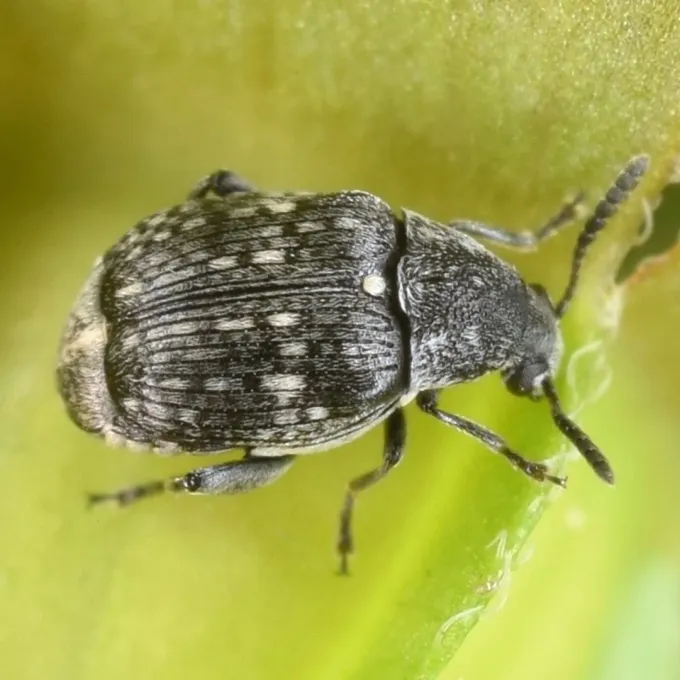
Description
How to identify
Acanthoscelides trabuti is a beetle belonging to the Bruchidae family, commonly known as seed beetles. These small insects are characterized by a compact, oval-shaped body, which is usually covered with dense, grayish or brownish hair.
Adult beetles have well-developed wings, allowing them to migrate into storage facilities or fields during the reproductive season. Their small size and cryptic behavior make them difficult to notice until a significant population is established.
The larvae are endophagous, meaning they complete their entire development inside the seeds of legume plants. They are typically C-shaped, legless, and possess a white, fleshy appearance, adapted to survive within a protected environment.
The life cycle of this beetle is highly influenced by temperature and humidity levels in the surrounding environment. Favorable conditions allow for rapid reproduction, resulting in multiple generations per year under storage conditions.
Morphological identification is crucial for determining the species correctly. Specialists often examine the structure of the hind legs and the pattern of the elytra, as these features are specific to the Acanthoscelides genus.
What it damages
This pest primarily attacks various species of legumes, with a preference for beans. The damage is caused by larvae that feed on the internal tissues, effectively consuming the germ and the nutrient storage of the seed.
Infestation leads to a total loss of seed germination potential, making the grain useless for future planting. This presents a major threat to agricultural producers who rely on quality seed stocks for their yearly operations.
In commodity markets, damage manifests as a significant reduction in grain weight and nutrient quality. Large quantities of product can be rendered unfit for human or animal consumption due to insect-related damage and contamination.
The activity of the larvae often leads to secondary infections by mold and other pathogens. These fungi thrive in the environment created by the waste and the heat produced by the pest population.
Economic impact is high, as infestations necessitate expensive decontamination or the complete destruction of infected grain batches. Preventive management is therefore essential for sustainable storage practices.
Signs of infestation
The most distinctive sign of infestation is the presence of small, circular holes on the surface of the beans. These exit holes are created by the adult beetles when they emerge from the pupal stage.
A fine, floury dust or powder accumulation around the seeds is a clear indicator of larval activity. This debris is composed of larval frass and pulverized seed coat particles that accumulate during the feeding process.
Observation of the seeds may reveal tiny, light-colored specks on the surface, which are the remains of eggs laid by females. These are often located in small depressions or irregularities of the seed coat.
Increased temperature within the stored bulk grain is a strong warning sign. The metabolic activity of a large colony of beetles causes localized heating, which can be monitored with specialized probes.
A characteristic musty or stale odor emanating from the storage bins often indicates high levels of pest activity combined with moisture-related spoilage, requiring immediate inspection and corrective action.
Control measures
The primary control method involves maintaining strict sanitation in storage areas. Cleaning out old grain and debris before the new harvest arrives is vital to breaking the pest's reproductive cycle.
Temperature management is highly effective, as freezing or heat treatment can kill all life stages of the beetle without chemical residues. This is the preferred method for organic and high-quality seed storage.
Fumigation is necessary for larger scale infestations in commercial facilities. This process must be conducted by certified professionals using approved pesticides to ensure safety and legal compliance.
Regular monitoring using pheromone traps and visual inspections helps in detecting the pest early. Early identification allows for targeted interventions, preventing the infestation from spreading across the entire warehouse.
- Use of airtight storage containers for small-scale operations.
- Keeping grain moisture levels below 14% to deter pest development.
- Quarantine protocols for new grain arrivals from infested areas.
- Proper sealing of storage facility entry points to prevent migration.
Taxonomy
- Latin name
- Acanthoscelides trabuti
- Order
- Coleoptera (beetles)
- Family
- Chrysomelidae
- EPPO code
- ACANTB
Discussion
No discussions yet — be the first.