
Acallepitrix
Acallepitrix
Description
How to identify
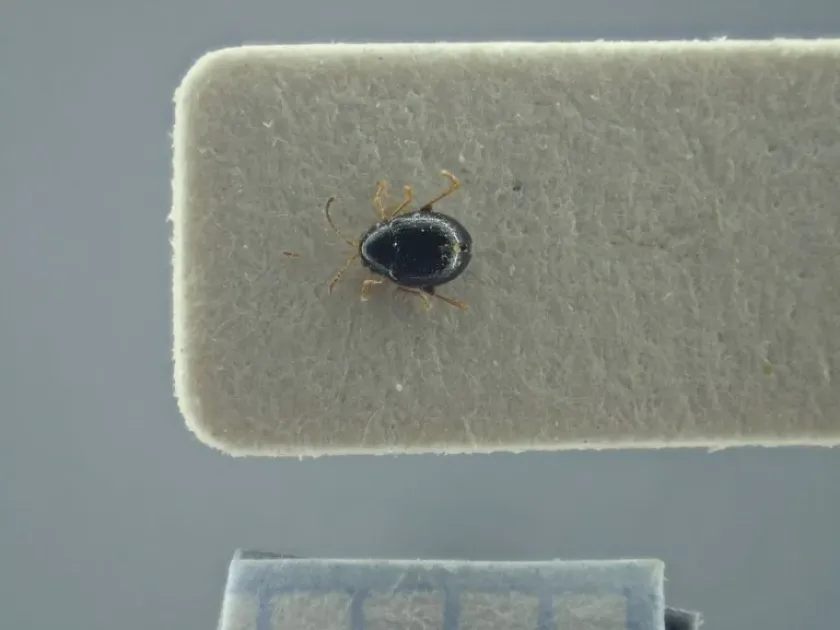
Acallepitrix belongs to the order Coleoptera and the family Chrysomelidae (leaf beetles). These are small beetles with a body shape typical of the family, often appearing rounded or elongated with a distinct metallic sheen.
The external anatomy of the insect is adapted to life on the leaf surface, where they spend most of their life cycle. Their sensory organs and antennae are well-developed, allowing them to react actively to environmental stimuli.
The larvae of Acallepitrix are worm-like in shape, often covered with fine setae or possessing specific coloration that aids in camouflage on the underside of the leaves.
The insect develops through the stages of egg, larva, pupa, and adult. Each stage requires specific humidity and temperature conditions to successfully complete metamorphosis.
Species identification often requires microscopic examination of the male genitalia, as external features can be similar to other leaf beetle species.
What it damages
The primary food sources for Acallepitrix are various herbaceous and woody plants, most commonly from the Solanaceae or Convolvulaceae families.
Adult insects (imago) prefer to feed on the leaf blade, chewing holes of varying shapes, often referred to as "window feeding" or irregular consumption.
Unlike adults, larvae may damage not only the leaves but also young shoots, and in some cases, the root system of young plants, weakening their overall vitality.
Under mass infestation, this pest can cause significant defoliation, which critically affects photosynthesis and the overall growth and development of the crop.
Damaged plant tissues often become entry points for secondary fungal and bacterial infections, significantly increasing the risk of crop failure.
When it appears
Pest activity begins in the spring when average daily temperatures exceed 10–12 degrees Celsius and the host plant vegetation starts.
The peak population density usually occurs in mid-summer, when weather conditions become optimal for reproduction and larval development.
The pest may produce several generations within a single season, provided the region's climate ensures a sufficiently long frost-free period.
Adults overwinter in the upper soil layer, under plant debris, or within bark crevices, where they are protected from extreme temperature fluctuations.
As autumn approaches, the beetles gradually decrease their activity and enter diapause, preparing for the dormant period until the following spring.
Signs of infestation
The first visual sign of Acallepitrix presence is the appearance of small, round holes in the leaf blades that gradually expand in size.
Egg masses can often be found on the underside of leaves, usually appearing yellowish or orange and arranged in clusters along the leaf veins.
The presence of the beetles themselves—which often drop to the ground or fly away when the plant is disturbed—is a clear indicator of infestation.
Larvae leave behind skeletonized areas of the leaf by consuming the soft tissue between the veins, leaving only a network of vascular bundles.
Stunted plant growth, curling leaves, and premature wilting of apical shoots are indirect signs of heavy pest pressure.
Control measures
Agronomic control methods include deep autumn plowing of the soil, which helps destroy overwintering stages by mechanical injury and exposure to the surface.
Crop rotation is a crucial factor, as depriving the pest of its specific food source in a given area significantly reduces the population growth rate.
Biological control options include the use of entomopathogenic fungi or specialized nematodes that target the larval stages residing in the soil.
Chemical control measures should be applied at the early detection stage, using systemic contact-stomach insecticides authorized for agricultural use.
- Regular monitoring of crops during morning hours.
- Hand-picking of adults in small areas.
- Removal of weeds that may serve as reservoirs for the pest.
Taxonomy
- Latin name
- Acallepitrix
- Order
- Coleoptera (beetles)
- Family
- Chrysomelidae
- EPPO code
- ACALSP
Discussion
No discussions yet — be the first.