
Peanut root-knot nematode
Meloidogyne arenaria
Description
How to identify
The peanut root-knot nematode (Meloidogyne arenaria) belongs to the phylum Nematoda and the class Secernentea. It is a microscopic, soil-borne obligate parasite of plants.
The life cycle encompasses an egg stage, four larval stages, and an adult stage. The species exhibits sexual dimorphism, where males are vermiform and motile, while females are pyriform (pear-shaped) and sedentary.
The primary habitat for the population is the soil and the root system of host plants, where the parasite completes its development within plant tissues.
Dissemination occurs via infested planting material, soil particles adhering to agricultural machinery, and movement of contaminated water through irrigation or runoff.
Optimal conditions for development include warm climates and sandy soils, where the metabolic processes of the nematode are significantly accelerated.
What it damages
The host range is exceptionally broad, exceeding 500 plant species, including peanuts, tomatoes, cucumbers, tobacco, peppers, and various legume crops.
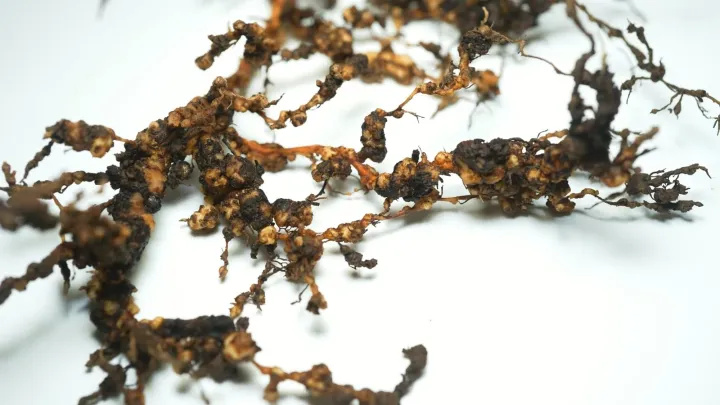
The larvae penetrate roots, triggering the formation of characteristic galls or knots, which obstruct the transport of water and nutrients throughout the vascular system.
Damage to the root architecture results in stunted plant growth, leaf yellowing, reduced blooming intensity, and the development of undersized or malformed fruit.
In cases of severe infestation, particularly during the seedling stage, the host plant may succumb to the infection, leading to significant gaps in crop density.
Furthermore, the physical damage to roots creates entry points for secondary pathogens, such as fungi and bacteria, which can cause severe root rot complexes.
Signs of infestation
The most diagnostic sign of an infestation is the presence of numerous swellings (galls) on the roots, which become clearly visible when a plant is uprooted.
Plants often exhibit symptoms of chronic water and nutrient stress, appearing wilted even when soil moisture conditions are adequate for healthy plants.
There is marked growth retardation, leaf chlorosis, and premature senescence, often mistaken for abiotic drought stress or localized root rot pathogens.
The root system may become excessively branched and appear brownish; in areas of severe mechanical injury, secondary necrosis is commonly observed.
Microscopic examination of larger galls reveals the presence of sedentary females within the cortical tissue, confirming an active Meloidogyne arenaria infection.
Control measures
The deployment of resistant or tolerant crop varieties remains the cornerstone of integrated management strategies for controlling nematode populations.
Implementing crop rotation cycles that include non-host species, such as certain grains or grasses, effectively reduces the baseline nematode density in the field soil.
The application of composted organic amendments and bio-control agents, specifically nematophagous fungi, helps suppress nematode populations in the rhizosphere.
Chemical control involving soil nematicides is available, though it requires strict adherence to safety protocols and environmental regulations to minimize ecological impact.
Sanitation practices, such as thoroughly cleaning equipment after working in infested zones, are crucial to prevent the accidental transfer of the pathogen to clean fields.
Discussion
No discussions yet — be the first.