
Solanaceous cyst nematode
Globodera solanacearum
Description
How to identify
Globodera solanacearum is a specialized plant-parasitic nematode belonging to the family Heteroderidae, primarily targeting Solanaceous crops in intensive agriculture systems.
The life cycle features a dormant cyst stage, which is the hardened, dead body of the female containing hundreds of eggs, allowing the parasite to survive for decades in the soil.
Once conditions are favorable, larvae emerge from the cysts, attracted by root exudates from host plants, and penetrate the root tissue to establish feeding sites.
This species is morphologically similar to other Globodera species, making precise identification difficult without the use of molecular techniques or detailed microscopic cyst analysis.
It is classified as a significant quarantine pest in many jurisdictions, requiring rigorous monitoring and strict phytosanitary protocols to prevent international and regional spread.
What it damages
The primary hosts include potato, tomato, eggplant, and various wild Solanum species, which suffer significantly due to the disruption of root function.
Feeding by the nematode inhibits nutrient and water uptake, leading to severe stunting, leaf chlorosis, and wilting, which essentially mimics the symptoms of drought stress.
Yield losses can be catastrophic, with severe infestations rendering entire fields unproductive due to the significant reduction in tuber weight and fruit size.
The root system often exhibits reduced biomass and secondary rot infections, as the tissue damage caused by the nematode acts as an entry point for various soil-borne pathogens.
The persistence of the cysts in the soil means that once a field is infested, the land value decreases significantly, and long-term management strategies are required.
Signs of infestation
Infested areas are often characterized by patches of stunted, yellowing plants that appear prematurely aged compared to the healthy crop surrounding them.
In the field, these patches are usually oval or circular, slowly expanding over subsequent growing seasons as the nematode population spreads through soil movement.
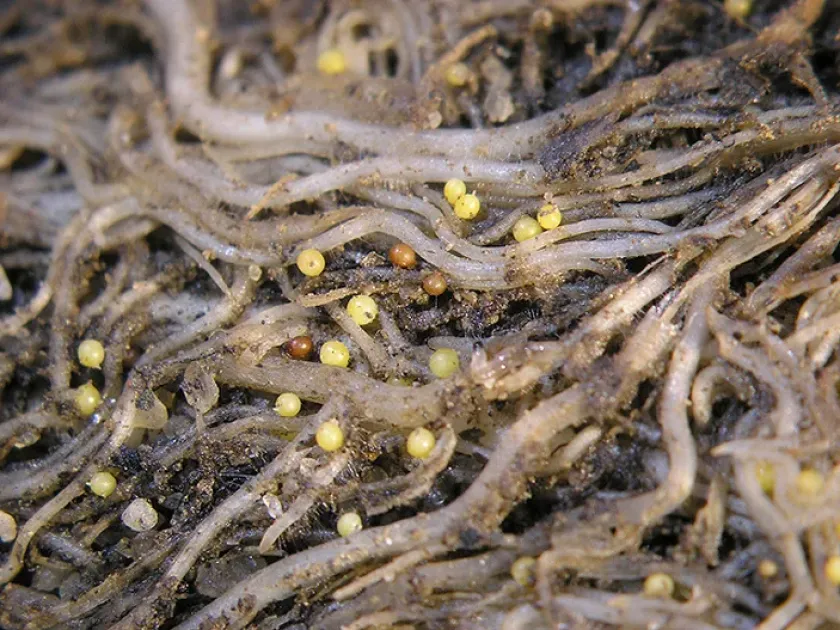
Upon careful examination of the roots, one can observe the presence of tiny, pearl-like white, yellow, or brown cysts adhering to the root surface.
A reduced root system, characterized by an overall lack of vigor and missing fibrous lateral roots, is a major visual indicator that an infestation has occurred.
Affected crops typically show poor canopy development and a lower threshold for recovery after periods of environmental stress, leading to early plant mortality.
Control measures
Integrated Pest Management (IPM) is essential, starting with the use of crop rotation cycles that replace susceptible Solanaceous crops with non-host grasses or legumes.
Strict sanitation practices, such as washing farm machinery and tools before moving between fields, are critical to prevent the transfer of infested soil and cysts.
The deployment of resistant cultivars is currently the most effective, sustainable long-term solution to mitigate the impact of the nematode in production fields.
Soil solarization and the use of nematocides are supplementary options, though their efficiency varies based on soil temperature, moisture levels, and the initial density of the population.
Regular soil sampling and mapping of infestation levels allow farmers to target control measures specifically at affected areas, reducing unnecessary costs and environmental impact.
Discussion
No discussions yet — be the first.