A summer variety developed at the Minusinsk Experimental Station for Horticulture and Melon Cultivation through repeated (saturating) crossbreeding of hybrid first-generation seedlings of Siberian apple with a large-fruited variety (specifically unknown) in 1943. Authors — I. M. Leonov, V. A. Shevchenko, V. I. Shevchenko. Included in the State Register of Selection Achievements approved for use in the East Siberian and West Siberian regions since 1979. Widely grown in Krasnoyarsk Krai, Khakasia, Tuva.
Medium-sized, slow-growing tree, height 2.7–3.0 m. Medium-density, spreading crown. Branches depart from the trunk at nearly straight angles, straight, sparsely arranged, branch tips directed upward. Bark on the trunk and main branches smooth, reddish-brown. Predominant type of fruiting structures — simple and complex clusters, fruiting spurs.
Medium-length shoots, straight, greenish-brown, weakly hairy. Many small buds. Buds pressed, medium-sized, conical, weakly hairy. Leaves large, egg-shaped, short-tapered, light green, smooth, shiny, with delicate venation. Leaf blade slightly concave. Petiole medium length and thickness, hairless. Absent or very small stipules.
Flowers medium-sized, small-cup-shaped, pink, fragrant. Petals oval, stamens medium-sized, pistil column medium-sized, weakly hairy, stigma above stamens.
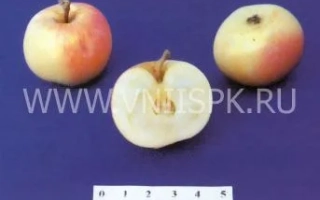
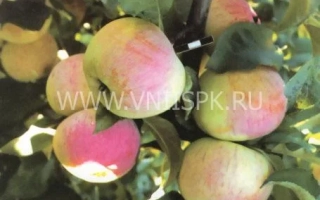
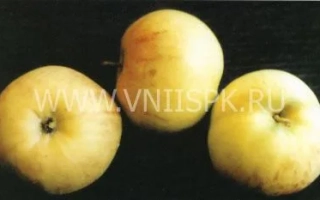
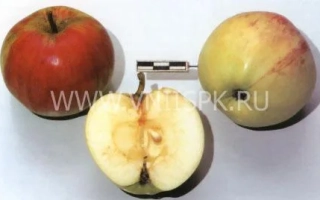
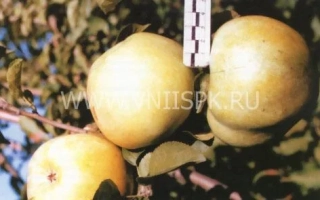
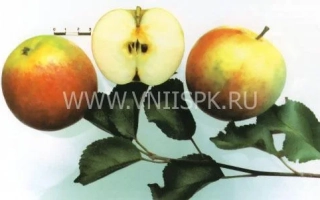
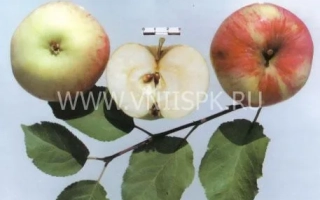
Fruits (see illustration) one-dimensional, average weight — 22 g, maximum — 32 g, round, surface slightly ribbed. Skin tender, smooth, shiny, with bloom. Color at harvest stage: main — golden-yellow, covering — over entire fruit, blurred, brick-red. Color at consumer maturity: main — golden-yellow, covering — over entire fruit, strongly expressed, blurred, brownish-red. Numerous, clearly visible, medium-sized, yellow lenticels. Fruit stalk long, thin, straight. Calyx small, acute-conical, narrow, slight rusting. Calyx persistent, closed. Dish small, narrow, ridged. External appearance attractiveness — 4.5 points. Core medium-sized, bulbous. Chambers open, medium-sized. Subcalyx tube short, narrow. Seeds medium-sized, round, dark-brown.
Flesh creamy, medium density, tender, oily, very juicy. Flavor characteristics: sweet, with moderate aroma, tasting score 4.3 points. Fruits contain: dry matter — 13.4%, ascorbic acid — 15 mg/100g, vitamin P — 240 mg/100g, sugars — 15%, titratable acids — 0.33%.
Summer ripening variety — second half of August.
Fruits do not drop. Fruit quality and transportability medium. Consumption period no more than three weeks. Universal variety, suitable for production of natural juices.
Self-sterile variety, best pollinators — Tubinskoe, Gornoaltayskoe, Ranetka Ermolaeva, Minusinskoe dessert. Early fruiting, enters fruiting on the 3–4th year after planting (through 4–5 years from the year of grafting in nurseries). Often begins fruiting in the second year after planting, some plants flower in nurseries. Yield increases rapidly. Fruits annually and abundantly. Average yield of 10-year-old trees — 143 centners/ha, or 21.1 kg/tree, maximum — 258 centners/ha.
Propagation methods — budding and grafting with cuttings, rootstock seedlings of Ranecka purpurovaya. Recommended planting scheme 5x3 m. Responds well to fertilization and irrigation. Crown forms freely, single or double-tiered scaffold branches. Later, pruning branches on two- to three-year-old wood is necessary to prevent overloading. Maternal trees for propagation must be selected in fruiting orchards due to high variability in fruit mass and taste qualities, yield.
High winter hardiness (in 1980, at air temperature -42.8°C, overall degree of freezing damage no more than 0.4 points, observed wilting of one-year-old shoots). High drought and heat resistance. Medium resistance to scab (in epidemic years leaf damage up to 3 points, fruits not affected). Flowers well tolerate light spring frosts.
Advantages of the variety: high winter hardiness, early fruiting, annual and abundant fruiting, harvesting period 25–30 days without overripening or fruit drop, high juice yield, due to easy fruit detachment, labor productivity during harvest increases twofold.
Disadvantages of the variety: medium resistance to scab, in some years fruits acquire bitterness, limited use for processing (only juice production).