Autumn variety from the Sverdlovsk Experimental Garden Station. Obtained by crossing Urals varieties Samotsvet and Negoy. Author: L. A. Kotov. Approved for the Volga-Vyatka region, including areas of the Middle Urals.
Medium-sized tree with a medium-density rounded crown. Main branches diverge from the trunk at an angle close to straight, with smooth gray bark.
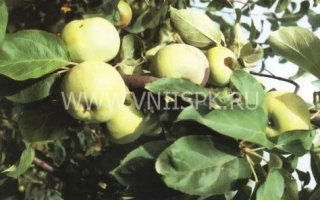
Shoots with brown bark, thin, straight, hairy, round in cross-section. Leaves green, flat, matte, elliptical, wrinkled. Blade curved downward, with finely toothed edge, medium-length petiole. Stipules lanceolate.
Flowers smaller than average, conical, white, with densely hairy pistil style, stigmas positioned at the same level or slightly above the anthers. Buds pinkish.
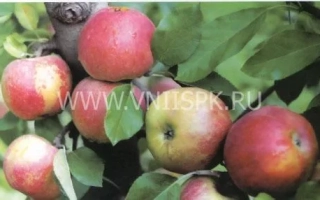
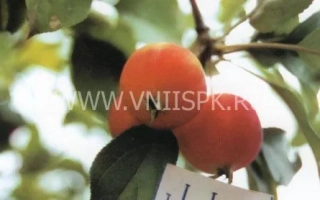
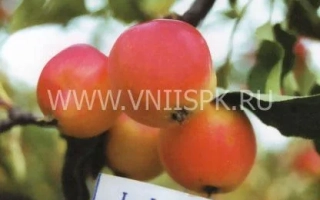
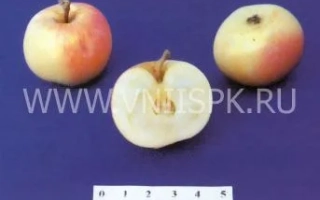
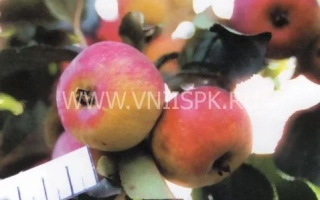
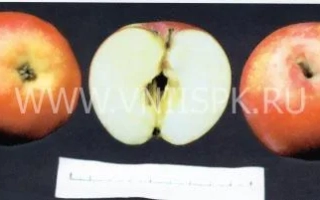
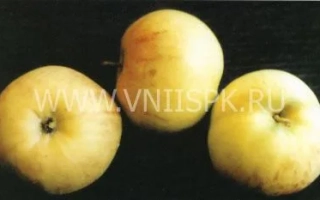
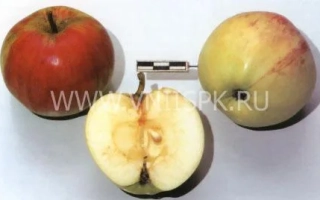
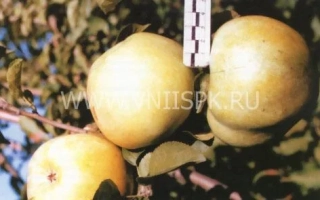
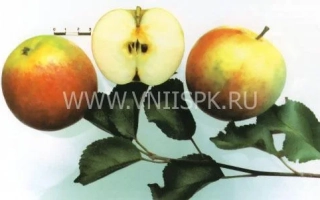
Fruits medium-sized, weighing 90–110 g (up to 135 g), one-dimensional, flat-round-truncated shape, wide ribs slightly expressed. Surface smooth. Skin dry, smooth, shiny. Main color when harvested greenish-yellow, later light-yellow; covering color mostly strongly expressed, striped, pink-red. Pedicels short, straight, medium thickness. Calyx wide, medium depth, funnel-shaped, unoxidized. Receptacle shallow, fairly narrow, smooth, cup open. Heart large, heart-shaped, chambers half-open. Sub-cup tube short, wide, cup-shaped. Seeds small, broad, slightly flat, brown, egg-shaped and conical.
Flesh white, loose, coarse-grained, juicy, tart-sweet taste with strong aroma. Chemical composition of fruit: soluble solids — 13.9% (up to 16.4%), total sugars — 11.1% (up to 13.1%), titratable acids — 1.0% (up to 1.34%), ascorbic acid — 11.3 mg/100g (up to 16.9 mg/100g), P-active substances (catechins) — 323.0 mg/100g (up to 506.2 mg/100g).
Storage life — 150 days. Fruit quality is good, suitable for fresh consumption and various processing methods.
Self-incompatible; all Urals varieties provide good pollination.
Trees begin fruiting in the 5th year after budding and produce abundant, regular yields. High productivity: at spacing 6 x 3 m, average multi-year yields exceed 200 centners per hectare. Flowers of this variety exhibit high resistance to spring frosts. Resistant to scab — even in epidemic years, maintains high field resistance.
Advantages of the variety: resistance to scab, high winter hardiness and yield, flower resistance to frost.
Disadvantages of the variety: loose flesh texture.