Ultra-early ripening variety, developed at Pavlovsk Experimental Station of VNIIR named after N.I. Vavilov from crossing (Bredtorp × Ribes dikuscha) and [R. nigrum subsp. europaeum + (Non-shedding × R. nigrum subsp. sibiricum №2)]. Authors: E.V. Volodina, S.P. Khotimskaya, O.A. Tikhanova. Under state variety testing since 1995.
Medium-sized, compact, moderately dense bush. Growing shoots of medium thickness, straight, smooth, green, anthocyanin pigmentation may be present only at the shoot tips. Woody shoots are medium-sized, with gradual thinning towards the apex, straight or slightly curved, gray with light-brown tips, glossy, very slightly hairy. Buds are single, medium-sized, egg-shaped with a pointed apex, pinkish, hairy, angled, apical bud not free, medium-sized, cylindrical with blunt apex. Leaf scars are large, wedge-shaped or wedge-shaped with elongated apex.
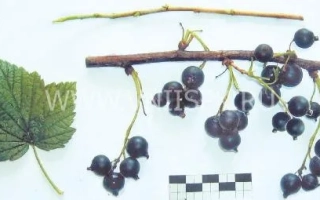
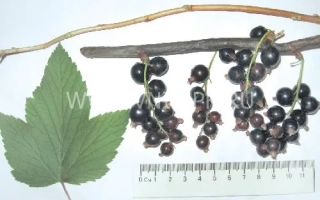
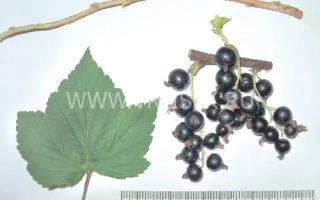
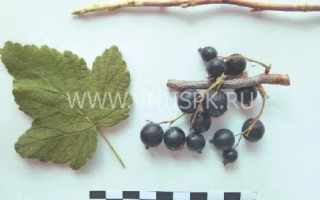
Leaf is five-lobed, medium-sized, green with bluish tinge, early aging and turning yellowish-green, matte, wrinkled or wrinkled-furrowed, leathery, with sparse hairs on main veins on upper and lower leaf surfaces (in the petiole sinus area on upper side with light woolly hairs), leaf blade almost straight. Main leaf veins are uncolored. Central lobe is triangular with acute apex, slightly longer than lateral lobes, additional projections are very weakly expressed, often asymmetric, or not expressed at all. Lateral lobes are small, triangular, pointed, widely spaced, angle between their veins obtuse, sometimes slightly rounded. Basal lobes are asymmetric, moderately and weakly developed, often expressed only on one side, their veins curve toward the petiole. Leaf base has an open, heart-shaped sinus. Teeth are large, serrated, medium depth with clearly visible whitish "claw". Petiole is short and medium-sized, thick, straight, hairy, green. Leaves are positioned at an acute angle to the shoot.
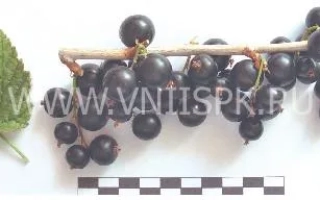
Flowers are medium-sized, round-urn-shaped or bell-shaped, pale pink, not bright. Sepals are egg-shaped with elongated apex, pale pink, curved, free, hairless. Petals are egg-shaped, rounded, uncolored or with very weak anthocyanin pigmentation, separate. Stigma is positioned at the same level as stamens or slightly below them. Ovule is smooth, hairless, with anthocyanin pigmentation at the lower part. Inflorescences are single and double, medium-sized (6.4 cm) and long (8.4 cm), dense, up to 11 berries, axis thick, hairless or with very weak hairs, bright green, with medium petiole. Berry pedicels are medium length, thick, green, hairy.
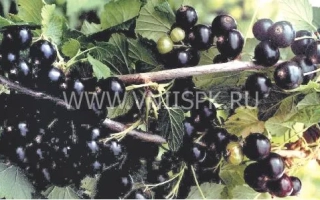
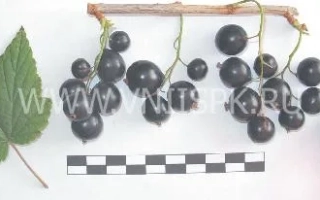
Berries are medium and large (0.9–1.1 g), round or slightly oval, black, with waxy coating, giving them a slightly bluish appearance, dull, smooth. Calyx is small, closed, falling off. Skin is thin but firm, fused with flesh. Berries contain, on average, 28 medium-sized seeds. Flavor is sweet-sour (3.9 points), with slight predominance of acidity. Berries are of universal use. Chemical composition: soluble dry matter — 16.5%, total sugars — 9.5%, titratable acidity — 2.8%, ascorbic acid — 182.5 mg/100 g.
Winter-hardy variety, self-fertility over 50%, resistant to powdery mildew, relatively resistant to anthracnose, weakly damaged by bud mites, stably high-yielding (3.0–4.0 kg/plant).
Advantages of the variety: high winter hardiness due to accelerated shoot maturation, ultra-early ripening (almost simultaneously with late strawberry varieties), high annual productivity, easy dry berry detachment, resistance to powdery mildew, compact bush form.
Disadvantages of the variety: weak berry aroma, slightly sour taste.