
Irish fuel protests expose weak links between farms, fertiliser and food
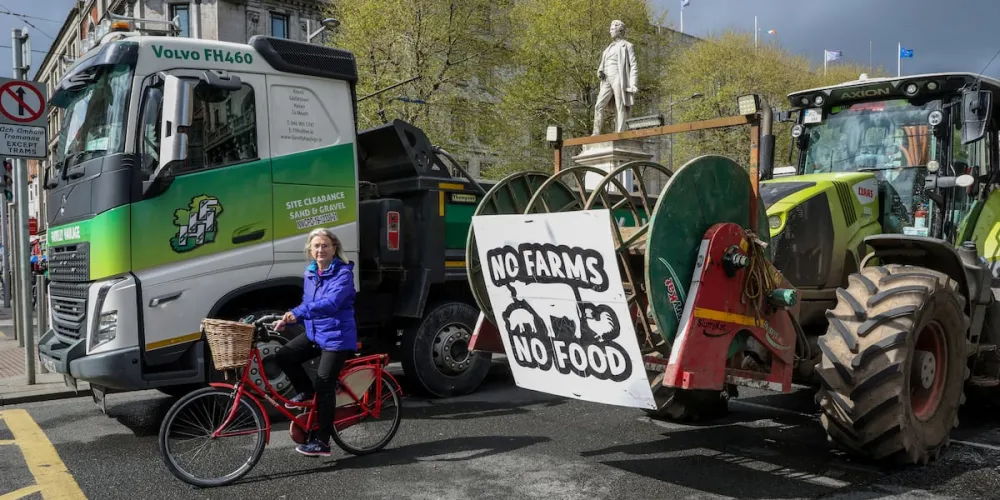
Ireland’s fuel protests have reopened a difficult question for the country’s agri-food system: how much food security is actually provided by domestic farming, and how much still depends on imports and transport? The Irish Times notes that protesters used the slogan “No farms, no food” and warned that high fuel and fertiliser costs could leave fields idle, but the country’s food balance is far more complex than the slogan suggests.
On paper, Ireland looks secure. The country ranks second out of 113 countries in the Global Food Security Index, which reflects the availability and quality of food. Yet economist Emma Howard of Technological University Dublin argued that Ireland does not really have food security in the strict sense, because the vast majority of what people consume is imported while much of what the country produces is sent abroad.
That contradiction is especially visible in livestock and fresh produce. Howard said between 80% and 90% of Ireland’s beef and dairy output is aimed at export markets. At the same time, the country imports around the same proportion of its fruit and vegetables, and even potatoes are imported. Central Statistics Office data also show that the average Irish person consumes about 100 kilograms of meat a year, with chicken accounting for half of that total, while self-sufficiency in chicken production is only 72%.
Even in sectors where Ireland produces far more than it consumes, imports still play a role. Self-sufficiency is measured at 210% for pig meat and 701% for beef, but the country still buys significant quantities of cheaper cuts and processed products from abroad. Grain tells a similar story: most bread in Ireland is made from imported wheat, while much of the wheat, barley and oats grown domestically is used for animal feed rather than direct human consumption.
The article recalls that during the 2022 fuel and fertiliser crisis, after Russia’s invasion of Ukraine, Irish farmers were urged to grow more grain for human food use. But according to CSO data, collective production of wheat, barley and oats fell by 20% the following year, and wheat output dropped by another 20% a year later, although barley and oats posted only modest gains. Irish farmers also import about two-thirds of their feed, which means port disruptions can quickly hit feed mills and livestock chains.
That vulnerability was illustrated when one feed mill cut production because grain trucks were blocked at Foynes Port. At the same time, the report notes that Ireland imports little food from Iran and sources most fertiliser from outside the region, with heavy stockpiling already carried out ahead of the EU carbon border adjustment mechanism. The immediate danger, therefore, is less about food disappearing overnight and more about how fuel costs, blocked logistics and import dependence can quickly raise prices and expose structural weaknesses across the farm-to-food chain.
Not yet comments. Be the first!
Comments · 0