
How the agricultural resource market in Ukraine is changing: from product sales to comprehensive solutions
The agricultural market of Ukraine is changing: farmers are calculating the cost per hectare, choosing seeds and crop protection products more carefully, and buying online more often. How AgroMen adapts to the new demands of agricultural producers.
The Ukrainian agricultural market has changed much more significantly over recent years than it might seem at first glance. It is not just about the war, logistics, price fluctuations, or more difficult weather conditions. The very approach of farms to purchasing seeds, crop protection products, and fertilizers is changing. While previously one of the main arguments for a seller could be the price of a product, today a farmer increasingly calculates the final cost per hectare.
According to the Ministry of Economy of Ukraine, in 2025 agricultural exports amounted to about $22.6 billion, or approximately 56% of the country's total exports. At the same time, agricultural production, according to the National Institute for Strategic Studies, decreased by 6.8%, and crop production by 7.5%. Given this data, it can be said that farmers have to work in conditions where the price of a mistake on each hectare becomes more and more noticeable.
Tangible changes are beginning to take place in the market of crop protection products. What I mean by this from my perspective is that conditionally, two herbicides can cost 500 and 700 UAH per liter. At first glance, the first one is more profitable. But if you take into account the application rate, the absence of additional treatments, the presence of a sticker in the product, and therefore the actual effectiveness against problem weeds, the economics may turn out to be completely different.
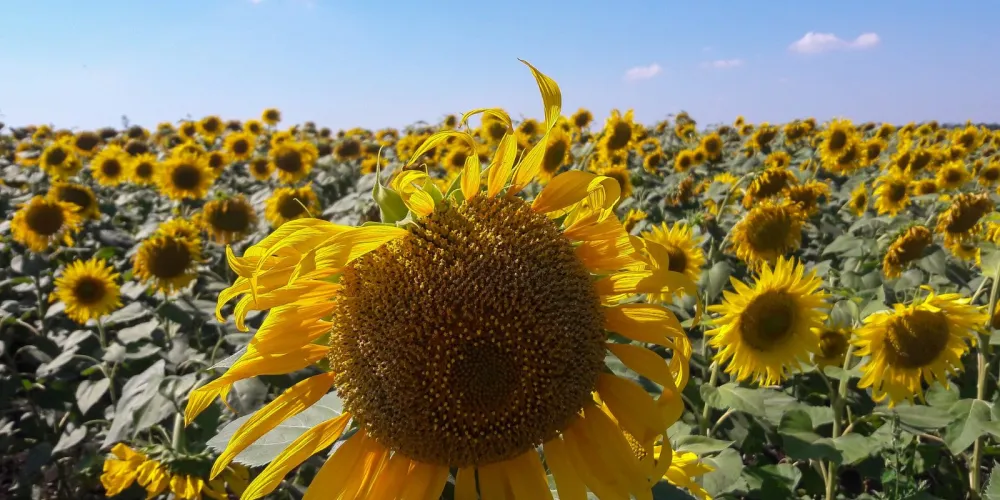
The same thing happens with seeds. When choosing sunflower seeds, not only the brand and the price of a sowing unit are becoming increasingly important, but also the growing technology, broomrape resistance, drought resistance, yield potential, oil content, and the behavior of a specific hybrid in a particular region. Because of this, the role of companies selling goods for farmers is also changing. Simply having goods in stock is no longer enough. The seller needs to understand what is happening in the client's field. A characteristic example of this approach can be seen in the work of the Ukrainian online store AgroMen, which specializes in seeds, crop protection products, fertilizers, and other crop production goods.
The company works with agricultural producers and simultaneously develops its online direction, trying to combine product sales with agronomic information. And it is this model today that looks more interesting than a regular online catalog. A few years ago, buying crop protection products and planting material via the internet was unusual for some farmers. Especially if it was not about a single canister of a product, but about supplying a farm for tens or hundreds of hectares. The situation is gradually changing.
A farmer from Kirovohrad, Cherkasy, or Poltava region no longer needs to spend half a day traveling to a seller to find out the price and availability of a product. A significant portion of initial information can be obtained online: view characteristics, active ingredient, application rate, recommended crops, packaging, and alternative products.
A herbicide can work wonderfully on one farm and give a significantly weaker result on another due to the weed development stage, temperature, moisture deficit, water quality, or incompatibility of tank mix components. That is why, along with the development of online sales, the need for proper consultation is growing. On the AgroMen website, for example, a large information section is gradually being formed alongside the product catalog. There are materials on weeds, crop diseases and pests, active ingredients of products, plant nutrition, and growing technologies.
This is already a somewhat different sales logic. A farmer may come to the site not for a specific product. They might search for information, for example, about ragweed in sunflowers, sclerotinia, corn protection, or a specific active ingredient. And only after figuring out the problem, move on to possible solutions. Sales in such a model begin not with the "Buy" button, but with an answer to the farmer's question. At AgroMen, they try to solve this problem through consultations and detailed product cards. The catalog features herbicides, fungicides, insecticides, seed disinfectants, desiccants, microfertilizers, stimulants, as well as seeds of sunflower, corn, grain crops, rapeseed, soybeans, peas, and other crops. At the same time, the buyer can get advice on selecting a product or planting material for a specific situation. In practice, this is more important than it seems. Sometimes a correctly asked question before a purchase allows a farm to save significantly more than an additional discount on the product itself.
A separate problem of the agricultural market is the origin of products. A farmer cannot always determine the quality of seeds or a product at the time of receiving the goods. The consequences of a bad purchase sometimes become apparent only after sowing or applying crop protection products. Therefore, along with the price, the buyer pays more and more attention to the seller, product documents, the possibility of getting post-purchase advice, and the company's track record. On its website, AgroMen declares that it works with certified products and can provide documents confirming its origin and quality. The company also publishes customer reviews. In agriculture, much relies on reputation in general. Especially when one failed product or an incorrectly selected hybrid can affect not just a single purchase, but the result of the entire season.
Editorial team agronom.info
Materials are prepared by the portal's agronomists and editors. We use only trusted sources: Ukrainian agricultural universities, variety registries, open scientific publications.
Related articles
Not yet comments. Be the first!
Comments · 0