
Services
How to choose a printing house for producing catalogs of retail products and flyers
To answer this question, it is necessary first to clearly define all the necessary stages of printing catalogs and flyers.
Editorial team agronom.info
5 July 2015
4 min reading
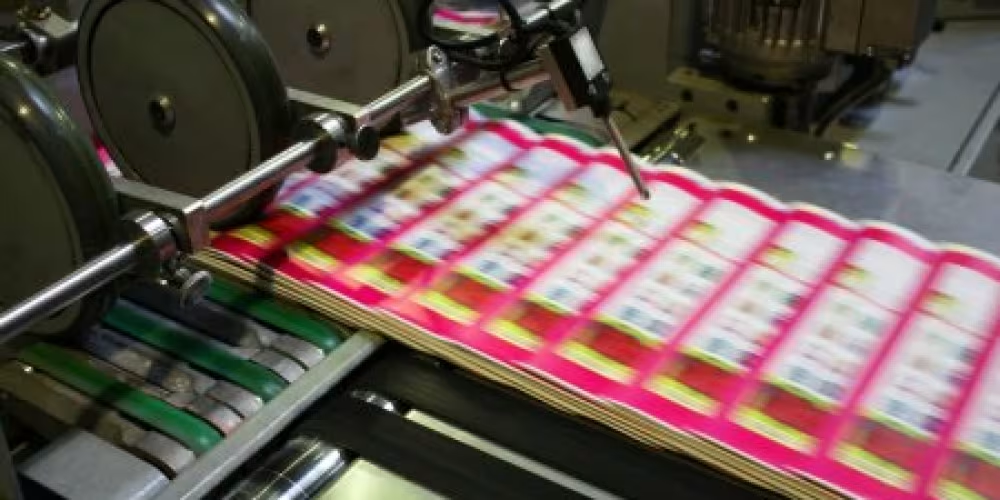
To answer this question, it is necessary first to clearly define all the necessary stages of printing catalogs and flyers.
Thus, any printed product goes through three main stages in a printing house:
- Pre-press preparation of materials;
- Direct printing processes;
- Post-print processing and finishing of printed materials.
Pre-press preparation methods
Pre-press preparation for producing catalogs of retail products, is the development of the main idea, concept of the future printed material. For flyers, it is necessary to create a bright, concise, and succinct layout on A4 or A5 paper, containing everything needed to attract potential customers. A catalog, on the other hand, represents a separate branch of the client's company, allowing the reader to learn everything needed to make a purchase as they flip through its pages. This is a multi-page layout with illustrations, detailed descriptions, and company history. It is a full-color magazine printed on coated paper.
The pre-press stage (premedio) includes not only concept development but also style design, necessary sketches, graphs, tables, photo or illustration preparation, text writing, and layout creation, whose main elements include:
— Color correction and separation of digital sources;
— Warning potential printing problems;
— Illustration layout;
— PS file recording;
— Rasterization:
— Plates and printing plates.
Previously, this was done using photo plates, created manually or mechanically. Now, all this is created using digital technologies.
The pre-press stage (premedio) includes not only concept development but also style design, necessary sketches, graphs, tables, photo or illustration preparation, text writing, and layout creation, whose main elements include:
— Color correction and separation of digital sources;
— Warning potential printing problems;
— Illustration layout;
— PS file recording;
— Rasterization:
— Plates and printing plates.
Previously, this was done using photo plates, created manually or mechanically. Now, all this is created using digital technologies.

Printing methods for flyers and catalogs
Main printing methods include: offset, screen, and digital. The most common, high-quality, and cost-effective printing method, capable of producing large print runs in short timeframes — offset. It comes in flat and deep types. In this printing method, the image is transferred from the printing plate to special rubber rollers with ink of four tones, applied sequentially. Even the smallest details and half-tones can be excellently reproduced using this technology.
In flat printing, all image elements are applied in one plane, and volume is achieved through halftones.
In deep printing, the rollers themselves have a deep form, allowing the image to be reproduced in three dimensions.
Screen printing is often used for applying to three-dimensional objects and is suitable for producing souvenirs.
Digital printing is advantageous for small print runs. In terms of image reproduction quality, it is close to offset printing.
In flat printing, all image elements are applied in one plane, and volume is achieved through halftones.
In deep printing, the rollers themselves have a deep form, allowing the image to be reproduced in three dimensions.
Screen printing is often used for applying to three-dimensional objects and is suitable for producing souvenirs.
Digital printing is advantageous for small print runs. In terms of image reproduction quality, it is close to offset printing.
Post-print finishing of flyers and catalogs
It includes four main stages: trimming of the print run, folding, assembly, and binding. There are also various secondary operations applied to specific product types — lamination, perforation, punching holes, etc.
Flyers may use only the first two, as simple flyers and brochures are not bound. Catalogs, however, are suitable for lamination, perforation, and binding.
One of the main issues is the balance between print price and quality, so choosing the right printing house is crucial. Many specialize in large print runs, making it difficult to find a printing house for a run of 20–50 copies. Creating a quality layout, printing on the most modern full-color flyers or catalogs, and post-print processing — all require significant investment of time, effort, and money. Often, the result will differ greatly from the client's expectations.
Another difficulty in finding a printing house is that large orders are usually scheduled at the beginning of the year, when companies form budgets and conduct tenders. Therefore, small print runs are either printed at higher rates or not printed at all. However, some printing houses operate differently. For example, www.zsa-print.ru — "Printing House Garant," whose staff strive to approach each order individually. There, even the smallest print run can be printed at an optimal price.
Flyers may use only the first two, as simple flyers and brochures are not bound. Catalogs, however, are suitable for lamination, perforation, and binding.
One of the main issues is the balance between print price and quality, so choosing the right printing house is crucial. Many specialize in large print runs, making it difficult to find a printing house for a run of 20–50 copies. Creating a quality layout, printing on the most modern full-color flyers or catalogs, and post-print processing — all require significant investment of time, effort, and money. Often, the result will differ greatly from the client's expectations.
Another difficulty in finding a printing house is that large orders are usually scheduled at the beginning of the year, when companies form budgets and conduct tenders. Therefore, small print runs are either printed at higher rates or not printed at all. However, some printing houses operate differently. For example, www.zsa-print.ru — "Printing House Garant," whose staff strive to approach each order individually. There, even the smallest print run can be printed at an optimal price.
Editorial team agronom.info
Materials are prepared by the portal's agronomists and editors. We use only trusted sources: Ukrainian agricultural universities, variety registries, open scientific publications.
Related articles



Not yet comments. Be the first!
Comments · 0