
Bacterial blight of coffee
Coffee oil
The disease, commonly referred to as bacterial blight or halo blight, is caused by the phytopathogenic bacterium Pseudomonas syringae pv. garcae. It is a highly specialized pathogen affecting Coffea arabica and other varieties.
What the section contains
Bacterial blight of coffee
Classified as a systemic bacteriosis, the organism targets both foliage and woody tissues. Its ability to persist in soil and crop debris makes it a difficult pathogen to eradicate once established on a plantation.
The bacteria utilize enzymatic degradation to colonize the host tissues. By secreting toxins, the pathogen disrupts normal cell functions, leading to chlorosis, necrosis, and subsequent tissue death within the coffee shrub.
The pathogen is highly active in humid environments. It spreads efficiently through the vascular system and via external contact, utilizing natural openings and microscopic wounds on leaves to infiltrate the plant.
Infection cycles are perpetuated by rain splash, wind-driven water, and human activities. Agricultural equipment that is not properly sanitized often acts as a vector for spreading the blight between different sections of the farm.
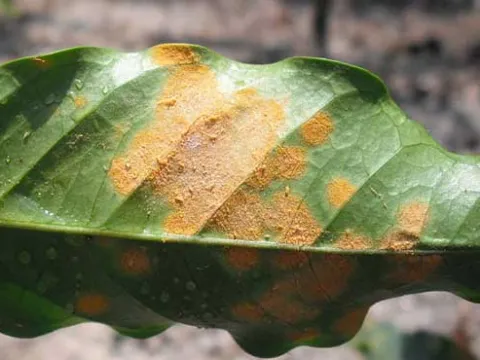
The characteristic symptoms begin as small, water-soaked, translucent spots on the leaves. These spots often look like drops of oil or grease, which is why the condition is colloquially called the oil spot disease.
As the infection progresses, these spots expand, darken, and develop a distinct chlorotic (yellow) halo. The surrounding tissue becomes yellow as the bacteria produce toxins that inhibit chlorophyll synthesis.
Lesions eventually coalesce, causing large parts of the leaf to die and become brittle. This is accompanied by severe leaf shedding, which significantly reduces the photosynthetic capacity of the entire plant.
Stem infections manifest as dark, elongated lesions or cracks. If the infection circles the branch, the tip of the branch will wither and die, leading to significant dieback of the plant's terminal growth.
- Small, greasy-looking translucent leaf spots.
- Dark brown necrotic centers with yellow halos.
- Bacterial exudate visible under high humidity.
- Dieback of terminal twigs and branches.
- Premature defoliation of infected shrubs.
The spread of Pseudomonas syringae is heavily dependent on microclimatic factors. Persistent rainfall and high relative humidity (above 80%) create the optimal environment for bacterial proliferation.
Moderate temperatures ranging from 18°C to 25°C are ideal for the rapid replication of the pathogen. Under these conditions, the latent period of the disease is drastically shortened, leading to explosive outbreaks.
Mechanical damage, such as that caused by heavy rain, windstorms, or hail, serves as an entry point for the bacteria. These events frequently precede the manifestation of the disease in healthy coffee groves.
Poor agricultural practices, such as excessive fertilization with nitrogen, result in flush growth that is highly susceptible to infection. Overcrowded planting arrangements that restrict airflow also encourage high humidity levels.
Leaf wetness duration is a critical parameter. Dew, mist, and continuous fog maintain the moisture required for the bacteria to swim and successfully infect new, healthy leaf tissues throughout the growing season.
Bacterial blight causes significant economic harm by reducing the overall vigor of coffee trees. The reduction in leaf area leads to lower berry yield and poor bean quality, affecting the final market value of the crop.
Persistent infections lead to long-term decline in the health of the plantation. Trees weakened by the disease are more prone to secondary infections by fungi and pests, eventually leading to tree mortality.
Increased operational costs arise from the need for frequent sanitation, regular fungicide/bactericide applications, and the labor-intensive removal of infected plant parts to prevent total crop loss.
The systemic nature of the disease makes recovery difficult. Once the vascular system is heavily colonized, the tree often loses its ability to produce fruit, necessitating the uprooting and replacement of infected individuals.
For large-scale operations, a bacterial blight epidemic can threaten the viability of entire harvests. The difficulty in controlling the disease in endemic areas often forces farmers to shift to more resistant cultivars.
Prevention starts with strict phytosanitary measures. Only certified, disease-free seedlings should be sourced for planting, as contaminated nursery stock is a primary driver of new outbreaks.
Regular pruning of infected branches is essential to reduce the inoculum pressure. All pruning equipment must be sterilized with appropriate disinfectants after every use to prevent mechanical transmission of the bacteria.
Copper-based sprays are the standard chemical intervention for controlling bacterial populations on foliage. Applications must be timed strategically before expected wet periods to provide a protective barrier.
Improved plantation management, such as maintaining adequate spacing and proper canopy management, ensures good aeration. This lowers the humidity around the trees, making the environment less hospitable for the pathogen.
Integrated Pest Management (IPM) is the most effective approach. By combining cultural practices, chemical control, and the selection of resistant varieties, growers can manage bacterial blight effectively and sustainably.