
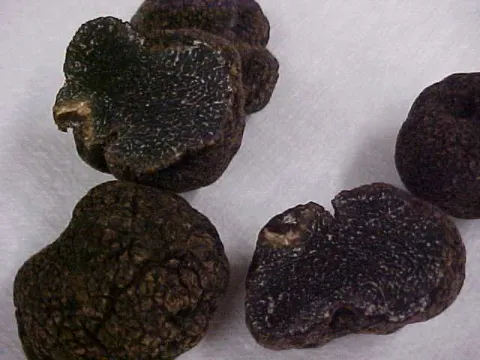
Himalayan truffle
Tuber himalayense
The causative agent is Tuber himalayense, a soil-borne ascomycete belonging to the genus Tuber. It is critical to state that this organism is not a plant pathogen in agricultural terms.
What the section contains
Himalayan truffle
Unlike phytopathogenic fungi that cause diseases, this species maintains a strictly symbiotic lifestyle. It forms ectomycorrhizae on the roots of specific tree species.
Biologically, this organism is classified as a beneficial mycorrhizal symbiont. Its development is closely linked to the root system of trees, where it exchanges nutrients with the host.
The fungus does not infect plant tissues in the classical sense of an infection. Its interaction with roots does not lead to necrosis, decay, or growth inhibition, thus excluding it from the list of plant diseases.
Classifying Tuber himalayense as a disease is a misinterpretation. It is an edible fungus valued in gastronomy, not an object requiring chemical or biological crop protection.
The development of the fungus requires specific conditions typical of high-altitude ecosystems. The optimal environment is calcareous soil with a high content of organic matter.
The most important factor for distribution is the presence of a suitable host tree, such as specific species of oak or conifers. The fungus develops in a temperate climate with seasonal precipitation.
The temperature regime must favor mycelial growth during the summer and the maturation of fruiting bodies in the autumn. Soil moisture is a critical parameter for mycorrhiza formation.
The fungus is sensitive to soil pH levels. It prefers slightly alkaline or neutral conditions, which limits its spread in the acidic soils of forest zones.
Spore dispersal occurs via soil-dwelling animals that feed on fruiting bodies, facilitating the migration of the fungus to new areas within its habitat.
There is no pathogenicity or economic harm caused to agricultural crops by this fungus. It is not a parasite that attacks field, vegetable, or horticultural crops.
Misperceptions of the fungus as a threat are related to its ability to alter the microbial composition around the tree's root system, but this is not of a destructive nature.
In forestry, the presence of mycorrhiza with Tuber himalayense can be beneficial for the tree, providing it with additional nitrogen and minerals from the soil.
Risks could only arise from the uncontrolled introduction of mycelium into regions where it might compete with native beneficial fungi or disturb the local ecosystem.
Thus, this species is not subject to phytosanitary control as it does not cause economic damage to harvests or trigger epiphytotics.
Control and protection measures against the Himalayan truffle are unnecessary, as it is not a harmful object. There are no agronomic regulations for its eradication.
If it appears in fields where it is undesirable, standard agrotechnical practices are effective. Plowing and altering soil pH will destroy the fungal mycorrhizal connections.
The application of broad-spectrum fungicides would also suppress mycelial development, but such measures are impractical due to the lack of threat to crop plants.
Prevention is limited to adhering to quarantine rules when importing planting material from the regions of natural occurrence to prevent unintended introduction.
- Monitoring soil composition in forest nurseries.
- Controlling the cleanliness of seedlings intended for export.
- Using standard fungicides if substrate disinfection is required.