
Olive Phytophthora
Phytophthora oleae
The causal agent of this disease is the oomycete Phytophthora oleae. It is a soil-borne pathogen that specifically attacks the vascular system of the tree, starting from the roots and moving upward into the root collar.
What the section contains
Olive Phytophthora
Although often called a fungus, it is technically an oomycete, which produces zoospores capable of swimming through moist soil environments to reach new root systems. This makes the disease highly mobile in saturated conditions.
The pathogen remains dormant in the soil for years, waiting for ideal environmental conditions, particularly moisture, to germinate and infect healthy host plant roots.
Once inside the plant, it disrupts the flow of water and nutrients, causing systemic stress that leads to the eventual decline and death of the olive tree if left untreated.
Its ability to spread through both irrigation water and contaminated soil makes it a particularly persistent threat in commercial olive nurseries and orchards.
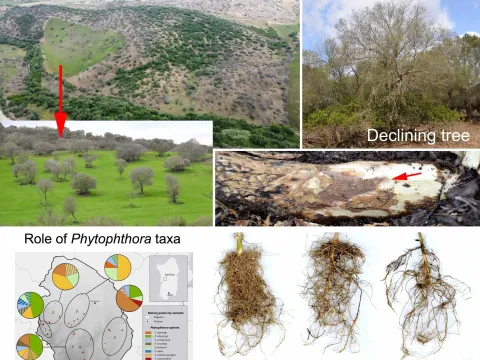
The first external signs of olive phytophthora often include a general decline in the tree's vigor. Leaves become chlorotic, lose their natural sheen, and begin to drop prematurely.
The bark at the base of the trunk or root collar may show dark, water-soaked lesions. When the bark is carefully peeled back, the underlying tissue often appears reddish-brown or necrotic.
Root system inspection typically reveals that small feeder roots are black, mushy, and decayed, indicating that the tree can no longer effectively absorb water from the soil.
Over time, the tree experiences branch dieback starting from the canopy edges, leading to thin foliage and, eventually, the total collapse of the olive tree's health.
- Chlorosis and premature leaf drop.
- Necrotic lesions at the root collar.
- Decayed and blackened feeder roots.
- Progressive dieback of branches.
- Stunted annual growth.
High soil moisture is the primary driver of disease development. Sites with poor drainage or excessive irrigation are significantly more prone to outbreaks of Phytophthora oleae.
Heavy, clay-based soils that are prone to compaction provide an ideal environment for the pathogen, as water lingers in the root zone for extended periods, allowing zoospores to thrive.
Temperatures between 18°C and 25°C (64°F–77°F) are optimal for the pathogen’s metabolism, making spring and autumn critical times for monitoring and prevention.
Mechanical damage to roots caused by plowing or close cultivation can create entry points for the pathogen, accelerating the infection process in otherwise healthy trees.
Furthermore, the presence of other soil pathogens or pests that weaken the tree's natural defense systems can exacerbate the impact of Phytophthora infection.
This disease is extremely damaging to olive plantations, often leading to total tree loss. Because it attacks the roots, by the time symptoms appear in the canopy, the internal damage is usually severe.
Economic losses include not only the loss of the tree itself but also the costs associated with the long-term quarantine of the soil, as it remains contaminated for years.
The disease significantly lowers the yield quality and quantity, as stressed trees prioritize survival over fruit production and vegetative growth.
Its rapid spread in irrigated systems makes it a nightmare for orchard managers, as one infected tree can easily spread the pathogen to the entire grove through shared water sources.
The inability to plant new olive trees in the same spot for a long period makes this disease one of the most significant long-term management challenges for olive growers.
The most important control strategy is maintaining proper soil drainage. Installing tile drains or creating mounds for planting can prevent water from pooling around the root collars.
Strict nursery hygiene is essential. Growers should only buy certified disease-free stock to prevent introducing the pathogen to previously clean orchard lands.
Disinfecting tools and machinery, especially when moving between different orchard sectors, is critical to stopping the mechanical spread of the oomycete spores.
Chemical control involving phosphonate fungicides can be effective as a preventative measure or to suppress the disease in its early stages by strengthening the tree's immune response.
Regular monitoring of tree health and soil moisture levels allows for early intervention, which is key to saving trees and maintaining the profitability of the olive grove.