
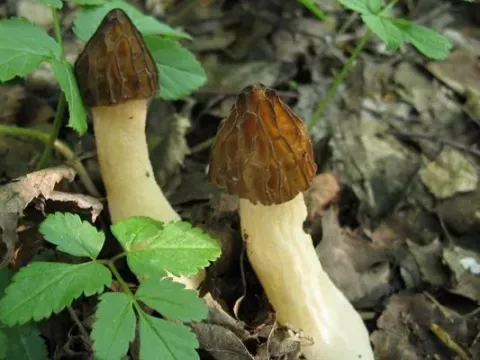
Half-free morel
Mitrophora semilibera
The half-free morel (Latin Mitrophora semilibera) is an ascomycete fungus characterized by a cap that is attached to the stem only halfway up its height. This distinct morphological feature is the primary diagnostic trait for identifying this species.
What the section contains
Half-free morel
The cap typically has a conical shape and is covered with deep ridges and pits, resembling a honeycomb structure. The coloration of the cap ranges from yellowish-brown to dark chocolate, depending on age and environmental conditions.
The stem of the half-free morel is hollow and relatively fragile. It is usually white when young but develops a yellowish or brownish tint as it matures, often featuring a finely granular or mealy surface.
The flesh is thin and has a mild, distinct fungal aroma. It is essential to note that the raw mushroom contains thermolabile toxins, meaning that adequate cooking is required before consumption to ensure food safety.
As a spring-fruiting species, it emerges shortly after the snow melts. Unlike other morel varieties, it demonstrates a preference for moist, sheltered environments such as riparian forests and floodplains.
Biologically, Mitrophora semilibera is classified as a saprophytic soil fungus. It is not a plant pathogen; it does not infect or damage living crops, trees, or decorative plants in any agricultural or horticultural setting.
The ecological role of this fungus is strictly limited to the decomposition of organic matter. It breaks down leaf litter and woody debris, facilitating nutrient cycling within the soil structure of deciduous forests.
The mycelium resides in the upper soil horizons, where it efficiently processes organic residues. Its life cycle is tightly synchronized with the phenology of forest trees, thriving in the nutrient-rich micro-habitats they provide.
The fungus produces fruit bodies by mobilizing resources accumulated in the soil substrate. Its genetic adaptability allows it to tolerate the unpredictable thermal fluctuations typical of the early spring season.
In agronomic and farming systems, this species is considered beneficial or neutral as it contributes to soil health through organic matter transformation. It poses no threat to crop yield or plant health.
Optimal growth conditions involve high soil moisture and temperate climate conditions. It thrives primarily in shaded areas beneath the canopy of deciduous trees during the months of April and May.
A fertile, humus-rich soil substrate is crucial for successful fruiting. The fungus is frequently found in proximity to poplar, aspen, and willow species, which provide the ideal soil microenvironment.
A prolonged spring season with consistent moisture levels promotes better development. However, excessive waterlogging or rapid temperature spikes can hinder the expansion of the fungal network.
The temperature range for active growth is between +10 and +15 degrees Celsius. Extreme heat or prolonged drought effectively halts mycelial activity and prevents the development of new fruit bodies.
Human activities, such as excessive soil compaction or the destruction of riparian forest zones, significantly reduce the availability of habitats required for the reproduction of Mitrophora semilibera.