
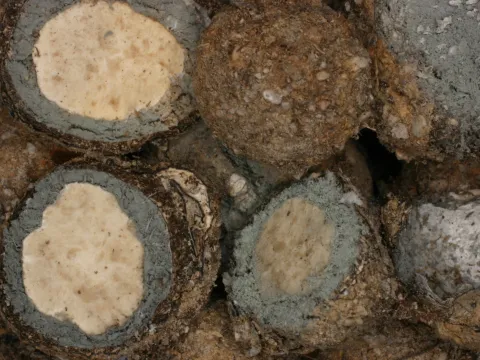
Mesophellia arenaria
Mesophellia arenaria
Mesophellia arenaria is a hypogeous basidiomycete fungus that is often misidentified as a plant disease. In reality, it is a beneficial mycorrhizal partner for various tree species, particularly in forest ecosystems.
What the section contains
Mesophellia arenaria
The fungus functions entirely beneath the soil surface. It does not infect plant tissues, nor does it cause any necrotic or pathological damage to crops or forest trees.
Biological interactions involve the formation of symbiotic relationships with roots, which assist in nutrient absorption, especially in nutrient-poor sandy soils. It relies on its host for carbohydrates.
The fungus structure consists of a firm, globose fruiting body buried in the soil. Unlike parasitic fungi, it lacks the mechanisms to penetrate or rot healthy plant stems or roots.
Therefore, Mesophellia arenaria is fundamentally a beneficial organism that contributes to soil health and tree vigor, posing zero threat to agricultural production.
The growth and development of Mesophellia arenaria are strictly dependent on the presence of compatible host tree species, often associated with Australian forest vegetation.
The species requires specific soil physical properties to thrive. Sandy, well-drained soils are essential to allow for the development of its specialized hypogeous fruiting bodies.
A unique condition for its survival is the interaction with small mammal mycophagists. These animals feed on the fungus and serve as the primary vector for spore dispersal.
Consistent soil moisture levels are crucial, as fluctuations in the water table can significantly impact the health of the subterranean mycelium and its connection to host roots.
Natural forest environments with minimal human disturbance provide the most stable conditions for the continuous colonization and reproduction of the species.
There is no evidence of harm associated with this fungus. It is completely benign and does not affect the vitality of cultivated or wild plant species.
The presence of this fungus is considered a sign of ecosystem health. Its role in the mycorrhizal network helps stabilize the soil and improves the nutrient uptake capacity of host plants.
Agricultural pest management strategies do not include this species. Treating soil for the presence of Mesophellia arenaria would be an unnecessary and potentially harmful intervention for the soil microbiome.
Farmers and foresters should view the presence of this fungus as a natural component of a functioning root-soil system rather than a symptom of plant stress.
Given its role in ecosystem maintenance, there is no economic or agronomic justification to classify this organism as a disease or harmful pest.