
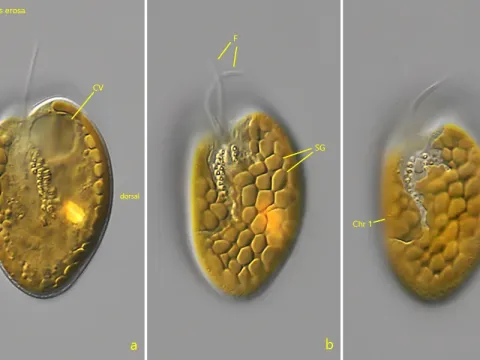
Cryptomonas erosa
Cryptomonas erosa
Cryptomonas erosa is a flagellated unicellular organism belonging to the Cryptophyta group, widely distributed in freshwater habitats globally.
What the section contains
Cryptomonas erosa
While not a traditional plant pathogen, it is a significant constituent of the phytoplankton community that affects water management in agriculture and aquaculture.
The cells are characterized by a distinct oval shape, two flagella for locomotion, and specialized chloroplasts containing specific photosynthetic pigments.
This organism exhibits mixotrophic behavior, meaning it can photosynthesize and supplement its nutrition by ingesting organic particles.
It occupies a crucial role in aquatic food webs, serving as a primary energy source for various zooplankton species in natural water bodies.
The proliferation of Cryptomonas erosa is largely dependent on the availability of nutrients such as nitrates and phosphates in the water column.
The species thrives in cool to moderate water temperatures and often exhibits peak growth during early spring or late autumn when competitors are less active.
Stable water conditions with minimal turbulence allow the cells to concentrate in favorable light zones, promoting rapid population growth.
Anthropogenic runoff from fields, rich in nutrients, significantly accelerates the growth rate of this alga in nearby irrigation ponds and reservoirs.
The presence of dissolved organic carbon enhances the survival of this species even in low-light environments, making it highly resilient.
High densities of Cryptomonas erosa cause water quality degradation, which negatively impacts the efficiency of precision irrigation systems.
During die-off events, the rapid decomposition of algal biomass significantly depletes dissolved oxygen, posing a threat to aquatic organisms.
In aquaculture environments, excessive algal blooms can stress fish populations and interfere with visual feeding behaviors.
The accumulation of these cells creates mechanical challenges for water filtration systems, leading to increased maintenance costs for farming equipment.
Algal bloom phenomena associated with this species can alter the pH balance of irrigation water, potentially affecting nutrient uptake in crops.
Effective management begins with reducing nutrient runoff from agricultural lands into water reservoirs through buffer zones and sustainable fertilization practices.
Biological control methods, such as introducing filter-feeding fish or zooplankton, can help regulate the density of phytoplankton populations.
Mechanical filtration systems, such as sand or screen filters, are essential for removing small-cell algae before the water enters irrigation networks.
Regular water testing for nutrient concentrations is a recommended preventive measure to identify potential risks of algal outbreaks early.
Minimizing water stagnation in ponds and reservoirs through aeration or circulation can inhibit the development of dense algal mats.