

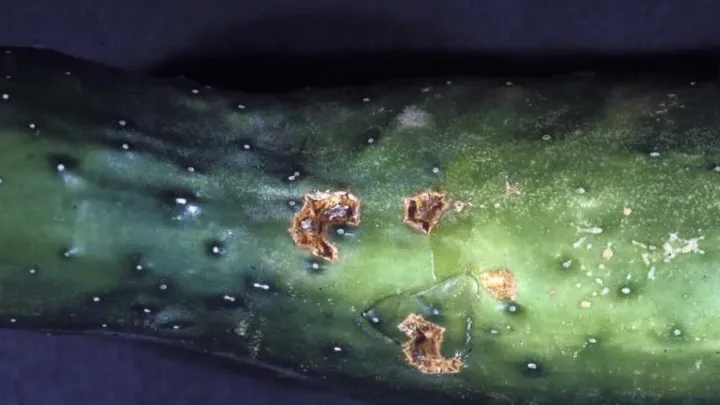
Description
Symptoms
The first symptoms of cucumber scab typically appear on leaves as small, water-soaked spots that eventually turn pale or light brown. As the infection progresses, the dead tissue often tears, resulting in a distinct shot-hole appearance.
The most alarming symptoms occur on the fruit, where small, sunken, circular lesions develop. These lesions often exude a sticky liquid, which then hardens into a dark, olive-green velvety mass of fungal spores.
As the fruit continues to grow, these infected areas stop expanding, causing the cucumber to become deformed and stunted. This physical damage renders the fruit completely unmarketable and unattractive to consumers.
Lesions can also appear on stems and petioles, which can lead to structural weakness and plant death. Under high humidity, the velvety sporulation is easily visible, serving as a clear indicator of the presence of the pathogen.
Accurate identification is crucial, as the olive-green sporulation is a unique diagnostic feature of Cladosporium cucumerinum. Growers should inspect their crops regularly, focusing on the lower foliage and younger fruit where infections often begin.
Pathogen
The causal agent of this disease is the fungus Cladosporium cucumerinum, belonging to the Ascomycota phylum. This pathogen is highly adaptable and can persist in soil, on plant debris, and on greenhouse structures for several seasons.
The fungus affects a wide range of cucurbit crops, but it is particularly destructive to cucumber plants grown in humid, enclosed environments. Its lifecycle is heavily dependent on moisture levels in the immediate environment of the plant.
Spores, known as conidia, are easily dispersed by wind, splashing water, tools, and farm workers. Once these spores land on a host plant, they require a film of moisture to germinate and initiate the infection process.
After penetration, the fungus colonizes the host tissue, causing rapid necrosis. The speed of colonization is accelerated by optimal temperatures and high humidity, which can lead to a significant outbreak within just a few days.
The pathogen produces enzymes that break down plant cell walls, leading to the characteristic spotting and eventual collapse of plant tissues. Understanding its biology is essential for implementing early detection and prevention strategies.
Conditions for development
Cucumber scab thrives in cool to moderate temperatures ranging from 15°C to 22°C combined with high relative humidity, usually exceeding 85%. Fluctuating temperatures that cause condensation on foliage are primary drivers of outbreaks.
Greenhouse environments that lack adequate ventilation are particularly susceptible to this disease. Stagnant air allows humidity to remain high, creating an ideal incubation chamber for the fungal spores to germinate and spread.
Overhead irrigation, which wets the leaves and fruit, is a major contributing factor to the rapid spread of the disease within a growing area. Keeping the canopy dry is one of the most effective ways to inhibit fungal growth.
Poor plant spacing restricts airflow between individual plants, leading to localized pockets of high humidity. This density makes it significantly harder to manage the disease once it has gained a foothold in the crop.
Plants under nutritional stress or those lacking proper micronutrients are more vulnerable to infection. A balanced fertilization program helps maintain the plant’s structural integrity and inherent defense mechanisms.
Why it matters
The economic impact of cucumber scab can be devastating, with potential yield losses reaching up to 100% if conditions remain favorable for the fungus. Infected fruit is unfit for sale, leading to total harvest failure.
Beyond the direct loss of fruit, the disease severely damages the photosynthetic capability of the plant by killing leaves. This reduction in leaf area weakens the overall plant, resulting in smaller, lower-quality yields even from uninfected fruits.
The persistence of the fungus in the soil and on greenhouse debris makes it a recurring problem for producers. Without stringent sanitation, the risk of re-infection in subsequent growing cycles remains extremely high.
Management of the disease requires intensive labor and chemical inputs, which increase the total cost of production. These expenses can significantly erode the profit margins of commercial greenhouse operations.
In cases of severe outbreaks, quarantine measures may be necessary, and entire blocks of greenhouse cucumbers might need to be destroyed to prevent further contamination of the facility.
Protection
Integrated disease management is essential for controlling cucumber scab. The most effective strategy is the use of resistant or tolerant cultivars, which are specifically bred to withstand the pressure of this pathogen.
Rigorous greenhouse sanitation, including the removal and destruction of all plant residues and disinfection of structures, is non-negotiable. Crop rotation should be strictly followed to reduce the level of inoculum in the soil.
Environmental management involves controlling humidity through proper ventilation and the use of drip irrigation. Maintaining a dry foliage environment prevents the moisture-dependent spores from germinating.
If chemical intervention is required, fungicides should be applied preventively or at the very first signs of infection. It is critical to rotate between different chemical classes to avoid the development of fungal resistance.
- Plant resistant cucumber varieties.
- Practice 3-4 year crop rotation cycles.
- Use drip irrigation to keep foliage dry.
- Ensure excellent greenhouse ventilation.
- Remove and dispose of infected plant tissues immediately.
Content graph
Connections · Cucumber scab
Most often together:
Marketplace
Products · 3
Community
Discussion
No discussions yet — be the first.