
Description
Symptoms
The most prominent symptom is the development of abnormal stem swellings and the formation of so-called witches' brooms on the affected cowberry branches.
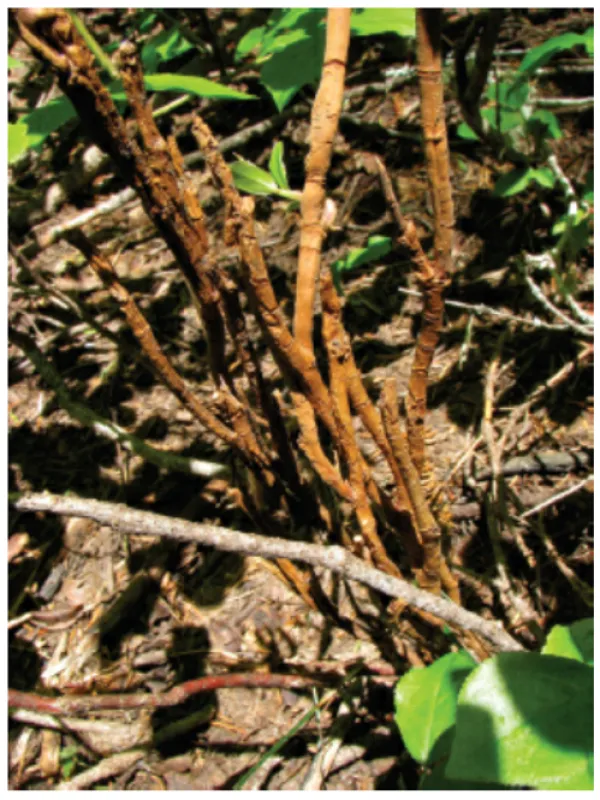
During the spore production stage, bright orange to rusty-brown pustules erupt from the bark of the infected stems, releasing a large amount of inoculum.
Leaves associated with the infected stems typically exhibit premature chlorosis, deformation, and early abscission, severely impacting the plant's metabolic health.
The disease effectively sterilizes the affected plant parts, meaning that infected stems will not produce any fruit or flowers during the growing season.
In advanced cases, the infected stems die back, leading to localized dry patches or the complete death of the affected cowberry bushes.
Pathogen
The causative agent of this disease is the fungus Calyptospora columnaris (syn. Pucciniastrum goeppertianum), a member of the rust fungi family (Basidiomycota).
This pathogen is an obligate parasite, meaning it requires a living host to survive and complete its complex life cycle, which often involves an alternate host.
The fungus is well-adapted to survive within the perennial tissues of its host plant, where it maintains its mycelium throughout the dormant winter season.
During the reproductive phase, the pathogen produces characteristic telia, which appear as column-like structures bursting through the epidermis of the host stem.
Dispersal of the spores occurs primarily through wind currents, allowing the infection to spread rapidly throughout dense berry patches and adjacent areas.
Conditions for development
High relative humidity and consistent moisture on the plant surfaces are the primary environmental drivers for spore germination and successful host penetration.
The fungus thrives in cool to moderate temperature ranges, which are typical for the boreal and temperate forest habitats where cowberries naturally grow.
Proximity to fir trees (the alternate host for this fungus) is a major risk factor, as it facilitates the completion of the pathogen's complex life cycle.
Poor air circulation within dense, unmanaged plantings creates a microclimate with stagnant humidity that significantly favors the spread of the disease.
Frequent rainfall or heavy dew periods provide the necessary water films required for the basidiospores to infect the tender tissues of the host plants.
Why it matters
The primary impact of cowberry rust is a significant reduction in fruit yield, as the disease renders infected plant parts unproductive and physiologically stressed.
Chronic infection weakens the entire plant, making it more susceptible to other pathogens, extreme cold, and drought, leading to long-term decline.
In commercial berry production, the spread of this rust can destroy the profitability of a crop and necessitate the expensive removal of infected plant material.
The pathogen depletes the energy reserves of the rhizome system, eventually causing the plant to lose its ability to regenerate after the growing season.
Widespread outbreaks can severely degrade the ecosystem value of wild cowberry populations, leading to lower biodiversity and decreased berry availability.
Protection
The most effective strategy is the spatial separation of cowberry patches from fir tree populations, which serves to break the pathogen's life cycle.
Early identification and rigorous sanitation, including the pruning and immediate destruction of infected stems, are essential for limiting the spread of spores.
Fungicidal applications, particularly those utilizing copper-based or systemic compounds, can help manage infection levels when applied at the right timing.
Promoting good agricultural practices such as adequate spacing between bushes helps increase air circulation and reduces the humidity around the plants.
- Sanitary pruning of symptomatic stems
- Avoidance of proximity to fir tree species
- Routine field monitoring for early detection
- Application of systemic fungicides
- Maintenance of optimal planting density
Pathogens and affected parts
Affects crops · 1
Discussion
No discussions yet — be the first.