
Description
Symptoms
The primary symptom involves the appearance of chlorotic (yellowish) spots on the upper surface of the leaves. As the disease progresses, corresponding white, raised, blister-like pustules develop on the underside of the leaves.
These pustules eventually rupture the epidermis, releasing a mass of white powdery spores. These spores can easily be dispersed by wind and rain to neighboring healthy plants.
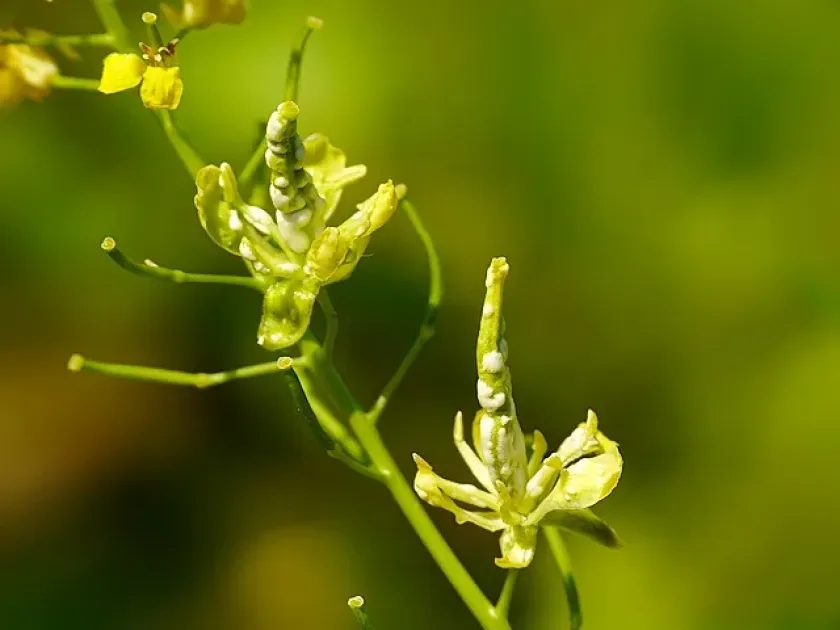
Systemic infections represent the most severe form of the disease. They lead to significant tissue hypertrophy (abnormal growth), causing stems, flowering shoots, and pods to become thickened, twisted, and distorted.
Radish crops often exhibit swelling on petioles and taproots. This damage not only degrades the physical quality of the radish but also makes the plant prone to secondary infection and rot.
Severe infestations cause early leaf senescence, yellowing, and drying, which drastically reduces the photosynthetic capacity of the plant and hinders normal seed and root development.
Pathogen
The causative agent of the disease is the oomycete Albugo candida. Despite its name and appearance, it is not a true fungus but a member of the Oomycota phylum, which are fungus-like organisms related to algae.
The pathogen is an obligate parasite, meaning it requires living host tissue to complete its life cycle. It reproduces by forming sporangia that release motile zoospores in the presence of free water on the plant surface.
Survival is achieved through the formation of thick-walled oospores, which are highly resistant structures. These spores remain viable in soil and plant debris for several years, waiting for favorable conditions to germinate.
The pathogen has a broad host range within the Brassicaceae family, including economically important crops such as winter oilseed rape, radish, cabbage, and mustard, as well as various cruciferous weeds.
Understanding the biology of Albugo candida is critical because its zoospores can move through water films, allowing the pathogen to spread rapidly within a field during rainy periods or heavy irrigation.
Conditions for development
The development of White rust is highly dependent on humidity. A high level of surface moisture, such as dew, fog, or frequent rainfall, is essential for the germination of sporangia and the movement of zoospores.
Temperatures between 10°C and 20°C (50°F–68°F) are optimal for the pathogen. In these ranges, the disease cycle can repeat quickly, leading to rapid spread throughout the crop canopy.
Poor field management, such as high plant density and lack of proper aeration, contributes to an increase in microclimate humidity, creating perfect conditions for the pathogen to thrive.
Areas with poor drainage are particularly vulnerable. Standing water or persistently wet soil creates a reservoir for zoospore movement, significantly increasing the infection rate in affected fields.
Warmer temperatures above 25°C typically slow down the progress of the disease, though they do not eliminate the infection, as the oospores remain dormant in the soil until cooler, wetter conditions return.
Why it matters
The economic impact is primarily driven by yield loss. In oilseed rape, severe systemic infection can lead to complete loss of reproductive structures and failure of pod filling, resulting in sparse, low-quality harvests.
For root crops like radish, the disease renders the product unmarketable. The presence of swellings and potential secondary rotting makes the crop unsuitable for consumption or commercial sale.
The reduction in photosynthetic area weakens the overall vigor of the plant, making it more susceptible to other abiotic stresses and secondary bacterial or fungal pathogens that exploit the damaged tissues.
Increased expenditure on fungicides is a major financial burden for farmers, especially in seasons with high disease pressure, which lowers the profit margins of vegetable and oilseed production.
If the infection occurs during early plant growth, it can severely stunt development, leading to uneven stands and potentially necessitating the replanting of the entire affected area.
Protection
Crop rotation is the most effective cultural practice. Growing non-cruciferous crops for at least three to four years helps to reduce the inoculum level of oospores in the soil.
Sanitation practices, including the deep plowing of crop residues and the systematic control of cruciferous weeds like shepherd's purse, are essential for breaking the survival cycle of the pathogen.
Using healthy, certified seeds treated with effective fungicides can provide a critical protective window for seedlings, preventing early-season establishment of the disease.
Fungicide application using appropriate active ingredients is recommended if initial signs of infection appear, particularly under weather conditions favorable for the disease spread.
Breeding and utilizing resistant cultivars is the gold standard for disease management. Selecting varieties with high genetic resistance provides a sustainable solution that reduces dependency on chemical sprays.
Pathogens and affected parts
Affects crops · 2
Discussion
No discussions yet — be the first.