
White leaf spot of oilseed rape
Pseudocercosporella capsellae
Description
Symptoms
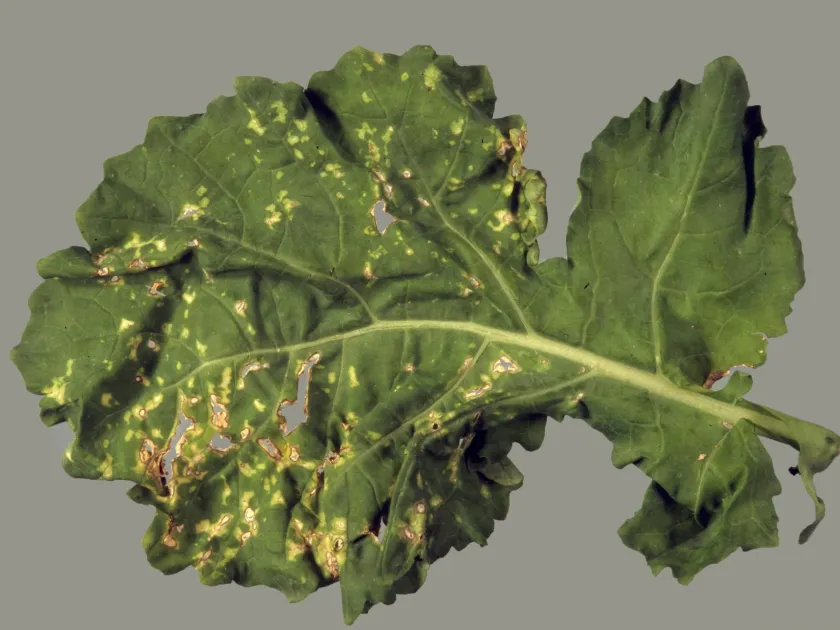
Initial symptoms appear on the lower leaves as circular, grayish-white spots surrounded by a dark margin. As the disease progresses, these spots expand and coalesce, covering large parts of the leaf area.
On stems and petioles, the lesions appear as elongated gray streaks. In cases of severe infection, stems become brittle and may snap under wind pressure or heavy moisture.
Under high humidity, a fine olive-gray mold—representing the conidial sporulation of the fungus—develops on the underside of the leaves within the affected spots.
As the infection advances, the tissue within the lesions may crack, leading to premature yellowing and leaf senescence, which significantly reduces the plant's photosynthetic capacity.
- Yellowing of lower foliage
- Whitish spots with dark borders on leaves
- Gray lesions on stems and stalks
- Premature leaf drop
- Stunted growth and plant weakening
Pathogen
The causative agent of the disease is the imperfect fungus Pseudocercosporella capsellae, belonging to the Hyphomycetes class. The pathogen survives in the soil and on crop residues as mycelium and conidia.
This microorganism primarily affects plants of the Brassicaceae family. Major hosts include oilseed rape (winter and spring), radish, mustard, cabbage, and various cruciferous weeds found in fields.
The fungus's life cycle involves the formation of conidia, which are dispersed by wind or rain splashes onto healthy plant tissues. Throughout the growing season, the pathogen produces multiple generations of infectious material.
The fungus can persist as a saprotroph on dead tissues for extended periods, waiting for favorable conditions to initiate infection. It can attack plants at any growth stage, from seedlings to flowering.
While infection can occasionally be transmitted via contaminated seeds, the primary reservoir for the pathogen remains the soil and plant debris left in the field after harvest.
Conditions for development
The development of Pseudocercosporella capsellae is favored by moderately cool temperatures and high humidity. The optimal temperature range for active mycelial growth is between 15 and 20 degrees Celsius.
Prolonged rain and misty conditions create an ideal environment for conidial spread. Water droplets serve as the primary vehicle for moving spores from diseased tissue to healthy leaves.
Poor agricultural practices, such as high planting density, restrict airflow within the canopy, leading to moisture accumulation in the lower zones, which triggers rapid disease outbreaks.
The lack of crop rotation is a critical factor. Planting cruciferous crops in the same field earlier than every three to four years causes a massive build-up of the pathogen in the soil.
Plants that are already weakened by nutrient deficiencies or pest damage are more susceptible to infection and exhibit more severe disease symptoms than healthy, well-nourished plants.
Why it matters
The disease causes a significant reduction in the photosynthetic leaf area, which directly impacts seed yield and quality. In severe epidemic years, crop losses can reach 15–25 percent.
Damage to stems impairs nutrient transport, leading to uneven pod development. The resulting seeds are often shriveled, poorly developed, and show a reduced oil content, lowering commercial value.
In radish cultivation, the disease spoils the aesthetic quality of the product, making roots and leaves unsuitable for the fresh market or requiring significant post-harvest culling.
Infected plants become more vulnerable to secondary infections, further weakening the crop and increasing the overall phytosanitary burden on the field.
The economic impact involves both direct yield loss and increased production costs due to the necessity of applying fungicides and potential management failures if the disease is not controlled early.
Protection
The foundation of effective management is a strict crop rotation schedule with at least 3–4 years between cruciferous crops. Spatial isolation of new fields from previous sites is highly recommended.
Deep plowing in the autumn helps bury crop residues, accelerating their decomposition and reducing the survival rate of the pathogen in the soil layer.
Using certified, high-quality seeds treated with appropriate fungicides is essential to prevent the introduction of the pathogen into the field at the start of the season.
Systemic fungicides should be applied at the first sign of symptoms. Preventive or early-stage applications are significantly more effective than curative measures after the disease has established.
Maintaining clean fields by removing cruciferous weeds (like shepherd's purse or field pennycress) is crucial, as these plants act as off-season reservoirs for the fungus.
Pathogens and affected parts
Affects crops · 2
Discussion
No discussions yet — be the first.