

Description
Symptoms
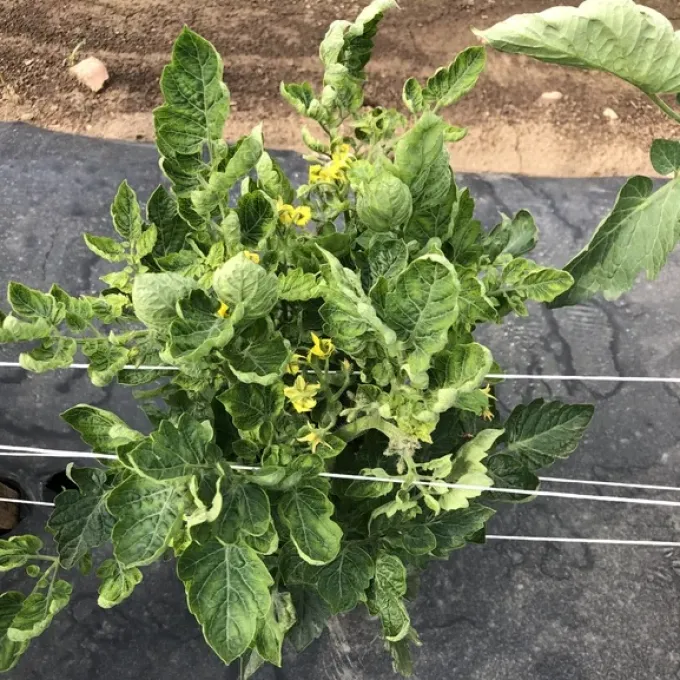
The first symptoms appear on the newest leaves, which show signs of yellowing along the leaf margins and crinkling.
Infected leaflets become smaller than normal, cupped upwards, and often develop a thick, leathery texture as the disease progresses.
Stunted growth is a hallmark of TYLCV, as infected plants remain significantly smaller and exhibit a bushy appearance.
Flower abscission is very common, often leading to a complete failure of fruit set and severe loss of yield.
- Upward curling of leaflets
- Chlorotic leaf margins
- Reduced plant size (stunting)
- Severe flower drop
- Bushy, stunted growth habit
Pathogen
The disease is caused by the Tomato yellow leaf curl virus (TYLCV), which belongs to the genus Begomovirus within the Geminiviridae family.
TYLCV is a DNA virus that predominantly infects tomato plants, but can also affect peppers, beans, and various weed species.
The virus is exclusively transmitted by the silverleaf whitefly (Bemisia tabaci) in a persistent, circulative, and non-propagative manner.
Once the whitefly acquires the virus by feeding on infected plants, it retains the ability to transmit the disease for its entire lifespan.
The virus is not transmitted through seeds or simple mechanical contact between plants, making insect control the primary focus of prevention.
Conditions for development
The spread of the virus is strictly tied to the life cycle and movement patterns of the whitefly population in the area.
Warmer temperatures and dry conditions facilitate faster whitefly reproduction, leading to explosive outbreaks of the virus.
Reservoir hosts, such as common weeds, allow the virus to persist during periods when tomato crops are not being grown.
In greenhouse settings, inadequate screening of vents allows whiteflies to enter and initiate localized infections that spread quickly.
Early season plantings are at the highest risk, especially if whiteflies migrate from neighboring fields or wild host patches.
Why it matters
Tomato yellow leaf curl is considered one of the most economically damaging tomato diseases worldwide, particularly in tropical and subtropical regions.
When infection occurs early in the growing season, yield losses can reach 100 percent due to the cessation of plant development.
Even moderate infection reduces fruit size, quality, and marketability, resulting in significant financial losses for commercial growers.
The ongoing threat of TYLCV necessitates constant vigilance and expensive pest control programs throughout the production cycle.
The presence of the virus significantly limits the selection of varieties and complicates management in regions with high whitefly pressure.
Protection
Integrated Pest Management (IPM) is essential, focusing primarily on the exclusion and control of the whitefly vector.
The use of insect-proof netting on greenhouse structures is the most effective physical barrier against whitefly entry.
Systemic insecticides should be applied as part of a rotation program to suppress whitefly populations during the vulnerable seedling stage.
Sanitation practices, including the removal of weeds that serve as alternate hosts, are critical to reducing the inoculum source.
Breeding and planting TYLCV-resistant tomato hybrids provide the most sustainable long-term solution for maintaining viable crop yields.
Content graph
Connections · Tomato yellow leaf curl
Most often together:
Marketplace
Products · 1
Community
Discussion
No discussions yet — be the first.