
Corynespora leaf spot
Corynespora cassiicola
Description
Symptoms
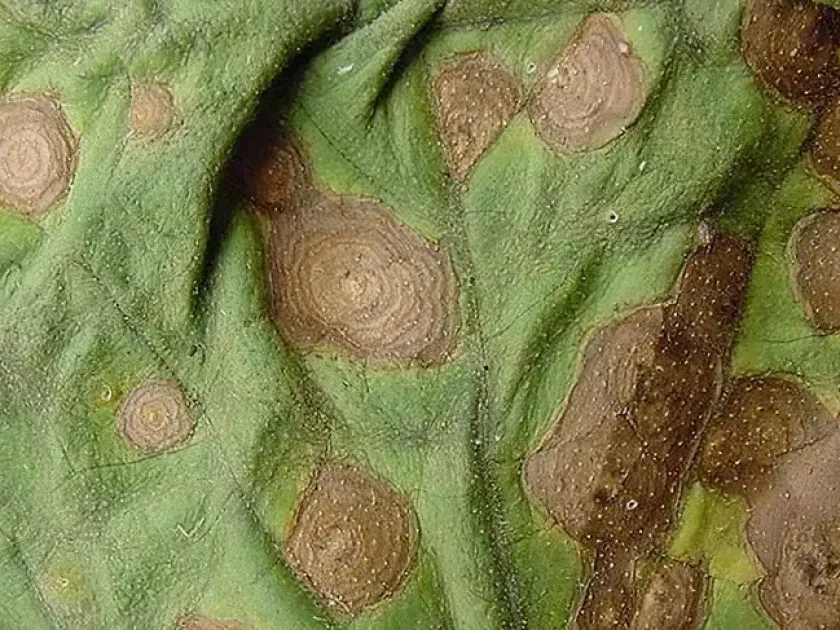
The initial symptoms typically appear as small, reddish-brown to dark brown spots on the foliage. As the spots enlarge, they often develop a distinct concentric ring pattern or a chlorotic halo.
Under favorable environmental conditions, the centers of the lesions may turn gray or light brown and become brittle. Sporulation often appears as a fine, dark, velvety coating on the underside of the leaves.
In addition to foliage, stems and petioles can show elongated, dark necrotic lesions, which can eventually lead to stem girdling and plant death. Fruit lesions on watermelons often appear as sunken, dark-colored pits.
Severe infections result in premature defoliation, which exposes the remaining fruit to sunscald and reduces overall plant vigor. The disease often progresses from the lower leaves to the upper canopy.
Visual identification can be challenging as the symptoms may resemble those of other leaf spots, such as target spot or Cercospora. Laboratory analysis is often required for definitive diagnosis.
Pathogen
The causal agent of the disease is the fungus Corynespora cassiicola, an ascomycete fungus known for its exceptionally wide host range. It is capable of infecting over 500 plant species worldwide.
The fungus produces a phytotoxin called cassiicolin, which facilitates tissue necrosis and allows the pathogen to colonize plant tissues rapidly. It survives as mycelium or chlamydospores in soil and debris.
Conidia are produced on infected tissue and are primarily disseminated by wind-blown rain and splashing water. The fungus thrives in high-humidity conditions, which are essential for sporulation.
Corynespora cassiicola exhibits significant genetic diversity, leading to the development of various physiological races. This variability often allows the pathogen to overcome host resistance genes.
The pathogen is particularly devastating to legumes like soybeans and clover, as well as cucurbits like watermelon. Managing its lifecycle is difficult due to its ability to persist in diverse environments.
Conditions for development
Warm temperatures, specifically between 25°C and 30°C (77-86°F), provide the optimal environment for the growth and reproduction of Corynespora cassiicola.
High relative humidity and prolonged leaf wetness are critical for infection. Rainfall patterns and frequent irrigation cycles significantly influence the rate of disease spread in fields.
Densely planted crops create a microclimate with reduced airflow and increased humidity, which serves as a prime environment for the disease to flourish. Lack of canopy aeration accelerates the epidemic.
Plants under physiological stress, such as drought, nutrient deficiency, or prior damage from insects or other diseases, are significantly more susceptible to infection.
Crop residue management plays a vital role in disease dynamics, as the pathogen persists well in buried or surface-level plant matter, serving as the primary inoculum for the next season.
Why it matters
The primary economic impact of Corynespora leaf spot is the reduction of the photosynthetic surface area, leading to severe yield loss. In soybeans, this manifests as reduced seed size and overall lower yield.
In watermelon production, the disease affects both the quantity and the aesthetic quality of the fruit. Infected fruit may exhibit storage rot, significantly reducing marketability and shelf life.
For forage crops like red clover, the disease reduces the nutritional value and palatability of the hay or pasture, leading to losses in livestock productivity.
Secondary infections by saprophytic fungi are common in necrotic tissues caused by Corynespora, further accelerating the decomposition of the plant structure.
During severe epidemics, if left untreated, the disease can cause total crop failure, leading to substantial financial strain on agricultural enterprises.
Protection
Effective management begins with strict crop rotation, excluding susceptible hosts for at least 3 years. Burying crop debris promptly after harvest is crucial to reduce the primary inoculum load.
The use of high-quality, certified seed is essential to prevent the introduction of the pathogen into clean fields. Seed treatment with appropriate fungicides can help suppress early-stage infections.
Fungicide applications, particularly those utilizing systemic chemistry, are necessary during high-risk periods. It is critical to rotate fungicide modes of action to manage potential resistance.
Selecting tolerant or resistant varieties is the most sustainable approach to managing the disease. Farmers should consult regional extension services for current variety recommendations.
- Maintain proper field sanitation by removing diseased debris.
- Use wider plant spacing to improve airflow in the canopy.
- Monitor crops frequently to ensure timely application of control measures.
Pathogens and affected parts
Affects crops · 3
Discussion
No discussions yet — be the first.