
Description
Symptoms
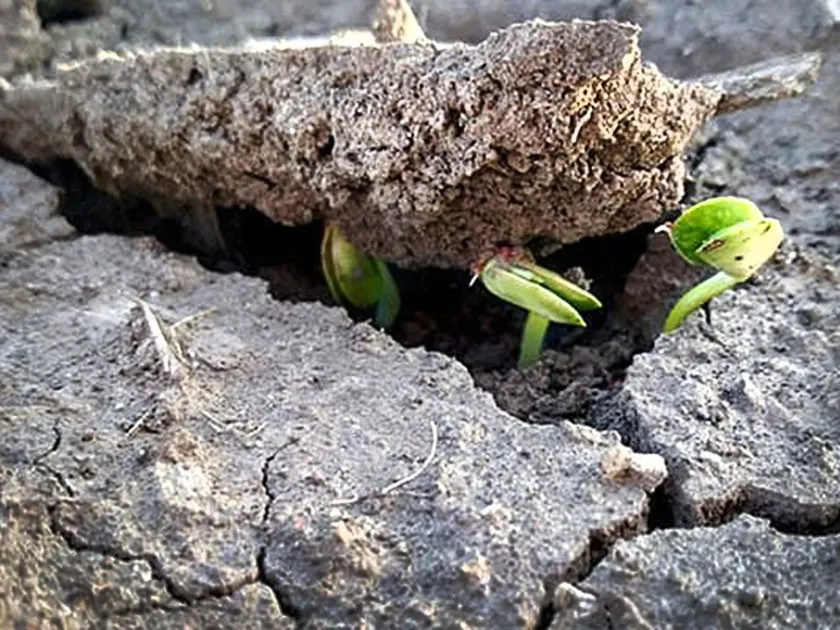
The primary symptom is the formation of a hard, dense, and often cracked layer on the soil surface following heavy rainfall and subsequent rapid drying.
Visually, emergence is severely delayed; seedlings appear stuck beneath the surface, showing thickening or bending of the coleoptile due to mechanical resistance.
Seedlings that do manage to break through often exhibit signs of stress, such as stunted growth, yellowish discoloration, or structural deformities.
Uneven crop stands are a hallmark of this condition, with large patches of missing plants where the crust proved too thick for the germinating seeds.
The soil surface acquires a baked, impermeable appearance, preventing air exchange and moisture penetration, which further stresses the young root systems.
Pathogen
Soil crusting is not a biological disease caused by a pathogen, but a physical-mechanical condition caused by the dispersion and collapse of soil aggregates.
The process is triggered when rain impact disperses soil particles, which then settle and cement into a solid layer as the moisture evaporates rapidly.
Soils with low organic matter content and a high percentage of silt or fine sand are inherently more prone to dispersion and structural collapse.
The lack of biological binding agents, such as fungal hyphae or bacterial mucilage, contributes to the inability of the soil to maintain a stable, porous structure.
Essentially, the condition is a failure of soil stability that prevents the natural upward movement of the emerging coleoptile toward light.
Conditions for development
Crusting most frequently occurs when heavy, high-intensity rainfall is immediately followed by high temperatures, direct sunlight, and strong drying winds.
Young crops, including corn, are most vulnerable during the critical phase between germination and the emergence of the first two true leaves.
Heavy clay or silt-loam soils are at the highest risk due to their smaller particle size and tendency to form dense, impermeable surface layers.
Deep planting depths can exacerbate the impact of crusting, as the energy reserves in the seed are depleted before the seedling can push through the surface.
Conventional intensive tillage practices that destroy soil structure and leave the surface bare increase the likelihood of severe crust formation after storms.
Why it matters
The main threat is a significant reduction in plant population density, which often leads to reduced potential yields and necessitates costly replanting efforts.
Seedlings that spend excessive energy overcoming the physical barrier often remain weaker throughout their life cycle, showing reduced vigor and stress tolerance.
In corn, severe crusting can result in the coleoptile twisting or splitting underground, leading to the death of the growing point and total plant loss.
The uneven emergence caused by crusting complicates subsequent weed control and nutrient management, as plants are at different developmental stages.
Economic losses arise not only from reduced final yield but also from the increased input costs and management time required to correct the poor stand.
Protection
Light rotary hoeing is the most effective mechanical intervention to break the crust and allow seedlings to emerge without damaging their delicate structures.
Improving soil structure through the addition of organic matter or compost helps increase the water-stable aggregate count, reducing the risk of crusting.
Maintaining soil cover through no-till or reduced tillage practices significantly mitigates the impact of raindrop energy on the soil surface.
Careful calibration of planting depth ensures that seedlings have sufficient vigor to emerge while remaining protected from early-season drought stress.
- Use of cover crops to improve soil stability.
- Avoidance of tillage when soil is excessively wet.
- Monitoring weather forecasts to anticipate crust formation.
- Selection of seed varieties with high seedling vigor.
Pathogens and affected parts
Affects crops · 1
Discussion
No discussions yet — be the first.