
Description
Symptoms
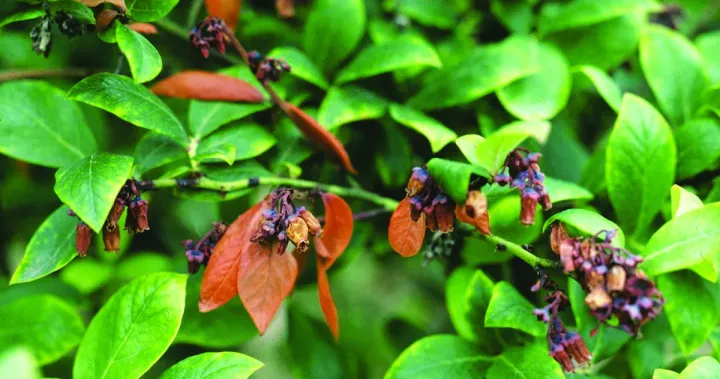
The primary symptom of the disease is the sudden wilting and death of flowers and young leaves during the bloom period. Affected areas turn brown or nearly black, resembling a scorch, which gives the disease its name.
In the early stages, leaves at the tips of shoots may curl and yellow before necrosis sets in. It is common to see the dieback of branch tips, which may remain hanging on the bush for some time.
In subsequent years, bushes infected with the virus exhibit general growth suppression, and their overall size is significantly reduced compared to healthy plants. A serious decrease in the number of developing flower buds is also observed.
The symptoms are most prominent at the beginning of the growing season when the plant actively consumes nutrients for flowering. By mid-summer, symptoms may partially subside, but the plant remains infected.
It is important to note that many blueberry cultivars can be asymptomatic carriers of the virus, showing no visible signs, which complicates diagnosis in large plantations.
Pathogen
The pathogen is the Blueberry scorch virus (BlScV), which belongs to the genus Carlavirus. This is a phytopathogenic virus that infects members of the Ericaceae family.
In addition to blueberries, this pathogen poses a serious threat to commercial cranberry plantings, causing similar destructive processes in the plant's tissues.
The virus is primarily transmitted by insect vectors, specifically various species of aphids that feed on the sap of infected plants and transfer viral particles to healthy ones.
The spread of the virus also occurs through the use of infected propagation material taken from cuttings of diseased mother bushes, making nursery certification critically important.
Genetic analysis reveals the presence of different viral strains, which may vary in their aggressiveness and the range of cultivars they infect, complicating the breeding of resistant plants.
Conditions for development
The development of the infection is favored by warm spring weather, which coincides with the period of active aphid migration, the main vectors for transmitting the virus between bushes.
A favorable condition for the rapid spread of the disease is high plant density, where insects can easily move from one bush to another.
Improper agronomic management, which contributes to weakening the plants' immunity, makes them more susceptible to viral invasion and the development of visible symptoms.
The presence of weeds or wild members of the Ericaceae family near plantations can serve as a reservoir for the virus, from which it spreads to cultivated crops.
A temperature range of 15–25 degrees Celsius is considered optimal for the active reproduction of insect vectors, which correlates with peak periods of disease expression.
Why it matters
The main danger lies in the progressive decrease in yield: infected bushes produce significantly fewer berries, and their quality also drops substantially.
The virus leads to chronic exhaustion of the plant, which eventually results in the total death of the bush within a few years after infection.
Economic losses are linked to the need to remove and destroy entire sections of the plantation, as there are no direct treatments for viral plant diseases.
The disruption of photosynthesis due to leaf damage leads to a decrease in fruit bud formation for the following year, creating a cycle of gradual productivity decline.
The infection spreads easily across the site, posing a risk of losing the entire commercial value of the crop over several seasons if left unmonitored.
Protection
A key measure is the use of certified, virus-tested planting material when establishing new plantations.
Regular monitoring of bush condition is necessary, as is the prompt removal (uprooting) of all plants showing signs of scorch, followed by immediate destruction by burning.
Control of aphid populations using authorized insecticides is an mandatory procedure to prevent virus transmission to healthy plants during peak activity periods.
It is important to maintain plantation hygiene by timely removal of weeds, which may serve as intermediate hosts for the vectors of the infection.
- Regular disinfection of pruning tools after working with each bush.
- Establishing spatial isolation between old and new plantings.
- Planting only virus-resistant cultivars, if registered in the region.
Pathogens and affected parts
Affects crops · 1
Discussion
No discussions yet — be the first.