
Description
Symptoms
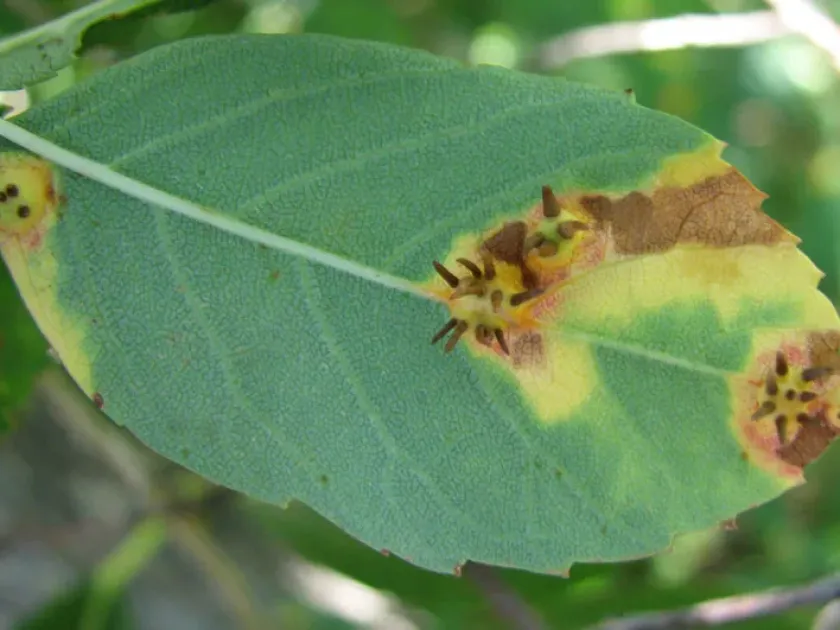
Early symptoms appear in late spring or early summer as bright yellow or orange spots on the upper surface of the pear leaves, often surrounded by a reddish halo.
As the infection progresses, the spots expand and turn dark red or brownish, with small black dots known as spermogonia appearing within the lesions.
On the undersides of the infected leaves, the fungus forms raised, cone-shaped structures called aecia, which release orange powdery spores into the air.
In severe cases, the fungus also attacks young twigs, petioles, and even the fruit, causing tissue deformity, cracking, and early fruit drop.
- Bright orange spots on the upper leaf surface.
- Cone-like protrusions on the lower leaf surface.
- Deformed leaves and shoots.
- Premature defoliation during the growing season.
Pathogen
The causal agent of this disease is a heteroecious rust fungus, Gymnosporangium nelsonii, which requires two different hosts to complete its complex life cycle: pear trees and juniper species.
The fungus overwinters as mycelium in the tissues of juniper branches, causing gall-like swellings. In early spring, during wet weather, these galls produce teliospores that spread to pear trees via wind.
The infection cycle is continuous: after infecting pear leaves, the fungus develops aecia that produce spores capable of re-infecting juniper hosts later in the season.
As a biotrophic parasite, it derives its nutrition directly from the host plant's living cells, which leads to metabolic stress and a reduction in the plant's overall vigor.
The ability of spores to travel over long distances means that infected juniper plants in the surrounding landscape can jeopardize an entire orchard, even if they are not in the immediate vicinity.
Conditions for development
The development of pear rust is strongly correlated with the presence of infected junipers nearby, which serve as the primary inoculum source every spring.
Warm and rainy weather in late spring is the most critical period, as moisture is essential for the germination of teliospores and their subsequent infection of pear leaves.
Poor orchard sanitation, such as failing to remove infected plant debris or ignoring symptomatic juniper hosts, contributes to a high annual disease pressure.
High humidity and poor air circulation within the canopy of the pear trees create an environment that significantly favors the establishment and spread of the fungus.
Trees that are already stressed or suffering from poor nutrition are typically more susceptible to severe outbreaks compared to well-maintained, healthy specimens.
Why it matters
Pear rust causes significant economic damage by reducing the photosynthetic capacity of the tree, which directly impacts fruit size and quality.
Premature leaf drop weakens the tree, preventing it from storing sufficient carbohydrates for the following year, which leads to a decrease in cold hardiness.
Fruit affected by the fungus is often deformed and unsightly, rendering it unmarketable for fresh consumption and reducing its overall value.
Chronic annual infections can lead to the dieback of shoots and branches, eventually resulting in the decline and potential death of the tree if left untreated.
Orchards with high levels of rust infection require increased management costs, including frequent fungicide applications and extra labor for pruning and removal.
Protection
The most effective strategy is spatial isolation by removing juniper trees from the proximity of the orchard, ideally maintaining a distance of at least 500 meters.
Sanitation is crucial: regularly prune and burn any infected branches or twigs from both pear trees and local junipers to reduce the amount of inoculum.
Implement a fungicide spray program, starting before or during the bloom period, to protect new foliage from the initial spore showers from junipers.
Copper-based sprays applied during the dormant season or early spring can help reduce the spore load on the bark of susceptible trees.
Select resistant pear varieties when establishing new orchards to reduce long-term reliance on chemical treatments and improve the sustainability of the crop.
Pathogens and affected parts
Affects crops · 1
Discussion
No discussions yet — be the first.