

Description
Symptoms
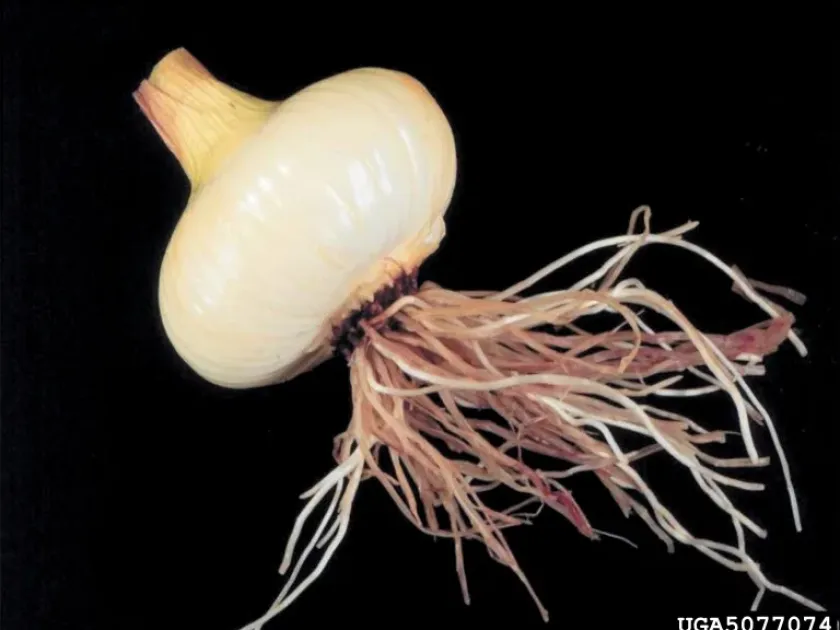
The first visual sign of infection is a change in root color: initially, they turn a light pink, which progresses to an intense pink, and eventually to a dark brown or purplish color as the roots begin to decay.
Infected roots quickly lose turgor, become brittle, and die, causing the plant to be easily pulled from the soil with minimal effort. Externally, the root system appears stunted, and the primary roots fail to perform their vital function of absorbing water and nutrients.
The above-ground parts of the plant exhibit classic drought stress symptoms even when irrigation is sufficient: leaf tips turn yellow, leaves curl and gradually wither, leading to a significant loss of photosynthetic surface area.
Bulb crops show retarded growth, and in cases of severe infection, plants stop growing entirely and may die in early vegetative stages. If the disease attacks a plant that has already formed a bulb, the size remains significantly smaller than normal, reducing marketability.
When examining the root system under a microscope or magnifying glass, one can often see small black fungal fruiting bodies (pycnidia) forming on the decaying root tissues under high humidity conditions.
Pathogen
The disease is caused by the soil-borne fungus Setophoma terrestris (formerly classified as Pyrenochaeta terrestris). This microorganism can persist in the soil for long periods as sclerotia or mycelium, waiting for favorable conditions to infect host plants.
The pathogen affects a wide range of plants but causes the most significant economic damage to members of the Amaryllidaceae family, particularly bulb onions, shallots, garlic, and leeks. Cases of root infection have also been reported in cucurbits, including watermelons, making this fungus a dangerous polyphagous organism.
In the soil, the fungus can survive on crop residues for many years, making it highly resilient when crop rotation is neglected. The infection spreads through infested soil, irrigation water, and infected planting material, entering plant tissues through microscopic wounds in the root system.
The fungus thrives in soil environments where it competes with beneficial soil microflora. Intensive accumulation of the inoculum occurs when susceptible crops are grown repeatedly on the same land over several seasons.
The biology of the pathogen is closely tied to soil temperature, which determines the dynamics of disease outbreaks in the field. Understanding the life cycle of Setophoma terrestris is crucial for planning effective preventive measures in vegetable production.
Conditions for development
Optimal conditions for the active development of pink root occur at high soil temperatures, typically between +24°C and +28°C. This is why disease outbreaks are most commonly recorded during hot summer months.
The disease progresses more rapidly in fields with poor aeration and compacted soil, where gas exchange is hindered and temporary waterlogging occurs. Under these conditions, the root system experiences stress, facilitating the entry of fungal spores into the tissues.
Extreme soil pH levels, whether too acidic or too alkaline, can indirectly promote pathogen development by weakening the natural defenses of the host plants. Maintaining a balanced soil pH is optimal for limiting the disease.
Deficiencies in essential nutrients, especially phosphorus and potassium, make plants more vulnerable to Setophoma terrestris. A well-managed mineral fertilization program allows the plant to withstand the infection pressure for longer periods.
Frequent and heavy irrigation, performed without considering soil drainage, creates a microclimate favorable for spore germination, making water management a critical aspect of disease prevention.
Why it matters
The primary danger lies in the substantial reduction of the root system volume, which leads to a critical nutrient deficiency. Plants become unable to develop properly even when all necessary fertilizers are available.
Infection leads to a sharp decline in harvest quality: bulbs become undersized, lose flavor, and store poorly during the winter, as weakened plants are more susceptible to secondary storage rots.
In cases of widespread field infection, marketable yield can decrease by 30–60%, resulting in severe economic losses for vegetable producers specializing in onions and garlic.
The disease is difficult to treat once symptoms become visible on the above-ground parts, which is why the main focus in protection remains on preventive measures rather than curative treatments.
The presence of the pathogen in the soil limits crop rotation options, as the fungus possesses high persistence, forcing farmers to exclude susceptible crops from the field for 5–7 years.
Protection
Strict crop rotation is the primary management method: it is recommended to return onion crops to the same land no sooner than every 6–8 years. Cereal crops, which are not susceptible to the infection, are better choices as precursors.
It is important to select onion hybrids and varieties that are resistant to pink root. Breeding programs allow the selection of genetically protected material that demonstrates stable yields even in infested fields.
Using healthy planting material and high-quality sets free from fungal spores significantly reduces the risk of infection. If necessary, pre-planting disinfection of seeds or sets with specific fungicides should be conducted.
Ensuring optimal growing conditions, such as proper drainage, soil aeration through cultivation, and balanced fertilization, helps the plant form a robust root system capable of resisting the pathogen.
- Application of organic fertilizers to stimulate beneficial soil microflora.
- Management of irrigation to prevent soil waterlogging and overheating.
- Use of fungicides to treat soil before planting in infection hotspots.
- Timely removal of plant debris from the field to prevent spore accumulation.
In brief
3
Affects crops
Biology
Pathogens and affected parts
Content graph
Affects crops · 3
Content graph
Connections · Pink root
Most often together:
Marketplace
Products · 1
Community
Discussion
No discussions yet — be the first.