
Tar spot of maple
Rhytisma acerinum
Description
Symptoms
The initial symptoms manifest in mid-summer as small, pale yellow chlorotic spots on the upper leaf surface. These spots serve as the early points of fungal colonization.
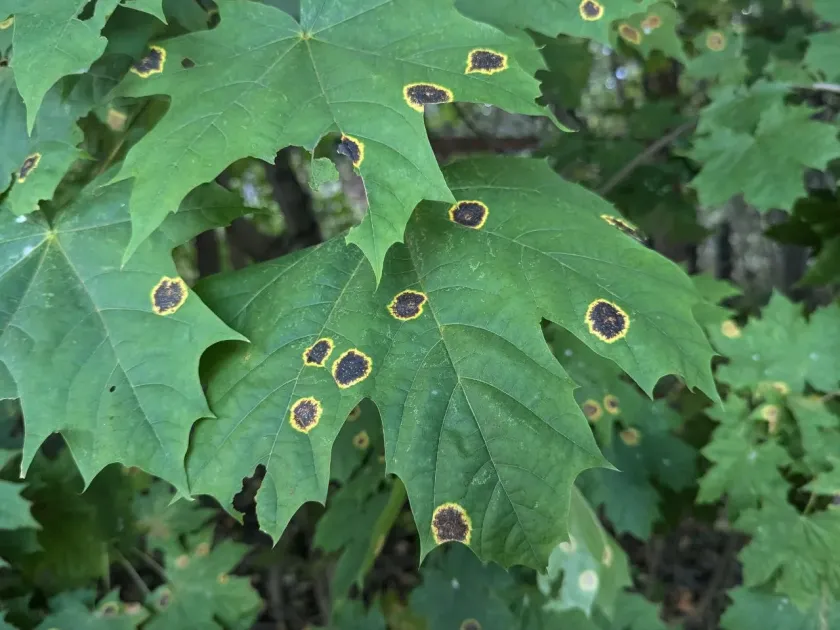
As the season progresses, these spots expand and develop characteristic glossy, black, raised structures. They resemble drops of black tar or paint splatters on the leaf blade.
The black areas are often surrounded by a bright yellow halo, which makes them highly visible against the green background of the healthy leaf tissue.
The symptoms are usually visible on the upper side of the leaves, while the underside may show slight discoloration. In cases of severe infection, leaves can become curled or deformed.
In autumn, infected leaves may drop earlier than healthy ones, or the black spots remain prominent on the foliage even after it has fallen to the ground.
Pathogen
The causal agent of this disease is the ascomycete fungus Rhytisma acerinum. It is a highly host-specific pathogen that primarily affects the foliage of various maple species.
The fungus survives the winter season in fallen, infected leaves. During the following spring, fruiting bodies known as apothecia develop on these decaying leaves, releasing ascospores into the air.
Wind and rain splashes disperse these spores to the newly emerged maple leaves. Once they land, the spores penetrate the leaf epidermis to initiate the infection process.
Throughout the growing season, the fungus develops as an obligate parasite, feeding on the nutrients of the host plant. It gradually builds up its biomass within the leaf tissues.
By autumn, the fungal mycelium hardens into characteristic black, elevated stroma. These structures act as a shield, allowing the pathogen to persist throughout the harsh winter months.
Conditions for development
The development of Rhytisma acerinum is strongly favored by high humidity and moderate temperatures. Rainy springs provide the perfect environment for spore dispersal and germination.
Trees planted in dense clusters or sites with poor air circulation are more prone to infection because the moisture remains on the leaf surface for longer periods.
The proximity of overwintering inoculum is critical; if fallen maple leaves from the previous year are not removed, the risk of infection in the following spring increases significantly.
Interestingly, the fungus is considered a bioindicator of air quality. It is sensitive to sulfur dioxide levels, meaning it is rarely found in highly polluted urban or industrial areas.
Tree vigor plays a role, as stressed or malnourished trees are generally more susceptible to the initial establishment of the fungal infection compared to healthy, well-nourished ones.
Why it matters
Tar spot is primarily a cosmetic issue. It significantly detracts from the aesthetic value of ornamental maple trees in parks, gardens, and residential landscapes.
Heavy infections can lead to premature leaf drop, which reduces the tree's photosynthetic capability. This, in turn, can lower the overall energy reserves of the tree before winter.
While the disease rarely kills mature, healthy trees, it can cause stress, especially in younger saplings that are still establishing their root systems and canopy.
Severe infestations over consecutive years may weaken the tree, potentially making it more vulnerable to other opportunistic secondary pests or environmental stressors.
The damage is strictly limited to the foliage and does not pose a threat to the wood or the internal vascular system of the maple tree.
Protection
- Rake and remove all fallen leaves in the autumn to eliminate the primary source of overwintering inoculum.
- Dispose of infected leaves through deep burial or municipal composting programs that achieve high enough temperatures to kill the fungal spores.
- Prune surrounding vegetation to improve air circulation and sunlight exposure in the canopy, keeping leaves dry.
- Apply fungicides containing copper during the early spring leaf expansion if the disease has been persistent in previous years.
- Provide proper irrigation and fertilization to maintain tree health and boost the plant's natural defensive response.
Discussion
No discussions yet — be the first.