
Description
Symptoms
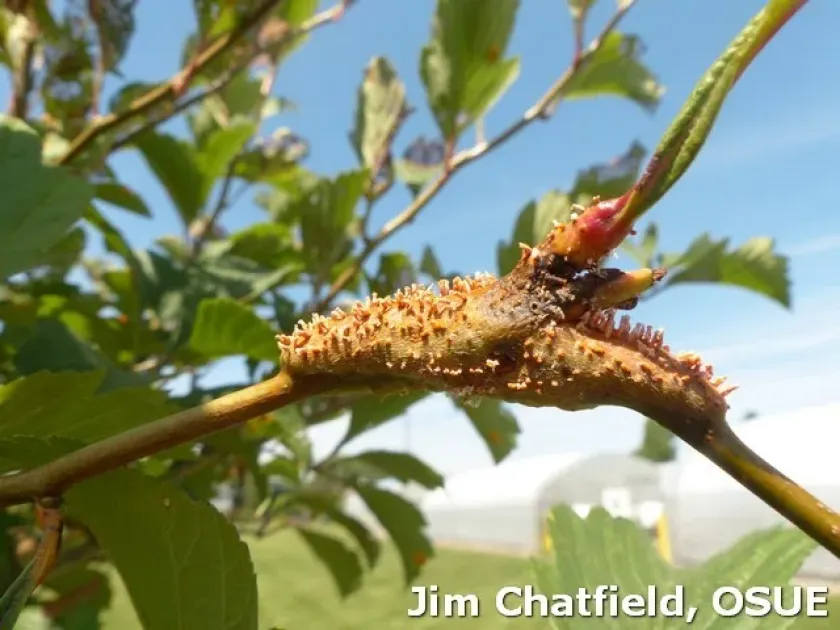
The disease manifests as characteristic orange-brown spots or swellings on plant organs, including fruits, young shoots, and leaf petioles. Tissues in affected areas often deform, causing young fruits to grow into irregular, ugly shapes.
Over time, aecia (fungal fruiting bodies) develop on the surface of the spots, appearing as small yellow or orange projections. In cases of severe infection, deep cracks and ulcers may appear on the shoots, leading to premature drying and death of the branches.
Leaf blades often turn yellow upon infection, with circular spots appearing, surrounded by a light-colored halo. Unlike other rust types, this pathogen is particularly aggressive toward generative organs and young, actively growing shoots.
A telltale sign is the release of a powdery spore mass when pressure is applied to the aecia during the ripening period. This turns the tree into an active source of infection for surrounding plants within several hundred meters.
On apple trees, symptoms appear similarly, causing fruit distortion and premature leaf drop, which negatively impacts the development of fruit buds for the following year.
Pathogen
The pathogen is a rust fungus named Gymnosporangium clavipes, which belongs to the class Basidiomycetes. This pathogen is a highly specialized obligate parasite that requires an alternate host to complete its lifecycle.
The fungus alternates between two different plant hosts: conifers, particularly junipers, serve as the intermediate host, while pome fruits like quince and apple serve as the primary host.
On junipers, the fungus overwinters as mycelium within the branch tissues, causing noticeable swellings. In the spring, orange telial pustules form, which swell in humid conditions and release basidiospores.
These spores are carried by the wind to quince or apple trees, where they infect young tissues. The infection penetrates the epidermis, forming a mycelium that gradually spreads into the deep tissues of the plant.
The pathogen's development is closely linked to climatic factors, particularly the presence of free moisture, which is essential for spore germination and the formation of aeciospores.
Conditions for development
Humid and warm spring weather significantly promotes the development of rust. Optimal conditions for quince infection occur after prolonged rains, especially when they coincide with the blooming and fruit-setting stages.
Proximity to juniper plantings is a critical risk factor for any orchard. The fungus can travel over long distances via air currents, making it difficult to contain without proper planning.
Dense, poorly ventilated tree canopies create a high-humidity microclimate, which is an ideal environment for fungal spores to germinate on leaves and young shoots.
Plants that are already weakened due to nutrient deficiencies or environmental stress are significantly more susceptible to the disease compared to healthy, well-maintained trees.
The incubation period of the disease depends heavily on temperature: it stretches in cool weather, while temperatures between 18–22 °C significantly accelerate the infection process.
Why it matters
The disease causes premature leaf drop, which severely reduces the tree's photosynthetic capacity and overall productivity. This leads to reduced cold hardiness and weakens the plant's immune response.
Damage to the fruit makes them unsuitable for consumption or commercial sale due to deformities and poor aesthetic quality. A significant portion of the crop may drop before maturity.
Bark destruction on shoots leads to gradual dieback, which disrupts nutrient and water transport and can ultimately lead to the death of individual scaffold branches or the entire tree.
The infection significantly impairs fruit quality: they become small, lose their juiciness, and have virtually zero shelf life due to secondary infections by rot-causing fungi.
In the long run, recurring rust epidemics lead to orchard degradation, requiring significant investment in sanitary pruning and efforts to restore tree vigor.
Protection
The primary control method is spatial isolation of the orchard from juniper plantings. If both types of plants are present on the same property, regular inspection and removal of infected juniper branches are essential.
The application of chemical fungicides is mandatory in high-risk areas. Effective treatments include copper-based products, as well as systemic fungicides from the triazole and strobilurin classes.
The first application should be done at the bud-break stage, followed by a second application immediately after blooming. If necessary, follow-up spraying should be conducted 10–14 days later.
Agronomic measures include the mandatory removal and destruction of fallen leaves and mummified fruits, as they can harbor fungal spores until the next season.
- Thinning the canopy to improve air circulation.
- Balanced application of potassium and phosphorus fertilizers.
- Pruning and burning of severely infected shoots.
- Selecting disease-resistant plant varieties.
Pathogens and affected parts
Affects crops · 1
Discussion
No discussions yet — be the first.