

Description
Symptoms
The primary symptom of infection is stunted plant growth followed by yellowing of the foliage, which is often misdiagnosed as nutrient deficiency or drought stress by inexperienced growers.
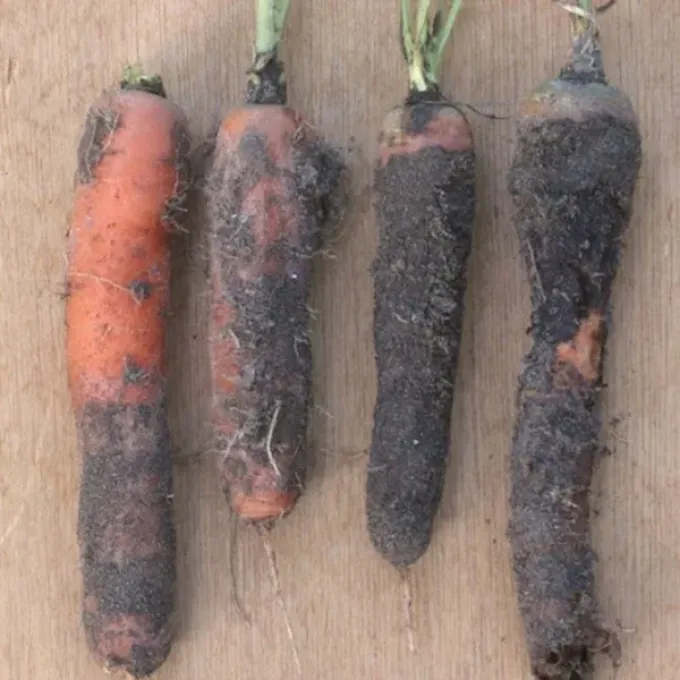
Dark, sunken lesions or spots appear on the surface of the taproot. These spots can vary in shape and often coalesce into larger, brownish necrotic areas as the infection advances.
Infected tissues become soft and watery. In severe cases, the taproot tip may die completely, leading to stunted growth, distorted shapes, and the proliferation of secondary lateral roots.
During the harvest, the destruction of fine root hairs is clearly visible. This lack of root system health prevents the plant from absorbing enough water, causing the tops to wilt during hot days.
If an infected carrot is sliced open, the decay can be seen penetrating deep into the internal tissues, typically showing a discolored brown or black appearance without a strong foul odor.
Pathogen
The causative agent of this disease is the oomycete Pythium violae. It is a soil-borne pathogen that belongs to the group of water molds, characterized by high mobility in wet conditions due to its motile zoospores.
The microorganism can survive in the soil for extended periods as oospores. These resting structures are highly resistant to adverse environmental conditions and can remain viable in the soil for several years.
The pathogen attacks the root system at various stages of plant development, entering the plant tissue through natural openings, root hairs, or wounds caused by external stress or pests.
The life cycle of Pythium violae involves the production of sporangia, which release zoospores. These zoospores use the soil moisture to swim towards the carrot roots, initiating the infection process.
The biological characteristics of this pathogen allow it to colonize the rhizosphere rapidly, making it one of the most destructive soil-borne threats to carrot production worldwide.
Conditions for development
Disease development is heavily influenced by soil moisture and drainage. Poorly drained, waterlogged soils are the primary factor that creates an ideal environment for Pythium activity.
The optimal temperature range for the pathogen's growth and infection is between 10 and 20 degrees Celsius, which explains why the disease is most severe during cool, wet spring or autumn weather.
Root damage caused by soil-dwelling pests, such as nematodes or carrot rust fly larvae, creates entry points that significantly facilitate the infection and speed up the colonization process.
High planting density reduces airflow and increases humidity around the root zone, creating a favorable microclimate that allows the pathogen to spread easily between adjacent plants.
Neglecting crop rotation and planting carrots in the same field repeatedly leads to a significant build-up of the pathogen's oospore population in the soil, making future infections more likely.
Why it matters
The main economic impact is the loss of marketable quality. Carrots with root rot lesions cannot be sold in retail markets, resulting in direct financial losses for the grower.
Early-stage infections can cause mass seedling mortality, leading to thin and uneven crop stands, which may require replanting and significantly increase production costs.
Infected roots are highly susceptible to secondary pathogens, such as soft rot bacteria, which can destroy the entire harvest during storage, leading to complete crop failure in the warehouse.
The cumulative damage includes reduced yields, increased expenditure on fungicides, and high losses during post-harvest handling, sorting, and long-term storage of the produce.
In heavily infested soils, yield losses can range from 50 to 70 percent, rendering the land unsuitable for carrot production unless comprehensive soil sanitation and disease management are applied.
Protection
Crop rotation is the most critical management tool. Carrots should not be planted after other Apiaceae family members, as they share similar susceptibility to various soil-borne diseases.
Improving soil drainage is essential. Using raised beds or ridging systems can help facilitate better aeration and prevent the water stagnation that promotes Pythium outbreaks.
Integrated pest management should be implemented to control soil-dwelling insects. Minimizing physical damage to roots reduces the number of infection sites available for the pathogen.
- Select carrot cultivars with improved resistance to root rot.
- Practice thorough sanitation by removing all infected debris after harvest.
- Avoid over-irrigation to maintain appropriate soil moisture levels.
- Apply authorized fungicides as a last resort if disease pressure is high.
Incorporating cover crops like mustard can improve soil structure and soil microbial health, which may help suppress the growth of Pythium and other pathogenic fungi in the root zone.
Reference
Connections · Pythium root rot of carrot
Most often together:
Marketplace
Products · 1
Community
Discussion
No discussions yet — be the first.