

Disease · fungal
Angular leaf spot of bean
Pseudocercospora griseola
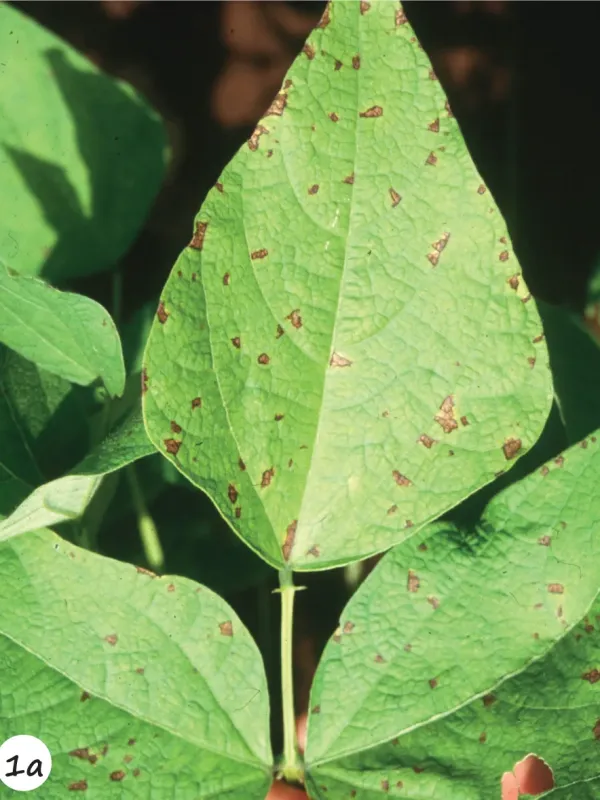
Description
Symptoms
Initial symptoms appear as small, chlorotic spots on the leaves. As the disease progresses, these spots become limited by the leaf veins, resulting in a characteristic angular shape that gives the disease its common name.
When humidity is high, a grey or dark olive-black mold develops on the lower surface of the lesions. This mold consists of masses of conidiophores and spores, which is a diagnostic feature of the disease caused by Pseudocercospora griseola.
As lesions enlarge, they may merge to cover large areas of the leaf blade, leading to yellowing, necrosis, and premature defoliation. Severely affected plants show stunted growth and poor pod development.
Stems and petioles can also be infected, showing elongated, dark-colored lesions. In cases of heavy infection, these lesions can cause stem breakage, particularly in the lower parts of the plant, which negatively impacts plant vigor.
Pods are often colonized by the fungus, showing spots with a dark center and a reddish-brown margin. The pathogen can penetrate the pod wall and infect the developing seeds, leaving them discolored or deformed.
Pathogen
The causal agent of this disease is the imperfect fungus Pseudocercospora griseola (synonym Isariopsis griseola). It is a highly specialized pathogen that affects common beans and other legumes, causing severe foliage and pod damage.
The fungus survives primarily in crop residues within the soil, where it can persist for several years. Furthermore, it is seed-borne, meaning that infected seeds can serve as a primary source of inoculum when planted in new areas.
The life cycle involves the production of conidia on conidiophores, which develop in the lesions on the underside of infected leaves. These spores are easily disseminated by wind, rain splashes, and human activity during field operations.
Infection occurs when conidia land on healthy tissues and germinate under favorable moisture conditions. The hyphae penetrate through stomata or directly into the epidermis, initiating the infection process and the subsequent development of mycelium within the leaf tissue.
This pathogen is considered a major constraint to bean production globally, particularly in regions with high humidity. Its ability to produce multiple cycles of spores during a single season allows it to spread rapidly under conducive environments.
Conditions for development
The disease thrives in warm and humid conditions, with an optimal temperature range for infection between 20 and 25 degrees Celsius. These temperatures facilitate rapid fungal growth and sporulation.
Frequent rainfall, fog, and prolonged dew periods are critical for disease development. A high level of moisture is essential for the conidia to germinate and for the fungal hyphae to successfully colonize the host plant tissue.
Dense planting configurations increase humidity within the crop canopy and reduce airflow, creating an environment that favors the rapid spread of the pathogen between plants during the growing season.
The presence of infected crop debris from previous seasons provides a continuous source of inoculum. Poor sanitation practices, such as leaving debris on the soil surface, significantly increase the risk of an outbreak.
Weather patterns during the critical stages of flowering and pod formation strongly influence the severity of the disease. Unfavorable wet conditions during these periods can lead to substantial yield losses across the field.
Why it matters
The primary impact of the disease is the reduction of the photosynthetic leaf area. Premature defoliation leads to a significant decrease in the plant's ability to produce energy, which directly limits pod development and seed filling.
Seed quality and quantity are severely compromised, leading to smaller, shriveled, and discolored seeds. This reduction in quality lowers market value and, if used as seeds, results in poor germination rates in subsequent seasons.
Infection can cause premature pod maturation or pod drop, further reducing the harvestable yield. If the pathogen reaches the seeds, they may become vectors for future infections, perpetuating the disease cycle on the farm.
In cases of severe epidemics, crop losses can exceed 50 percent of the potential yield. This level of damage poses a serious economic threat to farmers, necessitating costly control measures to maintain viability.
Furthermore, weakened plants are more susceptible to other pests and opportunistic pathogens. The overall stress caused by the infection decreases the plant's natural resilience to drought or nutrient deficiencies.
Protection
Implementing a proper crop rotation schedule is the first line of defense. Avoiding the cultivation of beans on the same land for at least three to four years allows for the natural decay of fungal inoculum in the soil.
Deep plowing or incorporating crop residues into the soil helps accelerate the decomposition process, effectively reducing the number of spores available for initial infection in the following growing season.
The use of certified, disease-free seed is essential to prevent the introduction of the pathogen into new areas. Seed treatment with appropriate fungicides can further mitigate the risk of early-season infection.
Foliar application of fungicides during the growing season is a common control strategy when initial symptoms are observed. The choice of fungicide should be based on local recommendations to manage resistance and maximize efficacy.
Breeding and planting resistant bean varieties are the most effective and sustainable methods for long-term disease management. Genetic resistance provides a robust defense that reduces the need for frequent chemical interventions.
Reference
Connections · Angular leaf spot of bean
Most often together:
Marketplace
Products · 1
Community
Discussion
No discussions yet — be the first.