
Porpidia crustulata
Porpidia crustulata
Description
Symptoms
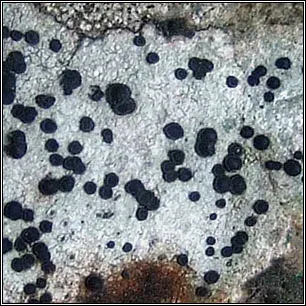
The presence of this lichen appears as a thin, tightly adherent crustose thallus, typically gray or whitish in coloration.
The thallus often displays a granular or finely cracked texture on the surface of the bark, justifying its common name.
Key diagnostic features include small black apothecia, which are fruiting bodies of the fungal component, appearing as scattered dots across the thallus.
Unlike fungal diseases or necrotic lesions, the bark underneath the lichen remains healthy and structurally intact.
The colonization is usually confined to the outer layers of the periderm and is most frequently observed on mature woody plants.
Pathogen
It is important to clarify for agricultural specialists: Porpidia crustulata is not a plant pathogen and does not cause plant diseases. It is a biological species of crustose lichen belonging to the Lecideaceae family.
This organism represents a symbiotic association between a fungus and algae, living on tree bark as an epiphyte rather than a parasite.
Unlike true plant pathogens, this lichen does not penetrate living tissues or derive nutrients from the host plant's internal fluids.
In most ecosystems, Porpidia crustulata is common on rocks, but it can colonize aged, slow-growing bark where the surface remains stable for a long time.
From an agronomical point of view, its presence should be categorized as epiphytic vegetation rather than a symptomatic pathology.
Conditions for development
The development of Porpidia crustulata is dependent on high ambient humidity and the availability of suitable surfaces for long-term attachment.
The species is highly sensitive to air quality; therefore, it is often found in areas with low pollution levels, serving as a biological indicator of clean air.
Shaded garden plots with restricted airflow provide the optimal microclimate for the establishment and slow expansion of the lichen colony.
Prolonged moisture retention on the bark, often caused by dense, unpruned tree canopies, accelerates the colonization process.
Stressed or aging trees with deeply fissured, inactive bark provide the best physical substrate for these epiphytic organisms to persist.
Why it matters
Porpidia crustulata causes no direct damage to crops, as it does not interfere with the plant's metabolic processes or structural integrity.
Indirect harm may occur if the dense thallus provides shelter for overwintering pests, such as scales or mites, which may use the lichen to hide from environmental factors.
In some cases, excessive lichen growth may serve as a visual signal that a tree is aging or lacks the vitality to shed its old bark naturally.
There is no evidence that this lichen causes chemical toxicity or nutrient deficiency in the host plant.
Overall, its impact is neutral in a well-managed orchard, though it can influence the aesthetic appearance of the trees.
Protection
No chemical pesticides or fungicides are required, as there is no infection to control.
Manual cleaning of the trunk and primary branches during the dormant season is the most effective way to remove lichens if necessary.
Applying a lime wash to trunks is a traditional and effective preventative measure that creates a surface environment unsuitable for lichen establishment.
Proper canopy management, including regular thinning and pruning, improves light and air circulation, naturally reducing lichen colonization.
Maintaining high horticultural standards, such as appropriate fertilization and hydration, encourages bark renewal and keeps the trees in a vigorous state.
Discussion
No discussions yet — be the first.