

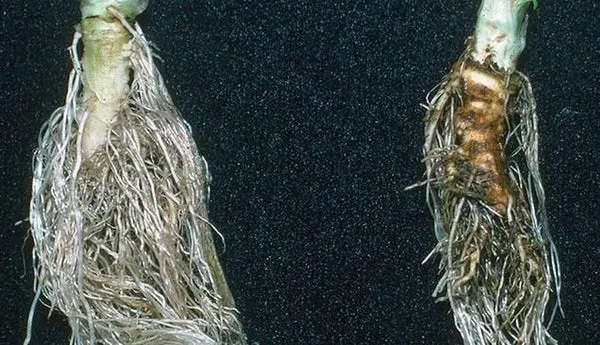
Description
Symptoms
The most distinctive symptom of Take-all is the blackening of the roots and the base of the stem, which is why it is commonly referred to as "black leg" in some regions.
Affected plants often show patches of stunted growth. As the disease progresses, the lower leaves may turn yellow and eventually wither, leading to a general decline in plant vigor.
During the grain-filling stage, the hallmark sign of the disease is the development of "whiteheads." These bleached, empty heads fail to produce grain or yield only shriveled, poor-quality kernels.
A closer inspection of the root system reveals severe rot, with roots appearing brittle, blackened, and easily detachable from the plant base. A dark fungal mat is often visible under the leaf sheaths.
- Blackened root systems and stem bases.
- Premature ripening and bleached whiteheads.
- Stunting and chlorosis of foliage.
- Root decay and fragility.
Pathogen
Take-all root rot is caused by the fungus Gaeumannomyces graminis. This soil-borne pathogen specializes in attacking the root systems of various cereal crops, primarily wheat, barley, and rye.
The fungus survives in the soil by colonizing crop residues. It persists as mycelium, allowing the pathogen to remain viable between growing seasons for several years.
The disease spreads primarily through root-to-root contact as the fungus grows along the root network. Spores produced in perithecia can also play a role in spreading the disease across longer distances within a field.
There are different varieties of the pathogen, with G. graminis var. tritici being the most notorious for causing severe yield losses in wheat-growing regions.
Biology of the fungus is tightly linked to the rhizosphere, where it utilizes specific enzymes to penetrate and digest plant tissue, eventually destroying the root's vascular system.
Conditions for development
Take-all development is favored by mild, wet conditions during the early growth stages of the crop. Moisture is critical for the initial infection and movement of the fungal mycelium.
Soil conditions play a significant role in disease severity. The fungus tends to thrive in alkaline or neutral soils, which is why liming acidic soils can sometimes inadvertently promote Take-all outbreaks.
Continuous cropping of cereals is the primary factor for disease buildup. When susceptible crops are planted back-to-back, the amount of fungal inoculum in the soil increases exponentially.
Minimal tillage practices may keep the inoculum near the surface, potentially increasing the risk of infection for subsequent crops compared to traditional plowing.
Nutrient deficiencies, particularly regarding nitrogen and phosphorus, can exacerbate the impact of the disease by weakening the plant's natural defense mechanisms.
Why it matters
Take-all is considered one of the most destructive root diseases of wheat. In conducive conditions, it can cause significant yield reductions, sometimes exceeding 40-50% in severe cases.
The disease disrupts water and nutrient uptake, causing the plant to suffer from physiological drought. This leads to poor grain filling and reduced test weight of the harvested crop.
Severe infestations often cause lodging, which not only decreases yield but also complicates the harvesting process and increases the likelihood of fungal contamination in the grain.
Economic damage is further compounded by the longevity of the pathogen in the soil, forcing farmers to avoid susceptible cereals for several years in affected fields.
The patches of "whiteheads" within a field result in non-uniform crop stands, leading to harvest inefficiencies and loss of revenue for agricultural businesses.
Protection
Crop rotation is the most effective management tool. Including non-host crops like legumes, oilseeds (canola), or pulses helps reduce the levels of inoculum in the soil over time.
Implementing a period of fallow or planting break crops can significantly decrease the viability of the fungus in the absence of a host root system.
Maintaining balanced soil fertility, especially adequate levels of nitrogen and micro-nutrients, supports plant health and improves the tolerance of the crop to infection.
Controlling grassy weeds in and around the field is vital, as these plants can serve as reservoirs for the fungus, allowing it to survive between cereal crop rotations.
While seed treatments offer some protection during the early stages, they are generally not a complete solution for Take-all; therefore, integrating cultural practices remains the cornerstone of control.
Content graph
Connections · Take-all root rot
Most often together:
Marketplace
Products · 3


Lametil WP
Nanjing No.1 Pesticide Factory of Red Sun Group Co., Ltd.
Fungicides
0
0
·
1.4K
1 offer
163.64 €per pack
Buy
Community
Discussion
No discussions yet — be the first.