
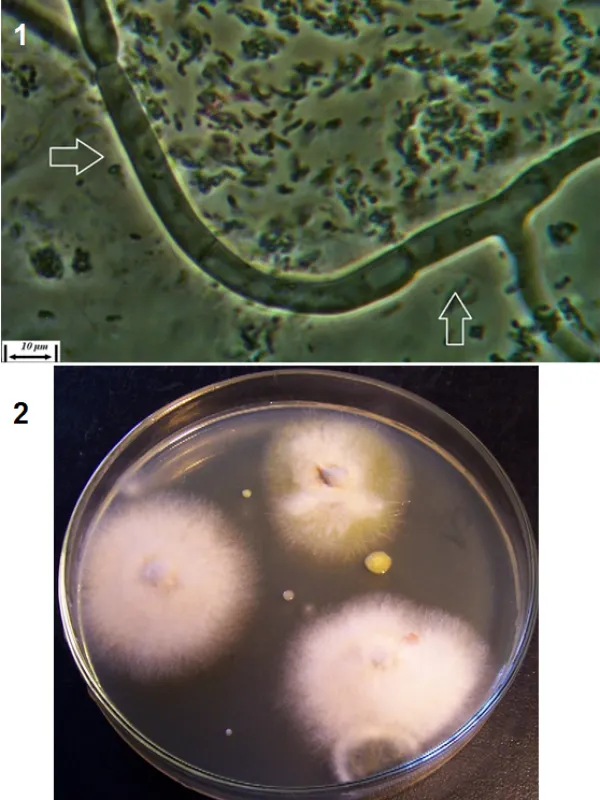
Description
Symptoms
Symptoms typically begin with wilting and yellowing of the lower leaves, which progress upward as the infection compromises the plant's vascular tissue.
Upon examination of the root system, one will observe characteristic browning or reddish-brown decay of the taproot and secondary roots.
Cutting the stem near the soil line often reveals vascular browning, a sign that the fungus has invaded the internal conductive tissues of the plant.
Under humid conditions, a sparse mycelial growth may appear on the base of the stem, often displaying white to pale pinkish coloration.
In chickpeas, the infection causes severe stunting, drooping of the stem, and premature death, frequently resulting in patchy stands across the field.
Pathogen
The disease is caused by fungi of the genus Neocosmospora, which are soilborne pathogens within the class Sordariomycetes, historically associated with the Fusarium complex.
These fungi survive in the soil for extended periods as chlamydospores or within infected crop residues, waiting for susceptible hosts to begin their infection cycle.
Neocosmospora species are highly aggressive, often targeting the vascular system of plants, which leads to structural damage and nutrient transport failure.
The pathogen reproduces efficiently in diverse soil types, making it a persistent threat in many agricultural regions where pulse crops are cultivated.
Spore dispersal occurs primarily through contaminated soil, agricultural machinery, and irrigation water, facilitating the spread of the fungus across fields.
Conditions for development
The development of Neocosmospora root rot is strongly favored by high soil temperatures, often exceeding 25-28°C during the growing season.
Excessive soil moisture is a key trigger for the disease, as it promotes the rapid germination of fungal spores and facilitates their movement towards roots.
Intensive cropping systems, where legumes are grown too frequently without proper rotation, lead to the accumulation of high inoculum levels in the soil.
Plants under physiological stress or those damaged by soil pests such as wireworms or nematodes are significantly more prone to rapid infection by the fungus.
Nutrient deficiencies, particularly low levels of potassium, reduce the plant's innate ability to defend its tissues against pathogenic invasion.
Why it matters
Neocosmospora root rot causes substantial economic losses by reducing plant stand density and overall crop yield, particularly in pulse production.
Affected plants often die before reaching maturity, leading to empty pods and shriveled grains with very low market quality and poor germination rates.
The disease causes systemic damage, disrupting the transport of water and nutrients, which impairs the plant's overall development and grain filling.
Fields infested with Neocosmospora can remain problematic for years, restricting the future choice of crops that can be successfully grown in those areas.
Large-scale outbreaks can lead to total crop failure in susceptible varieties, creating a significant impact on farm productivity and sustainability.
Protection
A robust crop rotation strategy is essential, with an interval of at least 4-5 years between pulses to decrease the fungal population in the soil.
Treating seeds with appropriate broad-spectrum fungicides is a critical first step in protecting seedlings during the most vulnerable early growth stage.
Utilizing resistant or tolerant cultivars is the most effective long-term management strategy to reduce the impact of the disease in infested fields.
Implementing proper field drainage and soil management practices helps mitigate the conditions that favor pathogen development and spread.
- Use certified disease-free seeds for planting.
- Maintain soil nutrient balance, especially phosphorus and potassium.
- Control soil pests that wound root systems.
- Incorporate crop residues deeply to accelerate decomposition.
Pathogens and affected parts
Affects crops · 1
Discussion
No discussions yet — be the first.