
Description
Symptoms
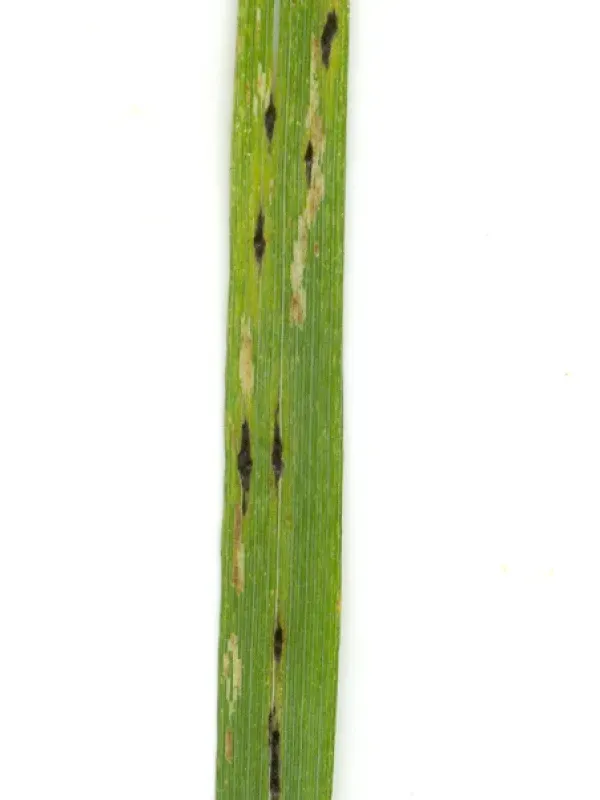
Initial symptoms appear on leaves as characteristic narrow, elongated spots running parallel to the veins. These lesions are typically brown or dark brown, measuring 2–10 mm in length, with a spindle or linear shape.
As the disease progresses, the lesions may coalesce, covering a significant portion of the leaf blade. Affected areas look like stripes that eventually undergo complete necrosis and die off.
A gray or olive-colored coating, which consists of the fungus's conidial spores, often forms on the underside of the leaf within the infected zone. In high humidity, this growth becomes more visible and appears velvety.
Symptoms usually affect the lower and middle leaves, but during severe outbreaks, the disease spreads rapidly to the upper canopy, including the flag leaf, which has a critical impact on total yield.
Damaged tissues become fragile, and in cases of severe infection, premature yellowing and desiccation of the entire foliage occur, which prevents the proper filling of rice grains.
Pathogen
The causal agent of the disease is the fungus Napicladium janseanum (formerly known as Cercospora janseana). It is a pathogenic microorganism that primarily infects rice plants during their active vegetative growth period.
The fungus belongs to the Deuteromycetes group and specifically targets rice foliage. The infection persists in crop residues, seeds, and on various grass weeds that serve as disease reservoirs during the off-season.
The pathogen's life cycle involves the formation of conidial spores, which are easily dispersed by wind to neighboring healthy plants. The fungal mycelium penetrates leaf tissues, causing cell necrosis and disrupting photosynthesis.
The biology of this pathogen is highly adapted to the humid conditions found in rice paddies. Infection spreads exponentially whenever free moisture is present on the surface of the leaves.
This pathogen is an obligate parasite that requires living host tissue to complete its life cycle. Researching the genetic diversity of Napicladium janseanum strains is vital for breeding rice varieties with improved resistance.
Conditions for development
Narrow brown leaf spot development is favored by consistently high air temperatures combined with high relative humidity. The optimal temperature range for fungal growth is between 25 and 30 degrees Celsius.
A critical factor for disease spread is the presence of dew or condensation on leaves during nighttime and early morning hours. Prolonged leaf wetness is a necessary condition for successful spore germination.
Poor agronomic practices, such as excessive plant density, promote stagnant air and localized humidity within the canopy, creating an ideal microclimate for the rapid reproduction of Napicladium janseanum.
Excessive application of nitrogen fertilizers, which triggers vigorous vegetative growth and softens leaf tissues, makes rice plants significantly more susceptible to fungal penetration.
Periods of frequent rainfall and cloudy weather during the boot stage and panicle emergence significantly increase the risk of massive infection across the rice fields.
Why it matters
The primary damage caused by the disease is a drastic reduction in the photosynthetic surface area of the leaves. This leads to a decline in nutrient flow to the panicles, directly reducing the 1000-grain weight.
When the flag leaf is affected, yield loss can reach 20–30% or more. The plants become weakened, making them more vulnerable to secondary infections and insect pest attacks.
Narrow brown leaf spot negatively affects grain quality, reducing its fullness and technological parameters. Rice harvested from heavily infected fields often shows a reduced milling yield during processing.
Massive disease development during late growth stages promotes premature ripening, leading to the production of shriveled, low-vigor seeds that are unsuitable for use as planting material for the next season.
Economic losses include both direct yield reduction and the additional costs incurred for fungicide treatments required to mitigate damage during an epidemic.
Protection
The main control method is the use of resistant or tolerant rice varieties. Breeding programs focusing on genetic resistance to Napicladium janseanum remain the top priority for long-term crop protection.
Agronomic measures include strict crop rotation to break the life cycle of the pathogen persisting in the soil and residues. Deep incorporation of crop stubble after harvest is essential to reduce initial inoculum.
It is recommended to avoid dense planting to ensure optimal plant spacing and improve air circulation. Nitrogen application rates must be balanced with phosphorus and potassium to strengthen leaf tissues.
Chemical control using systemic fungicides from the triazole or strobilurin groups is applied if necessary. Treatments should be carried out preventively or upon the first signs of disease according to local regulations.
Monitoring fields from early growth stages allows for the early detection and localization of infection hotspots. Phytosanitary measures, including the removal of grassy weeds, are also crucial for preventing disease buildup.
Pathogens and affected parts
Affects crops · 1
Discussion
No discussions yet — be the first.