
Myrothecium leaf spot
Myrothecium spp.
Description
Symptoms
The main symptom of Myrothecium infection is the appearance of necrotic spots on leaves and stems, which often exhibit concentric zonation. The color of the spots ranges from dark brown to almost black, sometimes with a yellowish halo.
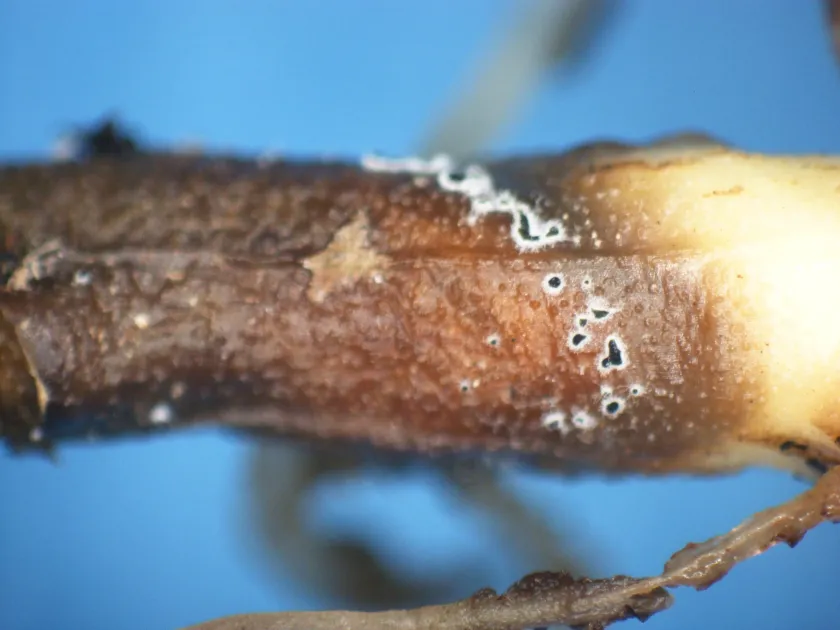
In the center of the affected areas during humid weather, compact cushions of fungal sporulation are formed. They have a specific appearance: initially whitish, then olive-black, covered with a dense coating of conidia.
On crops such as annual sunflower and Jerusalem artichoke, the disease manifests primarily on lower leaves, gradually spreading upward. In case of severe infection, premature wilting and death of leaf blades are observed.
In advanced cases, necrosis can spread to petioles and stems, causing them to become brittle. Plant tissues at the site of infection often crack, which facilitates the entry of secondary infections.
A characteristic feature is the rapid progression of spots under high air humidity. Affected areas often merge, covering significant portions of the plant's leaf surface.
Pathogen
The causative agents are fungi of the genus Myrothecium, the most well-known being Myrothecium roridum. These are imperfect fungi (deuteromycetes) capable of infecting a wide range of crops.
The fungus survives in the soil, on plant debris, and can also be transmitted via infected seeds. It possesses a high ability to survive in unfavorable environmental conditions.
The primary source of infection is the fungal mycelium overwintering in the soil layer. In spring, conidia are spread by wind, raindrops, or during agricultural activities.
The pathogen's biology is closely linked to its ability to rapidly produce a mass of conidia. These spores are easily carried to healthy plant tissues, where they germinate in a few hours if free moisture is present.
Myrothecium disease belongs to a group of illnesses that infect weakened tissues or plants under stress. The pathogen produces toxins that facilitate the destruction of host cell walls.
Conditions for development
Development of Myrothecium is favored by periods of high air humidity (above 80-90%) and frequent rainfall. The optimal temperature for the fungus development is in the range of 20–28°C.
Dense sunflower stands create a microclimate with insufficient ventilation. Under such conditions, pathogen spores germinate faster and infect neighboring plants, leading to epiphytotics.
Imbalanced nutrition, especially an excess of nitrogen fertilizers, reduces the natural immunity of plants. This makes them more susceptible to colonization by Myrothecium fungi.
Violation of crop rotation and leaving crop residues in the field increases the infectious load. The longer the pathogen persists in the soil, the higher the risk of early seedling infection.
Mechanical tissue damage or injuries caused by pests serve as "gateways" for infection. Through micro-cracks, the fungus enters the plant much faster than through an intact cuticle.
Why it matters
The damage caused by Myrothecium is primarily due to a significant reduction in the assimilation surface of leaves. This leads to the disruption of photosynthesis and slows down crop growth.
On infected sunflowers, underdeveloped heads and a reduction in the weight of a thousand seeds are observed. Yield can decrease by 15-30% depending on the severity of the disease.
The quality of produce deteriorates significantly as the flow of nutrients to seeds or tubers (in Jerusalem artichoke) is disrupted. Infected plants often produce seeds with reduced germination energy.
The disease can lead to mass lodging of crops when stems are infected. This complicates mechanical harvesting and leads to additional yield losses in the fields.
General weakening of plants makes them vulnerable to a complex of other diseases, including root and stem rots. Myrothecium often acts as a secondary infection that worsens the phytosanitary condition of the field.
Protection
The basis of protection is strict adherence to crop rotation. It is not recommended to return sunflower to the same field earlier than 4-5 years after the last sowing.
An important agronomic practice is deep plowing of crop residues in autumn. This accelerates the decomposition of organic matter and the death of overwintering fungal structures in the soil.
The use of resistant or tolerant hybrids allows for reduced infection intensity. Breeding for resistance to leaf spots remains a priority in sunflower protection.
The use of preventive fungicides is advisable during periods of high humidity. Treatments should be carried out before mass symptoms of the disease appear on leaves.
It is recommended to control pest populations that may act as infection vectors or damage plant tissues. Balanced nutrition focusing on potassium and phosphorus fertilizers increases the general resistance of crops.
Pathogens and affected parts
Affects crops · 2
Discussion
No discussions yet — be the first.