

Description
Symptoms
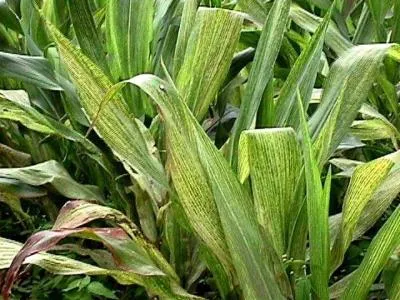
The most prominent sign of Maize mottle is the development of chlorotic streaks and spots on the leaves. These often appear as a mosaic-like pattern, giving the disease its common name, with interveinal yellowing being particularly common.
Affected leaves may show stunted growth and irregular development compared to healthy foliage. In severe cases, the leaf margins may curl, and the entire plant may appear yellowed or blanched under bright sunlight.
Stunting is a key diagnostic feature, especially when the infection occurs during the early vegetative stages of the plant. Such plants fail to reach their full potential height and show thin, brittle stems.
Reproductive success is severely compromised, with plants often producing small, poorly filled ears. In extreme infections, the cob might remain largely undeveloped or bear very few kernels.
- Chlorotic mosaic patterns on leaf surfaces.
- Reduced internode length (stunting).
- Yellowing of leaves along the veins.
- Malformed ears with low grain weight.
Pathogen
The causal agent of this disease is the Maize mottle virus, a systemic pathogen that affects the vascular tissues of the corn plant. It is categorized as an obligate parasite, meaning it depends entirely on the host plant for replication and survival.
The virus does not spread through wind or soil contact in the traditional sense; instead, it relies on insect vectors, primarily leafhoppers. These insects ingest the virus while feeding on infected plant sap and later transmit it to healthy corn plants.
Once introduced into the plant, the virus travels through the phloem. It interferes with the plant’s fundamental metabolic processes, specifically targeting chlorophyll production, which is essential for photosynthesis.
The virus persists in the bodies of the insect vectors, which act as reservoirs during the winter months. This biological mechanism allows the disease to survive in the environment even when no corn crops are present.
Pathologically, the virus destabilizes the cell membrane integrity, leading to reduced nutrient transport. Without the vector, the virus cannot survive for long in the open environment, emphasizing the role of insect management.
Conditions for development
The prevalence of Maize mottle is highly correlated with the seasonal activity of leafhopper populations. High temperatures and dry conditions generally create favorable environments for these vectors to thrive and spread the virus.
Weed management in and around corn fields is critical. Many common grass weeds act as alternative hosts for the virus, allowing it to persist in the field borders before migrating to the crop.
Early planting dates can sometimes act as a preventative measure, as it may allow the corn to reach a more mature stage before the seasonal peak of the insect vector population occurs.
Dense crop canopies and poor field aeration can increase local humidity, which sometimes provides a more stable microclimate for insect vectors, thereby increasing the risk of infection.
Nutrient deficiency or water stress in the crop makes the plants more susceptible to systemic infection. A well-fertilized, healthy crop has better physiological resilience to limit the spread of the virus once introduced.
Why it matters
The economic impact of Maize mottle can be significant, with yield losses reaching up to 50% in heavily infested fields. The reduction in grain weight and cob development directly impacts the grower's profitability.
The quality of the harvested grain is often reduced, with smaller, shriveled kernels that lack nutritional density. This makes the crop less valuable for both human consumption and livestock feed production.
Infected plants exhibit compromised photosynthetic efficiency, leading to overall weakness and increased vulnerability to secondary opportunistic fungal pathogens and insect pests that further damage the crop.
The irreversible nature of systemic viral infections means that once a plant is infected, there is no curative treatment. Consequently, the loss is permanent and cannot be remedied during the growing season.
In regions where the virus is endemic, it acts as a limiting factor for corn production, often forcing producers to choose less optimal but more resistant hybrids, which may yield less than sensitive varieties.
Protection
Management of the insect vector is the primary strategy for control. Targeted insecticide applications during the early stages of crop development are essential to reduce the transmission rate of the virus.
Sanitation practices, including the aggressive removal of weeds around field margins, are vital to eliminate reservoir hosts of the virus and minimize the initial inoculum sources.
Breeding and utilizing virus-resistant hybrids remains the most sustainable and effective long-term approach. Resistant varieties are developed to prevent the virus from replicating effectively within plant tissues.
Spatial isolation between successive plantings is recommended to break the cycle of viral transmission. Moving planting locations away from historical hotspots can significantly reduce infection pressure.
Regular field scouting for early symptoms is a critical component of integrated pest management (IPM). Detecting the virus early allows for localized intervention to prevent a widespread outbreak across the entire field.
Content graph
Connections · Maize mottle
Most often together:
Marketplace
Products · 1
Community
Discussion
No discussions yet — be the first.